Friday, October 5, 2012

FUTA and Free Education in Sri Lanka: Question of Social Justice and Democracy in an Oligarchy
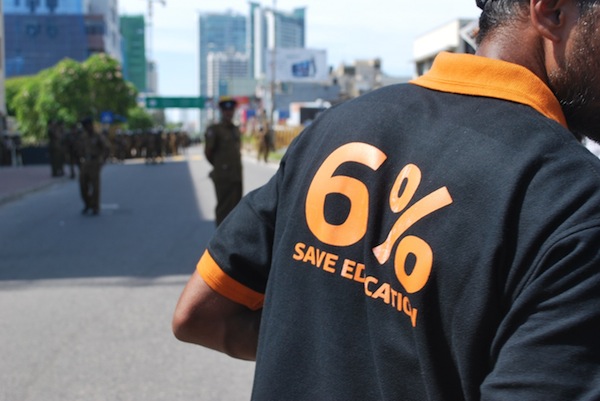

Photo courtesy Vikalpa
The results of the so-called ‘mother’s examination’, or the year five scholarship examination of this year, have once again sturdily testified for the importance and significance of preservation and continuation of the free education system of this country. The two students who have achieved the first places hail from two divergently opposing social classes, but the duo being educated in the same, state sponsored, free education system. When the boy student from socially affluent strata, attending a high ranked school scored the highest marks, the girl student attending a low ranked, poorly facilitated rural school could produce the same result under more difficult conditions than the conditions the boy student had to face. Both of them have made their schools proud and won the hearts and mind of the people equally; but if it weren’t for the free education would the underprivileged rural student ever have got that opportunity to be equal among unequal? I have just contemplated on this case at the beginning of this piece, because the narrow attempts at labeling the struggle being launched by Federation of University Teachers’ Association (FUTA) as a conspiracy against the government or its Ministers of Education are rightly debunked with this story. Further, the success story of the girl student of Thalathu Oya Kanishta Vidyalaya speaks volumes of why we should protect free education for further assuring and protecting social justice of this country.
Unfortunately, the much clichéd patriotism that this government continues to preach long after the end of war never distinguished the raison d’être behind the system of free, state sponsored education that has historically guided Sri Lankan society, after the independence, towards a more equitable and just society. The pillars of social justice, democracy and equality have remained the immaculate tenets of the philosophy behind a free education system and visionaries like C.W.W.Kannangara could correctly perceive the historical importance of this system in founding a united nation. However, the oligarchic and authoritarian tendencies that the post- war Sri Lanka has begun to experience currently has made the well-wishers of this majoritarian system keep their mouths shut and remain silent, still having some remorse towards a regime which violently defeated the LTTE. Conversely, the most educated strata of this country, the University academics, under FUTA Leadership, have displayed their character and power of knowledge and sent warning signals to the ruling regime that it has to conform to the norms of social juice and democracy by preserving the state education system
Now, three months have passed since the FUTA started a continuous protest campaign demanding, mainly, a 6% allocation of GDP on Education and autonomy of education sector. The progress of the FUTA protest campaign has flourished amazingly during the last couple of months and disproportionate to the response from the government. And today, it seems, the FUTA struggle is reviving an unresponsive opposition and attracting the support of left parties while converting its struggle into a large scale national and social movement of people from various sections of the society, who have realized the value of free education for social justice and democratic governance.
The five day foot-walk that FUTA begun at Galle, beating rough rainy weather conditions, now has culminated in a far stretched chain of people united for one goal, the freedom of education sector from the clutches of neo-liberal reforms that the current education ministers have jointly moved to introduce in the school and the University system. The FUTA has shown that it is determined to save the ill-fated education sector from the mismanagement and bad governance of the politicos and bureaucrats who are advised by a bunch of so-called intellectuals upholding neo-liberal policies. The very calculated process of making free education a marketable commodity, a process that would ultimately deprive this country’s poor people the opportunity to climb the ladder of social status through justifiable means, is now being battled at various fronts by University teachers, students, opposition parties, civil society movements and average masses. The message has reached the government that, despite its huge success at every election largely depending on the accomplishment at the battlefield, its public policy is what mostly hated by the educated sections and the civil society which raise concerns on behalf of the large sections of underprivileged masses of this country.
The Ministers, bureaucrats and their advisors who have upheld the virtues of righteous management of the education would have never imagined that the FUTA struggle would ever grow into a large social movement filling the vacuum of a responsible opposition in this country. The ideas of social justice and democracy are thoroughly etched in FUTA demands that have transcended the mere bargain for salary increases that not only University teachers but all the other sectors of employment are currently in urgent need in the face of sky rocketing cost of living.
The government which largely amassed the support of masses of rural and semi-urban Sinhala-Buddhist sections has not carefully analyzed the needs and wants of the very people which elected it into power in many times. Free education and free health have been the two major pillars that have historically uplifted the rural masses and poor of this country and paved the way for them to set their foot in a competitive open economic environment. The welfare character of the state showed its declining phase in the post-war era, and it seems that government was misconceived of the importance of further preserving the welfare image and embarked on an illiberal development process that only looked at the requirements of the Multinational Co-operations and wealthy classes. The ground reality of a war torn country was not carefully realized by the government and it suddenly attempted to close down all the access points open for average masses to participate in and benefit from the welfare-oriented state.
Today, FUTA’s long march has forced the government to think of what it has been doing in the name of large scale economic development and infrastructure building, allegedly accruing huge margins of profit for those undertake the contracts of such projects. While the state education and health sectors that historically founded strong pillars of equitable social justice and democratic governance were crumbling the government has tried to cherish the dream of making Sri Lanka the ‘wonder of Asia’. No wonder that this could be a noble dream of visionary thinking, but if it is to be realized while the social identity that Sri Lanka inherited from free education of welfare state is left for destruction, the future that this regime is making will not belong to the ordinary citizen of this country.
The path of neo-liberal development has been proved to be a failure in terms of assuring social justice, and democratic governance for larger masses of many states in the world and, unfortunately, the war ravaged Sri Lanka is mistakenly taking that path with a strong determination of ending the era of welfare state. The FUTA struggle and the ever growing support for it, has suggested that neo-liberal path would only lead this state to a tragedy of social unrest and authoritarianism, once again making the ordinary citizens bear the brunt of waging rebellions in the name of eliminating social inequality with class hatred. If the government correctly reads the message that FUTA is sending it with long marches, and many more to come in future, the future of this country would be safe with democracy and social justice guiding the way forward.

FUTA predicts

Academic year of 2011 batch in 2013

By Aisha Nazim, Ceylon Today

 The  Federation of University Teachers’ Associations ( FUTA) predicted the university academic year for those who sat for A/Ls in 2011 will begin only in June 2013, as cut-off marks, university selections and other formalities have to be settled before admitting the students.

 FUTA Vice President, Venerable Dambara Amila Thera said it would be impossible to admit new undergraduates to universities before June 2013, as cut-off marks have not been released and also older students would have to pass out first.

“It will take more time for the cut- off marks to be processed and the new students to get selected to universities. In addition, we also have to catch up on the lectures that have been missed due to the trade union action of the last few months. The first and second year undergraduates need to be passed up a year, and the final year undergraduates need to be passed out. By the time their exams are concluded, it will definitely be next June at least,”  Amila Thera said at a media briefing.

 He also said, if the lecturers’ issues are resolved satisfactorily, the academics guarantee that they will be able to produce world class professionals, who will bring pride to Sri Lanka.

“Our universities will produce engineers of the highest calibre, who would repair the Norochcholai Power Plant in such a manner that it will not break down every few months, unlike the repairs done by the Chinese,” he claimed.

The FUTA example

, The Island

article_image
This is the first time in our history that one of the trade unions went on strike hiding their main objectives behind a national issue.

FUTA is a set of educated people and they are usually innovative. Other trade unions which are famous for strikes – CEB unions, GMOA and other unions in the medical sector should follow this, as usually they openly put out their selfish demands and do not get the support of the masses.

B S Perera

Thursday, October 4, 2012

University crisis: Resume talks! Editorial


 , The Island
The Federation of University Teachers' Associations (FUTA) is reported to have reiterated, at a meeting with the Maha Nayake Theras who have offered their services as mediators to resolve the university crisis, that it does not expect financial allocations for the education sector to be increased to six per cent of the GDP overnight. It made its position clear at the very inception of its struggle. The government propagandists, true to form, misinterpreted that demand in a bid to make it out to be a flight of fancy. What the university teachers have done is to set a goal for the government to achieve in the national interest.

The FUTA strike is aimed at winning a pay hike, pressuring the government to increase funding for education, putting an end to political interference in universities and asserting university teachers’ right to be consulted when vital decisions are made on the higher education sector, among other things. Now that the FUTA has re-emphasised that it does not seek a huge increase in government funding for education overnight, the government ought to respond positively. There is no reason why it cannot undertake to increase funding for education as its avowed goal is to turn this country into Asia's Knowledge Hub. It could demonstrate its willingness to invest more in education by increasing funds for that sector from the next budget. It must also rid the universities of political interference, which has eaten into the very vitals of the higher education sector. It is puzzling why the government has not yet agreed to consult university teachers when crucial decisions are made on universities. This demand should be granted straightaway as teachers are stakeholders and feel for the wellbeing of universities more than politicians and their bureaucratic yes-men.

The government, in our view, has only one main problem to contend with–the FUTA demand for a pay hike. That, too, will not be intractable if it constructively engages the striking dons instead of trying to force them into submission.

The government is in the habit of adopting a confrontational approach and trying to bulldoze its way through in dealing with workers in spite of having within its ranks respected, veteran trade unionists. President Mahinda Rajapaksa himself is a former trade union leader and as Minister of Labour he mooted the Workers' Charter which President Chandrika Kumaratunga shot down. The government's abortive attempt to ram an ill-conceived pension scheme down the throat of the private sector demonstrated its arrogance and callous disregard for workers' concerns and rights. As for the FUTA strike, the government seems to think that it will be able to wear down the striking dons or engineer a rift in the FUTA. But, if the resilience of the strikers is anything to go by, the government has its work cut out.

As President Rajapaksa said in an interview with this newspaper when he was the Minister of Labour in the Kumaratunga government, in a labour dispute no one wins; both parties lose, for trade union action affects their institution's interests adversely. He often says that he is for win-win solutions to labour problems. But, regrettably, his government does not seem to practise what he preaches. It has allowed the FUTA strike to drag on indefinitely while universities remain crippled with students wasting the best years of their lives. No wonder youth unrest finds expression in violent uprisings from time to time!

The FUTA has not walked away from negotiations with the government or refused to talk. It has shown flexibility and the government should reciprocate by resuming talks with the strikers and going on negotiating as a national priority until a solution is found. It should desist from driving the university teachers to extreme action and labeling them as traitors. That is the only way to bring about a win-win solution in keeping with President Rajapaksa's thinking or Mahinda Chinthana.

Jumping the FUTA bandwagon!

 , The Island

article_image
Protest march by FUTA in Colombo,(file photo)

I wonder how many of those who joined the FUTA march from Galle to Colombo fully understood what the ‘6%’ printed on the back of the T-shirts some of them wore or the ‘6% of GDP’ displayed on boards they carried really meant, in terms of financial magnitudes or annual allocations from the national budget. I also doubt whether most of the politicians who jumped the FUTA bandwagon to gain some mileage for themselves or their parties as champions of free education and university autonomy had a clue.

In a short piece I wrote to The Island on 13th September, I asked as to why FUTA based its demand for additional resources for education on the GDP and not on the national budget which would have been more easily quantifiable and, therefore, more easily understood by the public whose support it is seeking. I pointed out therein that the GDP has different manifestations and that, in any case, it is a post facto computation as those who compute it will point out.

As for the march itself, it was interesting (if not amusing!), to see the JVP and the UNP joining it almost hand in hand, and making their presence felt at the Hyde Park rally. The JVP decision to jump the bandwagon did not come as a surprise as they have nothing to lose and everything to gain by joining in any campaign against the government, as a means of gaining some public support. The UNP doing so, however, mouthing slogans traditionally associated with the JVP and the so-called Antare (Inter-University Student Federation) came as a surprise. They seem to have forgotten how the SLFP, together with its allies, joined the JVP and organized mass protests and street demonstrations against the White Paper on Education placed for public discussion in 1981 by the then Education Minister, Ranil Wickremesinghe, and even got school children to come out of their class-rooms shouting slogans.

Together, they disrupted the schools and created such mayhem that the government was forced to roll back the White Paper which contained many useful proposals for improving education in this country. Very few of them knew what a White Paper meant, no different from most of those who are today clamoring for 6% of GDP to be allocated for education within the next couple of years. Adversity, no doubt, makes strange bed-fellows!

Eric J. de Silva

CMU donates Rs. 500,000 to FUTA

 , The Island


by Dasun Edirisinghe

The Ceylon Mercantile Union (CMU) donated Rs. 500,000 to the Federation of University Teachers’ Associations (FUTA) which is currently on a continuous strike.

FUTA President Dr. Nirmal Ranjith Devasiri said that CMU General Secretary Bala Tampoe had handed over the cheque yesterday.

"We formed a fund called FUTA activity and Welfare Fund to assist our members," he said.

Dr. Devasiri said that FUTA members could obtain loans from the fund as they had not been paid for last three months due to the strike.

He said that several people had donated money to the fund so far and FUTA was seeking more funds for their future course of action.

University teachers launched a continuous strike three months ago and government has not paid their salaries since then.

Govt.-FUTA crucial talks today

 , The Island

by Dasun Edirisinghe
The government would hold a crucial meeting with the striking university teachers today to solve the problems which had led to the strike, Higher Education Minister S. B. Dissanayake said.

He said that the meeting would most probably be held with the Economic Development Minister Basil Rajapaksa and Treasury Secretary Dr. P. B. Jayasundera, following a request by the Federation of University Teachers’ Associations (FUTA).

Addressing the media at Sri Lanka Foundation Institute, Minister Dissanayake said that he had met the Venerable Mahanayake theros and they too had wanted the university teachers’ problems solved through negotiations.

Dissanayake said that talks between the presidential secretary Lalith Weerathunga and university teachers had failed due to The FUTA’s opposition to a presidential commission to solve the problem.

The FUTA had initially agreed to the appointment of a presidential commission to solve the problem, but it had later changed its position, he said.

When contacted for comment, FUTA President Dr. Nirmal Ranjith Devasiri said that the government had yet to inform them of the meeting to be held today (04).a

President ready to talks to FUTA if strike is called off, SB tells prelates


article_image
By Cyril Wimalasurendre. The Island

KANDY: Higher Education Minister S. B. Dissanayaka, calling on the Most Venerable Mahanayaka, of the Ramangna Mahanikaye, Napana Pemasiri Thera, residing at Menikhinna, disclosed that President Mahinda Rajapaksa was ready to hold talks with the FUTA if the university teachers called off their strike.

The Minister paid similar visits to the Anunayaka Thera of Asgiriya and the Nayaka Thera of Getambe Rajopawanaramaya yesterday (03).

Explaining the university crisis due to the strike launched by university teachers, Dissanayaka said that at least 50 per cent of the academic staff of the universities had returned to work and only a handful of dons were still on strike.

The striking dons and their allies were demanding 6 per cent of the GDP for education. The government was currently allocating 4.5 per cent on education provided to students at different educational institutions including, universities, the Minister claimed.

However, President Rajapaksa hadcat announced that he would talk to the FUTA only if it called off the strike action, Minister Dissanayaka told the prelates.

Ven. Pemasiri Thera said that the being a group of intellectuals the university teachers were aware what a government could and could not do. Therefore, they should meet the President and find a reasonable solution for the sake of the country’s children.

The Minister also called on the prelate of Malwatte who conferred blessings him.

Prof. Athula Senaratne, Vice Chancellor University of Peradeniya accompanied the minister.

Only MR can solve FUTA problem: Dewasiri

Dailymirror
Federation of University Teachers’ Association (FUTA) Dr. Nirmal Ranjith Dewasiri yesterday said the trade union struggle launched three months ago by the FUTA had come to a position that only President Mahinda Rajapaksa could resolve it.

Addressing the media at the Ceylon Mercantile UNION (CMU) office after accepting a donation of Rs. 500,000 from the CMU, he said the FUTA was awaiting a positive response from the Presidential Secretariat to start a dialogue with President Rajapaksa.

“We are not ready to accept piecemeal solutions to our demands. We want satisfactory solutions to all our demand and we are ready for compromise. We expect President Rajapaksa’s intervention to achieve a durable solution,” Dr. Dewasiri stressed.   

Meanwhile giving a boost to the trade union action launched by university academics, CMU General Secretary, veteran trade union leader Bala Tampoe yesterday donated Rs. 500,000 to FUTA.

Addressing the media at the CMU office, Tampoe said he decided to make the financial donation to encourage and strengthen the FUTA struggle to win its demands.

The FUTA has launched a brave, courageous and legitimate struggle to win its demands not only for its membership but on behalf of the entire education sector. Therefore it is our duty and responsibility to assist them in any way possible. I believe all right thinking trade unions and other social organisations would take a cue from us and assist FUTA  to continue their trade union action until they will all their demands,”  Tampoe said.

He added the propaganda spread by the government that FUTA was getting help and sponsored by the Tamil Diaspora and the LTTE remnants was totally false. (Sandun A. Jayasekera)

Wednesday, October 3, 2012

Lanka needs independent education plan - Editorial


Daily mirror, TUESDAY, 02 OCTOBER 2012 00:00


The writing appears to be on the wall or the blackboard for education as university professors, lecturers and students in an unprecedented show of strength marched from Galle and Kandy to Colombo in support of their main demand that the annual budgetary allocation for education be increased.

Among other demands, the Federation of University Teachers Associations (FUTA) is also calling for the resignation of the Higher Education Minister S.B. Dissanayake – alleging he is Supiri Boru Dissanayake -- lacks the wisdom to handle such an important subject. Mr. Dissanayake, who was once jailed for making comments that were in contempt of the Supreme Court, does not appear to have learnt the right lessons from that jail term, and often speaks in a manner that is insulting if not outrageous. Some of the comments he recently made about the university academics were disgraceful and bordered on defamation.


The Government needs to understand that Sri Lanka has reached the highest literacy rate in South Asia, mainly because of the free education policy of the revered C.W.W. Kannangara. The main concern of the university academics is that the Rajapaksa government is in a subtle way trying to privatise higher education and set up private or international universities just as international schools were set up. Critics also say the Government is trying to promote more private tuition because Education Minister Bandula Goonewardane was a private tuition teacher. They also say that Education Ministry Monitor Mohan Lal Grero is the owner of one of the biggest international schools.

Colombo’s former Anglican Bishop, the Rt. Rev. Duleep de Chickera, a prophetic voice for democracy and social justice said in an article published in the Daily Mirror that Sri Lanka needed an independent education service to work out a sustainable national education policy which would not change with a change of government.
Since the Sinhala-only policy of 1956 and the change in the medium of education largely for narrow party political objectives, Sri Lanka’s education policy has been changed several times and the minus marks went to millions of students. Almost 50 years later we have now realised the importance of English in a world that is a globalised village and where the marvels of information and communication technology could be fully used only by those who have a command of the English Language. But some educationists believe it may be too late because the standards of English have dropped so drastically that even some English tuition teachers cannot match the verb with the noun in a simple sentence. They believe that in addition to all the other imports, we may also have to import English teachers from Britain.   

With the education service in a complex crisis, we urge the Government to bring together widely-respected educationists, administrators and others in an independent education commission to work out a long-term and long-lasting policy.