Monday, October 8, 2012

GMOA beats war drums over FUTA demands

, The Island

By Don Asoka Wijewardena

A GMOA spokesman yesterday warned the government not to increase the salaries of one particular group of State employees by considering them a special category. In accordance with the 2006/6 Circular, only four categories had been recognised as special.

The GMOA warning came amidst indications that the Federation of University Teachers’ Association were about to win their demands including their call to be recognised as a special category.

But, if the government took action to support one category it would be a flagrant violation of the National Wage Policy. In case one group was benefited, the GMOA would take strong trade union action against the move, the spokesman told The Island on the condition of anonymity.

He said that the 2006/6 Circular had clearly shown that only four categories of public servants had been recognised as special. It was the duty of the government to treat all the four categories alike. In accordance with the Circular 2006/6, salary revisions in these four groups should be made equally.

Sunday, October 7, 2012

Self delusion?

  Editorial, Sunday Island


We do not know what the result of yesterday’s talks between representatives of the government and Federation of University Teachers Unions (FUTA) will be as this is being written. But like all people of goodwill, we do hope that some sort of solution will be forthcoming. This imbroglio has dragged on for too long and President Mahinda Rajapaksa and his government cannot be unaware of what it is costing students already in universities and those aspiring for entry. Their parents and families also are greatly agitated. Politically too, the Executive knows very well that sections that had supported the regime have become disillusioned about the way this whole business has been handled. Along the way FUTA has won the support of many who feel strongly that the issues are much broader than salaries of academics and the State spend on education; and they have been snowballing in a manner that was least expected. Economic Development Minister Basil Rajapaksa has been enlisted to play the role of honest broker and Higher Education Minister S.B. Dissanayake, whom the university community regards as an adversary, were due to be present at yesterday’s meeting. Dr. P.B. Jayasundera from the Treasury would most likely have been there.

Both FUTA and the government appear fatigued over the long-drawn dispute. Opposition forces dreaming of regime change have also climbed the bandwagon although it is unclear how they would have handled the problem if they were in the saddle. The academics have not been paid for three months and it is likely that they will draw back pay as part of any settlement that might have hopefully emerged yesterday. FUTA must understand that Sri Lanka is a highly indebted country and resource constraints are many. Also, the academic community is not the most deprived sector of the population. Nevertheless, when the resources that are poured into the political Establishment, the mindless extravagances that are very much a part of State expenditure, the brazen use of tax money to ensure the perpetuation in office of political functionaries at various levels, poor governance and all that it costs the country are taken to account, who can blame the academics for demanding a fair slice of the cake? Tagging on State expenditure on education to their demands obviously struck a resonant chord among the people. While being sufficiently worldly wise to see this as a `demand of convenience,’ the disgust about what has been happening over the years to what we had in the areas of free education and health certainly strengthened the FUTA cause.

We do not know how the various factors in the equation will be balanced during the negotiations. Apart from the limits of what is possible, the government cannot shut its eyes to anomalies that will be created in the salary structures of various similar services that will trigger more demands at least on grounds of equity. As for committing six percent of GDP on State-funded education, it is likely that an assurance that the government will work towards this target will suffice for the time being. Meanwhile the government must take serious note about widespread disaffection in most segments of the population on the way this country is being run. Thinking that winning elections, whatever the means employed for that end however dead the opposition, implies that the president and government continues to enjoy the support they did when the war was won in 2009 would merely be an exercise in self-delusion.

To hell with the rules

Yesterday’s The Island report of a vehicle of a deputy minister copped for speeding on the Southern Expressway would surely have raised eyebrows – not for the fact of speeding which is far too common, but for the high handed manner in which the politician and his driver, alleged to have clocked 165 km. per hour, had departed from the exit gateway without completing the consequent formalities when appraised of the offence. It must be said in fairness to Deputy Minister Duleep Wijesekera that he did not throw his weight saying he was Assistant God Almighty. He had asked what the fine was, proffered the penalty of Rs. 1,500 to a policeman on duty, asked the cop to pay it and driven off saying he was in a hurry. Since he did not wait for a ticket or a receipt, possibly the policeman could have pocketed the money and that could have been the end of the story. Perhaps that was not possible as the speeding detection was made by a surveillance camera and the offence was on record; that may have meant trouble for the policeman if the fine was not accounted for. In any event the driving licence was needed to issue the receipt and that was not forthcoming.

The deputy minister, apparently, was in a hurry to get to his son’s birthday party and that perhaps was the reason for the excessive speeding. In any case the errant vehicle had been traced and the police spokesman is on record saying the driver would be prosecuted for the offence once the required statements are recorded. Both the speeding and leaving the exit point without completing the paper work is the responsibility of the driver rather than the passenger. But the chances are that both offences were committed on the instructions of the deputy minister with the driver most probably followed his boss’ orders. Issuing such orders was obviously irresponsible, if such was the case, and Wijesekera must take the rap morally if not legally. The police must be commended for acting correctly regardless of the offender, something they too often don’t do as some people are more equal than others in this democratic socialist republic or ours. Wijesekera whose official functions relate to disaster management would or should surely have been aware that excessive speeding, even on a clear highway, was inviting disaster not only to himself, his tax-payer paid driver and vehicle but also to other road users as well.

We hope that when VIPs travel on the expressway, there are no advance and back-up cars with white-gloved security personnel in attendance creating an unnecessary hullabaloo. We have repeatedly said in these columns that these so-called `security’ measures are both an annoyance to motorists and pedestrians alike and also create needless risks as was done by such a convoy brazenly driving on the wrong side of the road in Colombo the other day. Admittedly such convoys are less in evidence now than before but the sooner we see the end of them altogether, the better for all or us, our country and its image. There is very little security flowing from such arrangements that merely give some people and inflated sense of their own importance and maybe some relief from the rigours of traffic that is the lot of ordinary mortals.

FUTA, PBJ showdown tomorrow to end Uni crisis


The Federation of University Teachers Association (FUTA) will tomorrow meet with Treasury Secretary Dr. P.B. Jaysundara for a crucial round of talks aimed at settling the three-month long university strike by academics.

A FUTA delegation led by its President Dr. Nirmal Ranith Devasiri last night met with Economic Affairs Minister Basil Rajapaksa

University of Peradeniya, University Teachers Association Secretary Dr. Sanjaya Mathreepala, a participant at the discussions, said that, if the discussions on Monday are concluded on favorable terms, FUTA will hold a general meeting on Tuesday, followed by an Executive Committee meeting on Wednesday, to decide whether trade union action continues or not.

Ministry of Economic Development sources said that the salary demands of the FUTA members will be given priority, while the demand to increase the budgetary allocation for Education to 6% of the GDP, will be considered in the second stage. Both, FUTA members and Higher Education Minister S.B. Dissanayake met with the Mahanayaka Theras of the Asgiriya and Malwatta Chapters to resolve the university crisis.

FUTA in critical talks with Basil to end crisis

, The Island

The Federation of University Teachers Association (FUTA) met with Economic Development Minister Basil Rajapaksa yesterday evening for critical talks to end the crisis, but there was no immediate word on the outcome as the deliberations were expected to continue for at least four hours.

Prior to the discussions, FUTA President, Dr. Nirmal Ranjith Dewasiri told the media that if an agreement could be reached on the salary issue and other matters relating to university autonomy, the association is prepared to resume work.

He expressed willingness to compromise the demand for a 6% allocation of the GDP for education and this factor will not form the crux of their demands.

"If certain of our demands are met we are willing to willing to resume work immediately, while continuing to push for the 6% allocation.

He said that posters of a ‘provocative nature’ had been pasted outside his house on Friday night.

Saturday, October 6, 2012

Academicians express solidarity with protesting Sri Lanka teachers

 THE HINDU
As the three-month-old agitation by teachers, which has crippled universities in Sri Lanka, including Jaffna, shows no sign of ending in an amicable manner; prominent academics from India have joined a large group of intellectuals from different parts of the globe, to express solidarity with the protesting teachers.
They said that they were “deeply concerned” with the crisis in Sri Lanka’s higher education sector.
In a joint statement, 22 scholars noted that only 1.86 per cent of the GDP was being spent on education in the island nation. 

They pointed that the drastic decline in state investment was related to mounting issues in the education sector. 

“Such a predicament has led to the university teachers’ protests, agitations by teachers’ unions and demonstrations by students. These interventions have brought our attention to the crisis of education in Sri Lanka. We stand in solidarity with the teachers, academics and students in Sri Lanka, who have taken it upon themselves to shed some light on this crisis,” said the statement, signed by noted economists such as Venkatesh Athreya, C. P. Chandrasekhar, Jayati Ghosh, Prabhat Patnaik, Utsa Patnaik, and C. Rammanohar Reddy. 

“The post-war period holds much promise for the people in Sri Lanka, and in that hope, we appeal to the Government of Sri Lanka, university and teachers’ unions, students’ movements, parents’ organisations, and foreign aid donors to engage the crisis in education, and arrive at a solution that can rebuild the foundation for a democratic and prosperous society. The international community is watching Sri Lanka to see if past achievements in education will once again be revitalised,” it said. 

“Our appeal to address the crisis in education has as much to do with education, as it has to do with building the foundation of democracy. Prioritising and democratising education is imperative to the process of rebuilding a just and prosperous society. As people who have invested in accessible, fair and just education for all persons, globally, we strongly urge the Government of Sri Lanka to take immediate note of the education crisis, negotiate with teachers and university teachers’ unions in good faith, and put in place a vibrant process to address this serious concern,” it added.

Cartoon, The Island

Crucial meeting today to end FUTA strike

, The Island

article_image
by Dasun Edirisinghe

The government will, after a lapse of two weeks, resume discussions with striking university teachers this evening at the Ministry of Economic Development.

Higher Education Minister S. B. Dissanayake and Economic Development Minister Basil Rajapaksa will represent the government in the discussions with representatives from the Federation of University Teachers’ Associations (FUTA).

FUTA President Dr. Nirmal Ranjith Dewasiri told The Island that they had been invited by the government to participate in the discussion.

"We expect to resolve the problems at today’s meeting," he said adding that they had been willing to resolve it through negotiations from the initial stage but had to launch the strike as government ignored their problems.

The senior academic said that they had not been paid for three months and expected to receive their salaries after a settlement.

According to unconfirmed reports, after today’s discussion, the next meeting would be with Treasury Secretary Dr. P. B. Jayasundera on Monday evening.

Secretary to the Higher Education Ministry Dr. Sunil Jayantha Navaratne said they expected FUTA to end the strike after today’s meeting.University dons launched the strike on July 04. Their main demands were allocation of six per cent of the GDP for education, to be consulted when taking decisions on higher education and a pay hike.

Friday, October 5, 2012

Solution to Education Crisis Lies in Encouraging Democratic Discourse, Dialoguing with FUTA and Realigning the Budget to Reflect Constituent Values

By M.A.Sumanthiran M.P.

Teachers and students across the island have succeeded in securing space in national discourse for Sri Lanka’s degenerate education system. They have raised fundamental concerns about the quality of education being provided and the quality of student being produced.

pic courtesy of: VikalpaSL
For three months, nearly 5,000 university professors have been on strike forgoing their own pay, and all State universities in the country have been closed indefinitely.

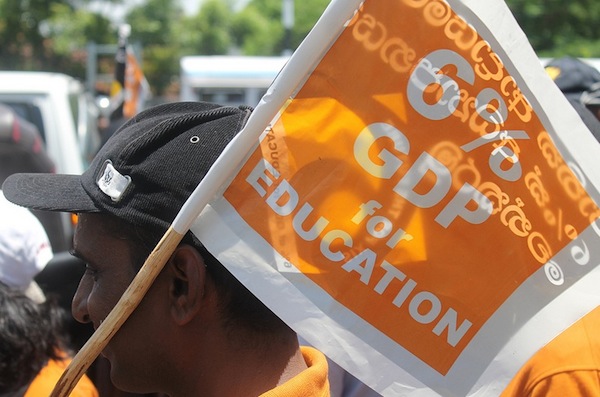
In this context, much of the discussion has come to centre on the demands of the Federation of University Teachers Association (FUTA), specifically the demand for the education budget to be increased from 1.9 % to 6 % of Sri Lanka’s GDP.
FUTA’s critics claim 6% is an arbitrary figure. They demand a detailed plan regarding what the additional funds will be used for, and how they will solve the problems plaguing Sri Lanka’s education system. In the critic’s view, answers to these questions are a prerequisite to action.
Consideration of the critic’s demand reveals an irony. Even as the demand for 6% circulates and gains grassroots support, Sri Lanka lives in the current reality of an education allotment of 1.9% of the GDP. The primary question, then, is not ‘why should we have 6%?’ instead, the primary question is ‘why do we have 1.9%’? The fact that the 1.9% was imposed without a detailed plan as to how it would solve the emerging education crisis, reveals the irony. The critic’s inquiry is thoughtful and legitimate, it is an echo of FUTA’s own exasperation, and it is best directed towards the government.
FUTA has stated the 6% figure is symbolic; it is a representation of the seriousness of their concerns and what they surmise are proportionately severe demands. FUTA’s stated intention has been to start a discussion and to frame that discussion in a consequential light. The grip education has on national discourse, can serve as some vindication of their method. The figure symbolizes a re-prioritization of education. While the figure itself serves as a wedge into discourse, the message the people have come to rally behind, is uncompromising and clear, the Government of Sri Lanka (GoSL) cannot marginalize education anymore.


The government’s position was recently defended in a forum discussion by Professor Rajiva Wijesinha. The professor argued a low education budget was actually a counter to ‘Statism’ and served as a de-evolution of the State ‘monopoly of supply’ on education. According to the professor, by decreasing the education budget the government is disentangling itself from the market. Furthermore, the professor argued education must be addressed in isolation, and the topic must not become politicized by other issues.
This position is problematic. Because the debate has been usefully framed in the context of ‘Per cent GDP’, it is clear that, budgeting a 1.9% of the GDP towards Education is not indicative of de-evolution; instead, it indicates de-prioritization. Per cent budget is zero-sum; an increase in one, necessitates a decrease in another, and vice versa. It is not hard to discover which sectors are being fortified to the detriment of others.
For example, the government has been steadily increasing the defence budget. In 2011, the defence budget rose by over 6%, and in 2012, it rose by 7%. While the government claims these increases were necessary to pay off old war debts, it is estimated nearly half of the defence budget is spent maintaining 200,000 military deployments. Keeping 16 out of 19 army divisions in the North and East is costly and education is paying for it.
The characterization of ‘monopoly of supply’ is also problematic. The professor assumes if this supply is broken up, it will be met by the private sector. He points to the success of private universities like Harvard and Princeton in the USA, to illustrate his point. But in determining what steps Sri Lanka is to take in developing an education policy, it becomes important to consider how and why those institutions were started.

‘Save State Education’, Protest march Moratuwa to Colombo, 2012 September 28, Organized by FUTA-pic: VikalpaSL
Harvard and Princeton were started as seminaries to train Christian clergy. They were conceived to address a gap in the American market, for which there was significant demand. Clearly, that gap and demand cannot be transplanted, but, perhaps, Sri Lanka has its own gap. In fact, technical and vocational schools are in increasing demand, but interestingly the private market has failed to meet it. The question then is, why has the private sector failed in this regard, and what confidence does that instill, upon which we ought to entrust a larger share of education? The solution to Sri Lanka’s education crisis is not necessarily in the private sector. And the private sector cannot be used as a safety net for government refusal to address inherited responsibilities.
The professor’s defence of the government position on education did touch on an important point. ‘Statism’ is a problem, but it is not limited to education. The Counter to ‘Statism’ is not for the government to withdraw from providing Education. Instead, the solution lies in combating Centralism by encouraging democratic discourse, dialoguing with FUTA and realigning the budget to reflect constituent values. The democratizing process will bolster both private sector confidence and public sector efficiency.

Plans underway to boost education system: SB

DailyMirror

Higher Education Minister S.B Dissanayake said today that the government was prepared to make amendments to the Universities Act of 1978 to expand and develop local universities to be on par with other internationally recognised institutes.

Minister Dissanayake said despite negative reports about local universities and the government’s role in education reforms amidst the ongoing university strike, the government had a clear vision to further develop the education system and that plans were already underway. (Olindhi Jayasundere)

A Review of Quotas in University Admissions


Photo courtesy Vikalpa
My good friend Somapala Gunadheera has made some thoughtful observations (The Island, 10 Sept 2012) on the problems of University admissions, and noted that in my “ Tamil Language Rights in Sri Lanka”( CPA, April 2012) I had not suggested ways and means of solving them. My analysis and suggestions were expressed in some publications way back in the 90s, and that is why I chose not to repeat them. But since my friend has raised the question, I will( belatedly) retrace some of what I had written then, supplemented with an outline of the historical back ground.
Jaffna youth have traditionally depended on education for employment since other avenues have been lacking in comparison with other districts. Since Sinhala Only in 1956, Tamil speakers have had even more problems than previously in finding employment. They have responded with even greater focus on education and on acquiring superior academic and professional qualifications, especially in fields such as Medicine and Engineering in which such qualifications virtually guarantee employment. Thus the proportions of Tamil youth entering the Medical and Engineering university faculties progressively increased, posing political problems for the Government. In particular the intake from Jaffna, which has long had a disproportionate number of very good secondary schools was very high. The political problem came to a head in 1970 -71, in the first year of the newly elected Srimavo Bandaranaike administration.
A hasty (and shortsighted and irrational) decision was taken by the Cabinet of Ministers to fix different pass marks to students of different ethnic groups so as to achieve an acceptable ethnic mix in University admissions in 1971. This was blatantly racist.  Predictably, the impact on Sri Lankan Tamils was traumatic, and a small section of Tamil youth took to armed rebellion. This “solution” was also widely critisised by educationists at home and abroad. Modifications were therefore introduced in subsequent years, for intakes in those years, but those schemes were also defective and, in any case, the damage done could not be undone. It was first sought to give a veneer of pseudo respectability by introducing what was called “linguistic standardization” which was again ethnic discrimination but in disguise. No educational or egalitarian or affirmative action / reverse discrimination principle was served. What it did serve was to instigate a serious of anti-Tamil pogroms culminating in a very bloody civil war which, with interruption, extended to 24 years (1985-2009), with a death toll of many tens of thousands, mostly of non-combatants.
Under “linguistic standardization”, Sinhalese ( Sinhala medium) students of all socio economic classes and in all schools gained privileged admissions to Medical, Engineering and some other faculties at the expense of Tamil and Muslim (Tamil medium) students of all socio economic classes and in all schools. This scheme was just as racist as the  1971 scheme. It would be an obscene travesty to describe as affirmative action / reverse discrimination a scheme that gives a step up to the child of senior Sinhalese professionals in the Sinhalese stream at Royal or Visakha or Trinity over a Tamil or Muslim child of estate laborers or slum dwellers purely on the basis of language medium.  Whereas under affirmative action / reverse discrimination the under privileged would get a step up over the privileged, under linguistic standardization, as in the  above example the reverse may take place.
What is affirmative action / reverse discrimination? Its objective is to give a step up to the under privileged and /or  the victims of discrimination with a view to compensate for the deprivation and/or discrimination. In India quota reservations are constitutionally prescribed for Untouchables/ Scheduled Castes, Scheduled Tribes and Other Backward Classes. For lack of space I will not spell out here the relevant sections of the Indian Constitution. In the USA preferences are mandated in the Civil Rights Act of 1964, which, however, does not expressly prescribe quotas nor identify the beneficiaries. In a land mark ruling the then Indian Chief Justice A. N. Ray affirmed that “Equality of opportunity for unequals can only mean aggravation of inequality. Equality of opportunity admits discrimination with reason” (State of Kerala v N.M.Thomas, 1976). In the USA, in a landmark judgment, Supreme Court Justice Harry A.Blackmun claimed that “ … in order to treat some person equally we must treat them differently”(Bakke v Regents of California, 1978). These quotations, approvingly cited in my book “Discrimination with Reason? The Policy of Reservations in the United States, India and Malaysia”, Oxford University Press, 1997, set out the essence of affirmative action / reverse discrimination.
What Sri Lanka now has is District Quotas, also unsatisfactory in that it has no rational basis and is divisive on several counts, but an improvement on “linguistics standardization” in that it is not overtly racist. What has not been tried out is any solution based on affirmative action/ reverse discrimination. Those of Scheduled Castes and Other Backward Classes and Schedule Tribes in India , and Blacks, Hispanics, Native Americans and few other categories  in the USA have claims to affirmative action /reverse discrimination to compensate for current discrimination as well as the cumulative impact of centuries of past discrimination. In Sri Lanka the major ethnic categories, with the possible exception of “Plantation Tamils”, cannot claim such benefits. Numerically smaller categories such as Veddahs,Rodiyas and a few “Untouchable” castes among Tamils may claim such benefits but these claims are not as compelling as those in India. There could be a case for reserving small numbers of places in Sri Lankan Universities for children of such categories.  But in any case being located in “backward areas” cannot generate such claims unless such privileges are tied to agreements to return to those areas after graduation to teach in under privileged schools with the view to progressively erasing such backwardness. In effect, since there are privileged schools in every district and the elite of those districts send their children to those or other privileged schools elsewhere, it is they who benefit from quotas outside Colombo and Jaffna rather than the most backward in those districts. Thus District Quotas help the rural elite at the expense of the urban underclass. Moreover, the markup for some Districts is  so high that within each class in the Universities the disparity between students is unduly large.
In India and the USA, a disproportionate share of affirmative action/ reverse discrimination benefits are appropriated by the elite of the disadvantaged communities. In fact those countries have attempted to exclude benefits from such elite by prescribing socio economic cut off criteria, but this proved to be cumbersome and unworkable. In India since the caste system continues to operate even among those converted to Christianity, they too enjoy quota benefits. But among Tribals, since converts to Christianity gain privileged access to good Christian schools, Christian Tribals were appropriating a disproportionate share of the Tribal quota benefits. For this and other reasons the Indian Supreme Court has ruled that the Tribals who convert to Christianity cease to be eligible for quota benefits.
Under the currently prevailing district quotas scheme, the under privileged everywhere in Sri Lanka suffer multiple  disadvantages of socio economics backwardness, poor schooling as well as the bulk of the district quotas being appropriated by the privileged of those districts. Their situation is made worse by the fact that the children of the underclass to which they belong are virtually excluded from admission to “good schools” to which children of privileged classes find easy access.
It is not possible to compensate for all handicaps. Moreover, most handicaps are difficult to define in terms of objective criteria. For example, if the parents are illiterate or if the situation at home is not conducive to children advancing in their studies, those handicaps are real but not easily quantifiable in terms of objective criteria and are therefore difficult to compensate for. But one handicap that is both real and definable in objective terms is the quality of schooling. Perhaps quotas can be justified if they are based on objective criteria related to a measure of the quality of schooling. It is also conceivable to use socio-economic criteria, but these would be highly subjective, especially in countries like Sri Lanka where most people are in the unorganized sector in which even the rich escape paying income tax. Our scheme may need to depend solely on an objective grading of schools.
For example schools may be graded 1,2,3,4 and 5 on the basis of the average of the last three (or four) years of admissions to university faculties. The total of  the marks scored by a student at the university entrance examinations can be increased by 10,20,30 and 40 respectively for those attending schools graded 2,3,4and 5 respectively. This ranking could vary from faculty to faculty since some schools may be good in Maths science, others in Bio science, etc. The ranking may also change gradually from year to year as schools improve or decline in respect of each discipline. This scheme has several important advantages. The grading is objective, transparent and any student or parent can understand it. It also addresses real disparities (unlike district quotas and linguistic quotas) in a meaningful manner. Further, the step up a child receives is modest so that there is no glaring disparity within each university class as under the current district quotas scheme. Moreover, since the step up is modest the incentive for each school to upgrade itself is not undermined; nor is it likely to provoke a negative backlash of resentment. It is a scheme such as this that can successfully replace the district quotas scheme   that now prevails. But a scheme such as this may not be acceptable to the  elite outside Colombo and Jaffna among whom Ministers and Members of Parliament are well represented and who are well served by the district quotas scheme. Perhaps this is why the District Quotas Scheme continued to prevail despite the protests of the Colombo elite, who also enjoy some political clout, and of the Jaffna elite and the underclass everywhere, who remain powerless.