Saturday, December 1, 2012

Jaffna University Tamil students boycott classes

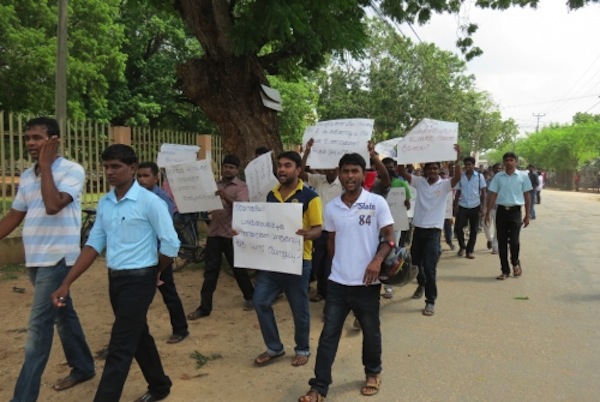
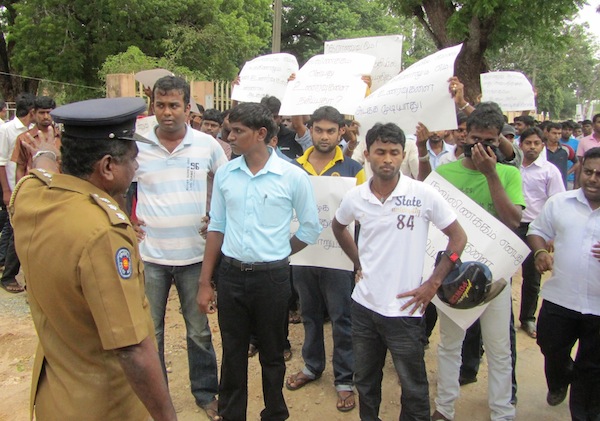
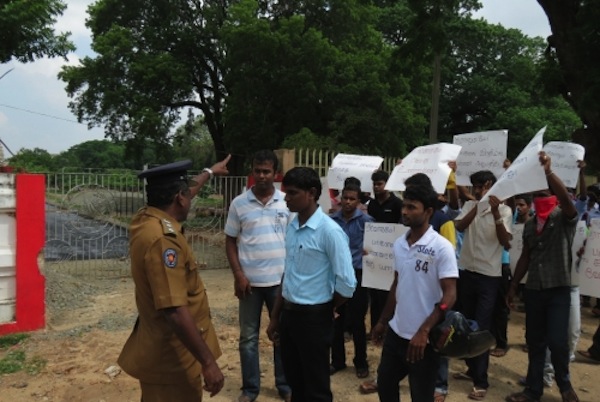
Sri Lanka protest at Jaffna University -  picture taken 28 November The campus was the scene of the worst political disturbances since the war ended in 2009

Related Stories

Students at Jaffna University in northern Sri Lanka have started a two-day boycott of classes after clashes with security forces on Wednesday.
They say they do not feel safe after several were beaten and injured in the worst political disturbances since the civil war ended in 2009.
Security forces entered the university, disrupting students marking a commemoration of dead rebel fighters.
The army said it had to restrain people who were throwing stones.
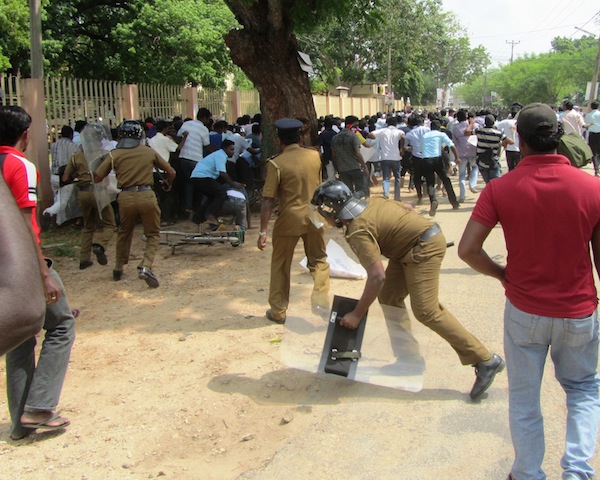
But some staff at the university accused the security forces of starting the violence, saying they believe the police baton-charged a group of students who had begun a planned march through the streets.
Only after that did some students throw stones, they said.
One staff member told the BBC the aftermath of the clashes was "like a battlefield". And on Thursday, reports said there was little activity on the campus.
There were Sinhala and Muslim as well as Tamil students on the campus, one staff member emphasised.
Tension in the north Across the former war zone in northern and eastern Sri Lanka there is a higher military presence than usual.
Asked by the BBC why the students in Jaffna should not be allowed to march in the streets, Jaffna's military commander, Maj-Gen Mahinda Hathurusinghe, said the students have been "categorically told not to" because "they would become violent".
He said that "for the betterment of the country", "Martyrs' Day" - which commemorates dead Tamil Tiger fighters - should not be observed by people.
The tensions arose as some students marked the death of Tamil Tiger guerrillas at small candle-lit memorials, while well-produced pro-Tiger posters appeared in various parts of the formerly Tiger-held territory.
Since the end of the war this had hardly happened within Sri Lanka, where the Tigers and their separatist ideology are strictly banned - although Tiger sympathisers in the diaspora call 27 November "Martyrs' Day" and mark it as such.
The clashes point to simmering tensions three-and-a-half years after the mainly Sinhalese security forces crushed the Tamil separatists, and as the army maintains tight control over the whole of the north where the war was fought most bitterly.
In a Jaffna suburb, a petrol-bomb was thrown at the offices of a small Tamil political party on Thursday. There were no reports of injuries. It is unclear who did it or whether it was related to the campus trouble.

The death of Freedom of Assembly, Expression and Religion in the North of Sri Lanka


Every 26th[1] and 27th of November since the end of the war (2009), we hear of people in the North not being able to moan their dead, not being able to carry out peaceful assemblies, not being able to partake in religious festivals or observances in public or at home, and every year it falls on deaf ears. Also noteworthy is the fact that such incidents are most often reported only in the Tamil media and sites or non-main stream news websites. This raises the question as to what “makes news” in the South, and what the mainstream media considers priority. The North not being one of them it would seem.

The trusty arms of the State once again ‘rose to the occasion’ with a real “vengeance” this time around, to suppress all events, deemed by them to be “unwarranted” or bearing potential to “incite” the populace, for the fourth consecutive year now. The only difference this year being that the State has blatantly ignored the recommendations made by its very own reconciliatory mechanism, the Lessons Learnt and Reconciliation Commission (LLRC), which has asked that the State “facilitate(e) their (the people’s) attendance at religious ceremonies, without placing any hindrance to such activities” and that “(p)eople, community leaders and religious leaders should be free to organize peaceful events and meetings without restrictions” (para. 9.116 and 9.118). The report has even gone as far as to recommend that a “separate event be set apart on the National Day to express solidarity and empathy with all victims of the tragic conflict…” (para. 8.304).

No Right to Assembly, Expression or Grieve


Despite all the aforementioned recommendations though, the security forces wielded chaos in the North yet again. Groups of students who had gathered at the Jaffna University grounds on November 27th Tuesday, a Poya holiday, which also marked Maaveerar Naal[2] and the Hindu festival of lights, Karthiaai Vilakkeedu, were threatened and forced to flee the premises by 10 unidentified men in civil, suspected to be military intelligence officers, bearing pistols and riding motor bicycles.
As it was a holiday, students had met as usual to conduct group discussions and badminton practices within the University, rightfully presumed to be a ‘safe space’ for students to congregate. That was unfortunately not the case earlier this week, when students were terrorized into evacuating the University premises.
A student had noted down the details of one of the motorcycles as being an Indian made Bajaj Pulsar bearing the registration number NPJM 3172. The two riders of this bike had stopped at a group of students and threatened them to leave the area. Even after all the students had dispersed, the bikes had continued to circle the University premises.

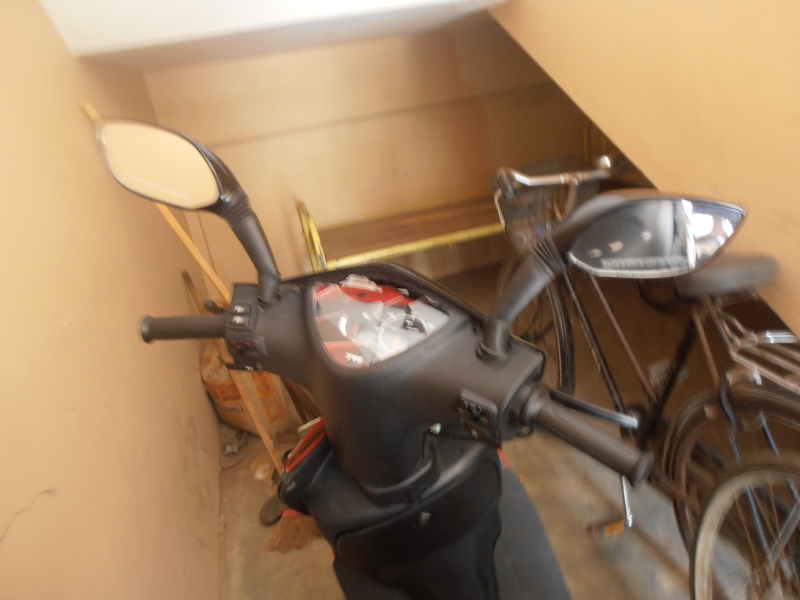
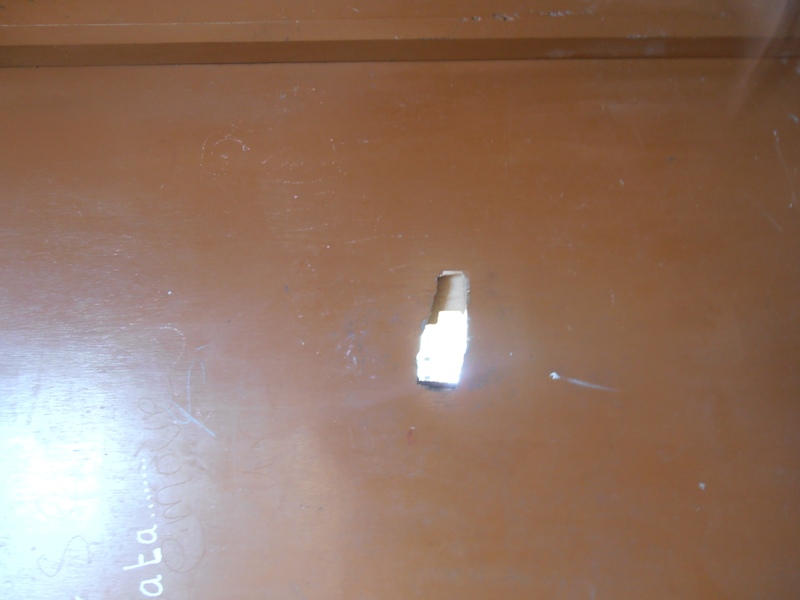
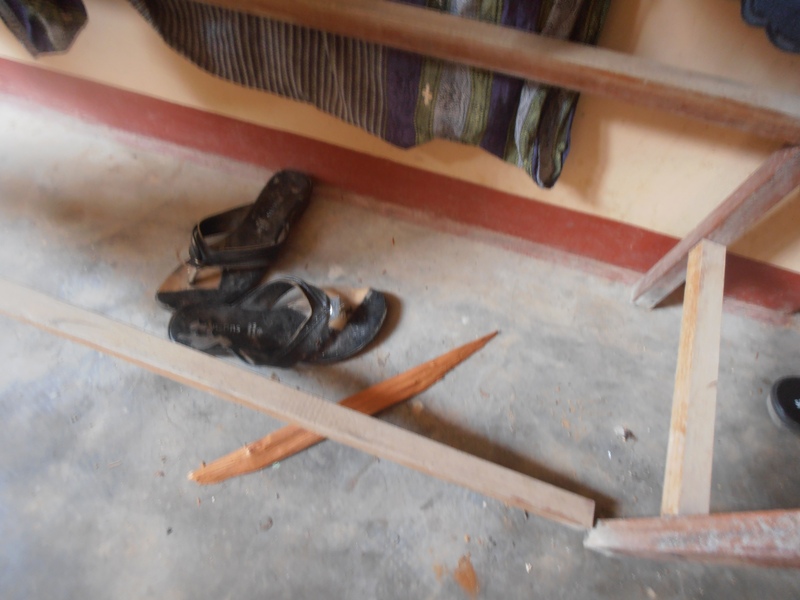
Furthermore, on the 27th morning, military forces had stomped into the Jaffna University student hostels, expecting there to be some lighting of lamps. Having heard that the lamp lighting to commemorate Maaveerar Naal had been shifted to the female hostels, the military had broken into their hostel, terrifying the students. The Army had entered the hostel through the water tank, broken open the doors of the girl’s hostel, and put out the lamps. They had also frightened the girls by putting guns to their head, threatening to shoot them. Some girls had fainted out of fear and shock. Subsequently, there was a heated argument between the male hostellers and the army.
Furthermore, an alleged CID officer in civil, had taken photographs of five students standing with their motorbike, from the Medical Faculty, photocopied their national identity cards (NIC) and returned it to them.
A member of the Student Union said that “as today is Maaveerar Naal, Government forces are trying to prevent any type of commemorations from taking place. Last year too, forces were deployed at many temples and churches, preventing them from carrying out even routine rituals and religious activities. Therefore, it is most definitely a military intelligence activity to prevent people from lighting oil lamps and paying tribute to the martyrs.”

Following the tense situation at the University on the 27th, MP Saravanapavan visited the students at the University to find out details of the incident. On his arrival, alleged intelligence officers in civil had thrown stones at the MP.

A news journalist belonging to the Uthayan newspaper (a Jaffna Daily), was assaulted[3] allegedly by the military intelligence, whilst covering the unrest at the university premises on the 27th. “I was taking photographs of the university incident, when two people with their faced covered with cloth, approached me and attempted to forcibly remove my camera from my hands. When I tried to protect it from them, they assaulted me and tried to take my camera from me again,” said the journalist. Following the incident, he immediately lodged a complaint with Jaffna Police, and was admitted to the Jaffna General Hospital for treatment.
In addition, also on the 27th, four students traveling along the Aadiyapatham road in Jaffna town were stopped and intimidated by unidentified persons, suspected to be military intelligence. Their NICs were taken and photocopies were then made and the cards returned to the students. Fortunately they were not assaulted or arrested but they are said to be traumatized by the incident.
Yet another group of students belonging to the Jaffna Hindu College, who had gathered at the school grounds yesterday for their routine practices, were allegedly intimidated by military intelligence officers and forced to leave the grounds. This unexplained activity carried out by the military had caused much panic and fear among both parents and students.

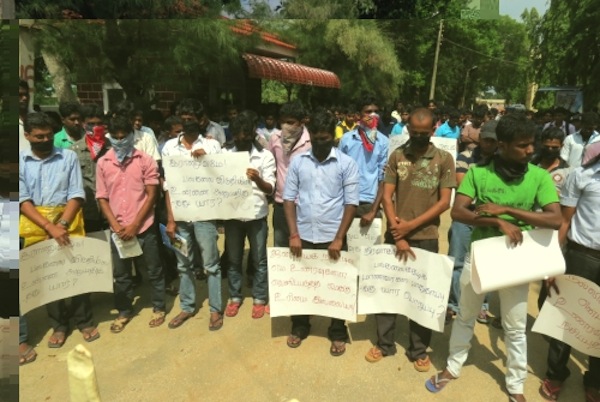
The following day (28th November 2012), students who were harassed and intimidated on the 27th, gathered at the University to conduct a silent protest against the terror tactics carried out by the military intelligence the previous day, having acted in total disregard of the University’s administration.
Some of the placards they held up, included the following slogans;


“No freedom of expression in this democratic nation”, “Who is responsible for student’s safety?”, “Can the military justify military intrusion into the female hostel?”
After having silently protested for half an hour, the students attempted to walk out of the main University entrance and re-enter the premises via the Science Faculty entrance located on Ramanathan road (distance of less than 100 meters). As the students set foot out of the University entrance, the Riot Police Unit and officers dressed in civil batten charged the unarmed students. Many students, including female students were injured, with four students and an intelligence officer being hospitalized for further treatment, as a result of batten charge and stone pelting. The officer was discharged within one hour of being admitted, whilst the students remained for further treatment.

The students had also called Jaffna District MP E. Saravanabawan to come and intervene, as they were under attack by the military and Police. “University students fought for their rights were brutally attacked and five of them were arrested. My vehicle was attacked… and…smashed the windows by the intelligent unit personnel, while police and military were watching. Students who were peacefully demonstrating were arrested but why they could not arrest those culprits attacked my vehicle,” stated MP Saravanabawan at a media briefing held in Jaffna on the 28th of November, 2012[4].

Having arrived on the scene, the military had not permitted the MP to enter the premises. He had argued with them and was eventually permitted to enter. “They did not respect me as a parliament member. They behaved in an uncivilized manner. This was watched by the officer in charge of Jaffna police station.”
“Yesterday military attacked me by pelting stones. Today they have smashed my vehicle. Regarding these incidents, I have made complains to the police station. Regarding this incident I will bring to the attention of Defense Ministry and Parliament was mentioned by him,” he added.

Many students have said that alleged intelligence officers were still wandering the university premises, with hidden guns and filming the student activists, and hundreds of military, intelligence and Police officers surrounding the University premises, had caused a tense atmosphere within the university.
A journalist from the Maharaja Network too was injured, along with a few University Media Unit students who were being treated for swellings caused by batten charges.

All vehicles entering Jaffna on the 27th were checked at Ottumadam, Arali and Thaddar Street junction, and the forces were patrolling the vicinity of the University in pick-ups and jeeps. They stood guard outside the University gates for the entire night.

The Jaffna University administration has yet to speak out, or take action against this incident. However, the Jaffna University Teacher’s Association (UTA) has issued a statement condemning the incident, raising the question as to how at a time Emergency Regulations are not in place, such an extent of force could be used on unarmed students, partaking in peaceful assembly. It has also condemned the numerous injuries caused to the University students, including female students.

People have also complained that the army had stationed themselves at the Navanthurai cemetery and prevented people from lighting lamps for the dead on the 27th.

The Chairman of the Karainagar (Jaffna) Pradeshiya Sabha, Anaimukan Velayutham’s home was set ablaze by unidentified persons at around 7pm on the 27th of November, 2012, as he was accused of having paid
homage to “fallen heroes,” at his house.[5] “Some unidentified people stormed into my home and set some vehicle tires on the floor in the middle of my home and set them on fire,” described the Chairman.
On the 28th, a local businessman in Kilinochchi was assaulted and intimidated by the military, as he had lit lamps in his shop in commemoration of Maaveerar Naal.

There was also a scheduled meeting for clergy and lay people to discuss some community issues to be held on the 27th in the Mannar district, which had to be postponed due to the prevailing situation. The meeting venue had received a call on the 26th evening inquiring details regarding the meeting to be held the next day. As the priest heading the meeting had not wanted to risk the security of the lay people attending, they decided to postpone the meeting.
No Right to Religion and Culture
In celebration of the Karthiaai Vilakkeedu, which happened to fall on the 27th of November this year, people in the Jaffna had lit oil lamps on their fences and gates through the night. This was in keeping with the DIG (Jaffna), Eric Perera’s assurance that there would be “no obstacle to the public of Jaffna celebrating the ‘Hindu Karthikai Deepam’ festival by lighting oil lamps or engaging in religious activities in Kovils on November 27.”[6] Despite this assurance though, on Brown Road, Jaffna, the military had put out lamps and asked people why they were burning oil lamps. Even after being told about the Festival, the military had demanded that they put off all oil lamps in the area. Similar action had been taken by the military in Gurunagar and Paraiyoor. In Karainagar the military had gone as far as to kick out lamps, and told people not to re-light them. Envision a scenario where a similar act was done to a Buddhist on Vesak day? It would have made headline news! So one can pose the question, why the double standard?

A priest in Kilinochchi said that the military had surrounded most of the churches in the area and had called many priests and questioned them as to why they were having mass on the 27th. He said that much like any other Tuesday where there would be a mass to St. Anthony, on the 27th too, he was preparing to say mass as usual. Many military persons were listening to our sermons and watching our services. As it was Maaveerar Naal as well, people wanted to light lamps in the church in remembrance of their fallen heroes, but the military did not permit them to do so.

In Mannar, Hindu temples were instructed not to con
duct special Pooja to celebrate the festival of lights on the 27th, and also to keep the temples closed for the day.

The military had visited a priest in the Mannar district, on November 26th evening, and instructed him not to conduct mass the following day. The priest had told the military that he was under the instruction of the Bishop, and that he would only adhere to the orders of the Bishop. Having reported this incident to the Bishop, the Bishop had asked that the priest not conduct the service as a precaution, but had instructed an alternative priest to carry out the service the following morning. A large number of parishioners had attended the mass.

Another priest in Mannar had received phone call from the Police OIC instructing the priest not to carry out mass on the 27th. However, the priest had carried out his service regardless.

Yet another priest was approached by a person in civil on the 26th evening, and passed on instruction by the military, not to conduct mass on the 27th. The priest had then given his contact details to the boy and told him to ask the military person to get in touch with him and tell him directly. As he heard nothing more from the military, he too went ahead with his service as planned on the 27th. He had even asked people to bring candles and commemorate the lives of their loved ones.

Three and a half years on and citizens of our country still have no freedom of speech, association or religious observance; absolutely nothing has changed. If at all, the State has become progressively more insecure. Before a Government can speak of reconciliation and peace, should it not have in place justice and equality?
Update: 1st December 2012: Seven students from Jaffna University including union members have been summoned by Jaffna Kopai police over an accusation of connection with alleged arson attack on 28th night. Out of the seven students, two have surrendered at Kopai police with Faculty Deans Prof. Kanthasami (Dean Faculty of Science) and Prof. Velnampi, Dean Faculty of Management.

Sanmugam Soloman. a science faculty student union member was the victim who was brutally assaulted by riot police on 28th morning and treated for internal injuries. A picture taken while he was assaulted is widely available in the media. Kanagasapapathi Jenamayan is President of Arts Faculty student union. Both have surrendered. Two other students named have already graduated and working under government graduate scheme at Nedunkeny, in Vavuniya North (this has raised more questions about the alleged arson attack).
The students surrendered at 1pm. They are still under going questioning.

The seven students named are strong activists and active members of Jaffna University Student Union. They have taken part in several marches and protests against the oppressive nature of the Sri Lankan military, including the silent match on the 28th, which was brutally attacked by the Police and other organised armed groups.

This incident and subsequent arrests have created fear amongst students. The safety and personal security of those in custody are also in question.

[1] Former LTTE Leader, V. Prabhakaran’s birthday.
[2] Maaveerar Naal (Martyr/Hero’s Day), a day set apart by the LTTE to remember and pay tribute to fallen cadres.
[3]Online Uthayan, University students lighted lamps, forces were in pandemonium. “Udayan” reporter assaulted by forces – http://onlineuthayan.com/english-news/uthayannews/3334x2l1h1h1r2
[4] Online Uthayan, “Intelligence unit personnel smashed my vehicle while police and military watching”. Saravanabawan MP elucidates to Medias - http://onlineuthayan.com/english-news/uthayannews/333423l1h1h1r2  
[5] TamilNet, SL military attacks house of Kaarainakar PS Head for observing Heroes Day - http://www.tamilnet.com/art.html?catid=13&artid=35797
[6] The Island, Jaffna people free to celebrate ‘Hindu Karthikai Deepam’ festival — DIG - http://www.island.lk/index.php?page_cat=article-details&page=article-details&code_title=66866

Tuesday, November 27, 2012

Universities find it difficult to accommodate additional intake

, The Island

by Dasun Edirisinghe

 Although the University Grants Commission and the Higher Education Ministry vowed to admit over 5,000 additional students to universities, following a Supreme Court order, faculty boards of universities are crying foul due to a shortage of facilities to accommodate them.

Undergraduates claimed that some faculty boards decided to stop some academic courses and they had informed their decision to the UGC recently.

Convener of the Inter University Students’ Federation (IUSF) Sanjeewa Bandara told The Island that two academic programmes of the Agriculture Faculty, of the Peradeniya University, had been suspended by the faculty board due to the huge increase in the number of students.

Normally, 50 undergraduates were admitted to the Animal Science and Fisheries degree programme, he said adding that this time an additional 29 students had been added to the course as the intake was increased to honour the court ruling.

Bandara said that the faculty board decided to stop the course due to lack of facilities to meet the enhanced intake.

He said that the UGC sent 56 more students to the Agricultural Technology and Management degree course in the same faculty and the faculty board decided to stop it too.The situation was same in the other universities, but yet had not informed the UGC, Bandara said.

When contacted for comment, Dean of the Peradeniya Agriculture Faculty Prof. K. Samarasinghe said that they had not stopped the degree programme, but they could not recruit the new batch as it was too big.

"We are conducting three degree programmes, Animal Science and Fisheries, Agricultural Technology and Management, Food Science and Technology," Prof. Samarasinghe said adding that 275 students had been enrolled for the three courses on the basis 200, 50 and 25 respectively.

There were some subjects common to all three degree programmes and the lecture halls could not accommodate more students at one time, he said.

Prof. Samarasinghe said because of that the faculty board decided not to enroll the new batch until additional facilities were given.

Secretary of the Higher Education Ministry Dr. Sunil Jayantha Navaratne refused to comment.

"We will look after that and the media need not worry over those solutions," Dr. Navaratne said.


Monday, November 26, 2012

Dons allege VCs violating their agreement with govt.

, The Island

by Dasun Edirisinghe

University teachers yesterday claimed that Vice Chancellors of universities countrywide, were refusing to accept and implement the conditions in the agreement between the government and the Federation of University Teachers’ Associations (FUTA).

These conditions are spelt out in a joint statement issued after both parties came to an agreement which resulted in the suspension of the FUTA’s 100-day strike on Oct. 13.

They said that the government’s response to FUTA’s demands, including the cancellation of eight circulars issued by the University Grants Commission (UGC), allocating 6 per cent of the GDP for education, consulting university teachers before commencing the leadership programme for prospective university entrants, a pay hike, etc. was included in the joint statement signed by Economic Development Minister Basil Rajapaksa, Higher Education Minister S. B. Dissanayake and FUTA President Dr. Nirmal Ranjith Dewasiri.

Dr. Dewasiri told The Island that one and half months had passed since the statement was issued, but university administrators had refused to implement it.

"We will meet Minister Dissanayake on Dec. 03 to review the progress of the agreement," the FUTA Chief said, adding that the neglecting of the joint statement by VCs was the major issue to be taken up at the meeting.

Dr. Dewasiri said that they would also discuss the appointing of members to the proposed committee to look into the problems university teachers were faced with.

the FUTA had been asked to name two members to the committee and it would make a decision at its next Executive Committee meeting scheduled for Thursday (29), the senior academic said.

Dr. Dewasiri said that UGC had already informed them that they could withdraw only three circulars out of eight. "According to the UGC, three circulars would be withdrawn, two would be amended, one would remain and two would be discussed with the Treasury and the Labour Commissioner," he said.

The FUTA would discuss it at Thursday’s Ex-Co meeting and inform its decision to the government at the Dec. 03 meeting, he said.

When contacted, Secretary to the Higher Education Ministry Dr. Sunil Jayantha Navaratne said that they had sent a letter to Vice Chancellors of universities countrywide, last week, to abidy by the agreement.

"However, university teachers still have problem over the implementation of the joint statement. We will discuss it at the meeting scheduled for December 03," Dr. Navaratne said.

Sunday, November 25, 2012

Govt. to back private unis, won’t privatise state ones

SundayTimes
The issue of private universities came up in Parliament on Wednesday, when the votes of the Ministry of Higher Education were taken up for debate. Higher Education Minister S.B. Dissanayaka said that Government would encourage private higher educational institutions, but would not privatise State-owned universities.

“Of the 150,000 students who qualify for higher education in this country, only around 20,000 can find placements within State universities. It is the responsibility of the Government to find them educational opportunities in the country,” he said.

The Minister added that Sri Lankan students were going to countries such as Nepal, Bangladesh and Pakistan for medical studies, as there is resistance to private medical colleges within the country. “Not one, but we need two, three or four private medical colleges in Sri Lanka,” he said.

UNP MP Sujeewa Senasinghe said that his party would not object to the setting up of private universities, but oppose the lack of transparency in the procedure adopted by the Government in this regard.
“It is ironic that, those who once spoke against private education, are now speaking in support of it,” he said.
JVP MP Anura Dissanayaka who spoke during the debate, accused the Government of setting up private universities, and attempting to cripple the State ones. “The Government needs to invest money in State universities,” he said.

Saturday, November 24, 2012

Does Grade 5 scholarship exam show academic superiority?

, The Island

article_image
by Douglas King

President Mehinda Rajapaksa has a justifiable goal of Sri Lanka becoming an "educational hub" in this region of Asia in a similar way that Singapore achieved. The President has taken initiatives in several areas of education that may sow the seeds towards his vision. The "Year of English and IT" which he kick started has long gone and in the opinion of some educators, little has changed in the way English is taught or practised. The President is now embarking on a far reaching goal of updating 1000 secondary schools. Only time will tell whether Sri Lanka will be recognised as having "World Class" education.

The annual grade five Scholarship examination is now firmly embedded in the educational year timetable. Theoretically, to justify this major country wide test being foisted upon more than 300,000 nine and ten year old children, the results should identify the academically most gifted students and predict their success through school, university and beyond.

Several factors have inspired me to make some basic research into the validity of the Grade 5 Scholarship Examination which has become a vital aspect of the education system. Three very different incidents have come into my purview. A middle income neighbour of mine was very disappointed several years ago when his son scored less than 100 in the examination despite scholarship tuition classes twice weekly for 18 months. The local primary school he attended had also intensified similar test paper revision for students in grade 4 and 5. It was difficult enough for the parents to cope with such failure but the effect on their son was more severe and he refused to attend school for the following 3 weeks after receiving the result. By contrast another neighbour, a daily labourer and very low income, was both astounded and gratified that his son scored 171 and in the top five percentile in the country. In this case the boy had not attended any extra private tuition classes. A third occurrence is that of a recent university graduate who I know very well. He is among the brightest and most able and intelligent young men I have met and is well on his way to post graduate education or a well paid career with a large business. His scholarship score in 1999 was well below 100.

Highly competitive

In October 2010 Education Minister Bandula Gunawardena announced that the government was considering shifting the Grade 5 scholarship examination to Grade 7 to reduce the pressure on students. The Minister went on to say that medical specialists who attended the consultative committee meeting of the Education Ministry considered that the Grade 5 scholarship examination placed an undue burden on children at a tender age.

"The Grade 5 Scholarship exam is a highly competitive Sri Lankan examination conducted by the Department of Examinations of the Ministry of Education. Based on the results of the exam, students could transfer to prominent national schools. This Exam is a means for gifted students from villages to move to better schools with government scholarships. Annually, cut-off marks are set by the Ministry of Education based on demand for individual schools." Most primary schools add extra lesson periods for students to practise past examination papers. In addition many students attend private tuition classes practising the same tests. Every parent likes to enroll their child to a popular good school in major cities and hope that their child will obtain a high mark in Grade 5 Scholarship examination.

Over 300,000 children are entered for the grade 5 scholarship examination every year. In 2004 approximately 7% obtained marks above the cut off and around half of these were below the income level necessary to receive bursaries, so approximately 8,000 received bursaries out of the 300,000 who sat the examination. The Mean mark was 38%. It is unlikely that subsequent years reflected major changes in these statistics. Despite the Scholarship examination occupying such an important part in the education system, it has not been possible to find any published research on the subject.

The Scholarship examination questions and format are planned to identify the children that are well above average intelligence and who are considered best able to take advantage of the higher academic standards in certain schools. Eight years further down the education road and only students who score very highly in "A" level examinations, and thus the coveted "Z" score, gain a place in one of the government universities. There should be a positive correlation between the grade 5 scholarship results and Z scores. A survey of 100 students at University of Peradenya shows some interesting statistics.

Year 1998/9 62 students

6 scored higher than the cut off mark of 135 1 scored 180 and the remaining 5 scored within the 135-145 range 16 scored less than 100 2 scored 51 or 69 35 scored between 100-135 and therefore failed to pass. Only 1 student scored high enough to be admitted to one of the very popular 20 boys’ schools.

Year 2000 cut off mark 146 37 students

14 scored less than 100 4 passed the cut off mark with the highest being 168 19 scored between 100 and 146 and therefore failed to pass.

The marks were given voluntarily by students on pieces of paper and did not identify their names so an assumption can be made that these are accurate with only a small margin of error due to memory. A student gaining a university place implies a very high "Z" score and should indicate very high ability and intellect. Yet to a great extent their performance at the grade 5 scholarship examination does not indicate any academic superiority.

Further research

Further research was made on the 3 years scholarship examination results of 80 grade five students at a popular semi-urban primary school. In the most recent year, 2012, only 1 student qualified for a place in one of the top boys’ schools. 30% of students scored less than 100 marks (38% of total marks). 13 (16%) passed the cut off of 142 of which approximately 50% (6) were below the income level to receive financial bursaries.

The results for the years 2010 and 2011 are similar and show less than 5% variations.

Several years of extra scholarship classes at the school and similar extra classes at tuition centres for 80 children results in only 1 child achieving entry into one of the coveted 20 urban schools, and 6 children entitled to financial assistance. To add a necessary extra dimension to this research requires a follow up of those students who are the "heroes" of the examination.

In a recent article by Carmen Wickramagamage she writes "Every year, around this time, the Lankan media become engrossed with a phenomenon that I find distressing, if not downright annoying: the parade on TV and newspapers of the supposed high achievers at the Grade V Scholarship Exam. This year is no different and we have already been treated to the photographs, interviews and life stories of these kids flanked by their proud parents and/or teachers. Every year the phenomenon irritates me. It irritates me because the publicity only encourages an already skewed education system: the race to be first, the race to get perfect scores or grades at exams at the expense of everything else that formal school-based education is supposed to be about:"

Select school children

There are 20 "select" boys’ schools and 20 "select" girls’ schools which in total offer around 5000 places in their grade 6 classes. Some obscure evaluation system ranks these schools according to the level of marks required for entry. Thus the schools at the top of the list may require 170+ and those at the bottom of the list 160+. Some of these schools have primary classes and entry at grade one is based on locality and not academic selection. How do these students compare with the "scholarship" entrants when they receive their "A" level results?

The research identified in this article is only on a small scale and a larger sample is necessary to be sure that the results can be generalised. However, it does raise some serious questions as to the purpose and validity of the scholarship examination. The majority of children "fail" to achieve the cut off point and even if the word "fail" is not used, the reality cannot be avoided. Numerous well meaning parents subject their children to unnecessary stress through private tuition classes, spending money they can ill afford in the very remote possibility of achieving a high score.

What does the scholarship examination test? Is it a test of IQ or a test of rote learning? Does it really identify intellectual superiority? Do all these numerous extra classes benefit the children or only the teachers? How many people now in top positions in government or private corporations achieved higher than the cut off mark, or how many scored less than 100? What happened to those 5000 students who achieved the highest marks in the country? Certainly a lot more research needs to be done to answer these questions? As a step towards the President’s goal of Sri Lanka boasting a world-class education system, the necessity and desirability of the scholarship examination needs serious consideration.

(The writer could be contacted at douglasking1939@yahoo.com)

Most universities fail to answer audit queries


by Dasun Edirisinghe, The Island

Most of the universities have not answered audit queries during the last few years. This had been noticed by the Parliamentary watchdog, the Committee on Public Enterprises (COPE).

Universities and Higher Educational Institutions, coming under the University Grants Commission (UGC) met the COPE during last three weeks.

Sources said that each university had an audit committee and they met at least four times a year to answer audit queries.

"The Peradeniya University did not answer 189 audit queries during the 2009 /2010 period," a high ranking official of the university sector told The Island on condition of anonymity.

He said that Sabaragamuwa University too, was badly exposed at the COPE hearing for ignoring audit queries.After the COPE advised the administrators of those universities on their responsibility, they were now correcting their grave lapses, he said. When contacted for comment, UGC Chairman Prof. Gamini Samaranayake said that there had to be accountability in universities as they dealt with public money.

He said that the financial auditing helped to mitigate waste and corruption, but, academic auditing was also very important for the universities.

"Universities in other countries, including those in India, had academic activities too under auditing," Prof. Samaranayake said.

He said that they wanted to establish good governance in the universities.

Friday, November 23, 2012

A Way forward

Global higher education system and the proposed knowledge hub for Sri Lanka:

, the island

article_image
Speech delivered by Prof. Gamini Samaranayake, Chairman, University Grants Commission, at the AGMof the Sri Lanka Quantity Surveyors Association in Dubai

Continued from Midweek Review

on 21. 12. 2012

To accommodate an increased demand of university education ad hoc measures such as creating another Faculty of Arts in Colombo and a Faculty of Science in Peradeniya was taken by the government. By 1970 the number of universities increased to five and by 1978 there were seven universities in the country. The rest were established after 1994.

The number of students entering higher education thus increased form 1612 in 1948, to 5000 in 1959, to about 14,000 in 1970 and 17, 449 student enrolments in 1978. By 1988/89 there were 29,781 students internally in university education. At present, 80, 000 students are in universities. Annually about 13,000 internal graduates pass out from universities and more than 50 percent of them are from the Arts and management streams. The output of external graduates is around 6,500 and the Open University too has an output of about 500 per year. Thirty years ago 70 percent of the student population was admitted to the faculties of Social Sciences and Humanities. In addition, since 1962, there has been a system of external examinations in university education and almost 200,000 students are registered with the eleven universities in the country.

Currently, there are 14 conventional universities, three campuses, one open university, 9 undergraduate and 7 post-graduate institutes, 9 degree awarding institutes under the purview of the University Grants Commission. Besides, there are two religious universities under the Ministry of Higher Education. There is one university under the Ministry of Defense, and one under the Ministry of Vocational Training. Thus, there are 19, universities have been engaged providing higher education under the principle of Free Education since 1945. Almost, 80,000 students are studying at our universities. Another, more than 150, 000 students are there as external students. The exact statistics are not available regarding the number of students in universities overseas. According to estimates of the UGC nearly 8000-10000 students leave the country for higher education annually.

Issues and Challenges

The biggest challenge facing our university education is offering equity in access and quality of education. In 2010, 54,000 have applied for 22,000 placements at our universities. The Gross Enrollment Rate (GER) the ratio of students enrolled in higher education to the size of the age cohort between 18 to 24 is close upon 16 per cent. The UGC is planning to increase the GER up to 20 per cent in 2016 and 30 per cent in 2020. It is essential to have the GER to level of 20 per cent to move to a knowledge economy.

The challenge before us is to increase access to higher education while improving the quality of education to suit the demands of the new millennium. The answer lies in changing the traditional model of teaching and learning measured by where we study and what we learned. New pressures such as alignment of industry and the demand of the workforce, the move to mass education, a geographically fluid workforce and mass communication have exacerbated the need to move away from rote learning to competency based education. Therefore, we need to redefine our programs to provide competencies for a new generation of learners.

The state monopoly in higher education has come under increasing pressure as the state has not been able to keep pace with the demand for higher education and diversify and increase access and quality at the same time. We at the UGC are grappling with issues of expanding access and quality and it is well known fact that the state cannot allocate the financial resources required to meet these challenges and neither can the country find the human resources required to increase quality.

Given the rapidly changing context globally as well as within Sri Lanka the Ministry of Higher Education and the UGC are compelled to rethink its policies and strategies and as I said before forecast change and plan for change. If not we are left behind and the forces of change will continue in an unplanned and unregulated environment which is not conducive for the development of the country. Establishing Sri Lanka as a knowledge hub in South Asia is one such that is being explored.

Knowledge Hub

A Knowledge Hub is broadly defined as a designated region intended to attract foreign investment, retain local students, build a regional reputation by providing access to high-quality education and training for both international and domestic students, and create a knowledge-based economy. A knowledge hub is concerned with the process of building up a country’s capacity to better integrate it with the world’s increasing knowledge based economy, while simultaneously exploring policy options that have the potential to enhance economic growth. An education hub can include different combinations of domestic/international institutions, branch campuses, and foreign partnership, within the region. The main functions of hubs are to generate, apply, transfer, and disseminate knowledge.

The concept of a knowledge hub for Sri Lanka was proposed by HE the President Mahinda Rajapaksa through his policy document during the presidential election in 2009. It is stated that Sri Lanka will "develop youth who can see the world over the horizon". "We have the opportunity to make this country a knowledge hub within the South Asia region. I will develop and implement an operational plan to make this country a local and international training centre for knowledge".

The Ministry of Higher Education is grappling with the empirical implications of translating this promise into reality. The Ministry has invited foreign universities to set up campuses to provide a more diversified higher Education programme to increase access for local students and to attract students from overseas to study in Sri Lanka. Just as in Singapore Sri Lanka’s strategy is to piggy- back on internationally renowned universities so that the process is cost effective and mutually beneficial. Furthermore, it is planned that 10 branch campuses of "world class" universities would be established by 2013. The Knowledge Hub Agenda has given greater prominence especially to the fields of Science and Technology, Information and Communication Technology, Skills Development, and Research and Development in Applied Sciences.

Malaysia is the first country in Asia that has strategically established itself as a knowledge hub admitting 100,000 overseas students, although the university education in Malaysia was introduced far later than Sri Lanka. It has a clear strategy to consolidate as an international hub for post graduate studies. Another successful hub is Hong Kong although its catchment area is more Southeast Asia than South Asia. Other countries such as India, Singapore, Viet Nam and Thailand are aspiring to establish a knowledge hub in their respective regions. India, attracts a 100,000 students annually while Hong Kong, attracts 5,823, China 162,895, and Singapore 72,000 overseas students annually. Sri Lanka has a projected target of attracting 10,000 foreign students by 2014 which would increase to 100,000 by 2020.

Advantages

Sri Lanka enjoys several advantages to develop into an education hub. First, of all the ever increasing demand for higher education in the country is an impetus for growth and advancement. Annually, well over 250,000 students sit for the Advanced Level Examination and half of them are qualified for university education. However, only 22,000 are able to enter university education in the country. Of them, 9000 enroll in vocational training through 12 Advanced Technological Institutes, 20,000 enroll at the Open University, 8000, access overseas education, 20,000 register as external candidates while 9000 are studying for a foreign degree via cross border institutes. Nearly, 60,000 students are looking for alternative higher education locally.

To be Continued on Saturday

Pera U’grads protest against ‘leadership’ training

, the island

by Dasun Edirisinghe

Undergraduates, of the Peradeniya University, protested at the Galaha Junction, blocking the Colombo – Kandy road, against the leadership training programme for university freshers.

President of the Students’ Council Janaka Madushan told The Island that the government was now putting new undergraduates through military training claiming it was leadership training.

He said that several students were injured during last year’s training, but the government did not compensate them.

"We marched from the University to Galaha junction and held a demonstration there," Madushan said adding that they would continue this protest with other universities joining in.

The Higher Education Ministry had planned to commence the leadership training programme, for the next batch of university entrants on Dec. 27 at 25 centres countrywide.

Secretary to the Higher Education Ministry Dr. Sunil Jayantha Navaratne said that this year, the leadership training programme had to be postponed twice, in May and November, due to university teachers demanding that it be delayed until they submitted their recommendations.

"We planned to start this year’s leadership training programme in three batches consisting of 9,000 students each," Dr. Navaratne said.

He added that this time 26,721 students would undergo the leadership training programme in military and police establishments countrywide from Dec. 27 to Jan. 13.

"We consulted Vice Chancellors and faculty boards of all universities before deciding on the dates for this year’s programme," Dr. Navaratne said adding they made several changes in the programme following VCs comments.

UGC says ‘no pay’ circular stands
FUTA members already paid for strike days

, The Island

by Dasun Edirisinghe

Although the UGC has decided against abolishing the controversial circular No. 890 of June 7, 2007, which deprives university employees of their salaries during a strike, the university teachers, who struck work for one hundred days at a stretch, from July 04, have already been paid their salaries for that period, The Island learns.

The university teachers were paid their salaries for more than three months, in spite of their strike, in keeping with an agreement between the Federation of University Teachers’ Associations (FUTA) and Economic Development Minister Basil Rajapaksa.

The abolition of eight circulars including No. 890 is one of FUTA’s main demands.

FUTA President Dr. Nirmal Ranjith Dewasiri, contacted for comment, confirmed that university teachers had already been paid their salaries for the period between July 04 and Oct. 12.

Asked whether the FUTA would object to the UGC’s decision to retain the controversial circular, Dr. Dewasiri said a decision on that matter would be taken at the FUTA Executive Committee meeting scheduled for Nov. 29.

Having suspended the 100-day-long strike, consequent to an agreement with the government, the FUTA said that the government would have to face the consequences if the latter failed to honour its promises.