Sunday, January 19, 2014

JUSTA Faults Selection Procedure For Academic Positions On Campus
Filed under: Colombo Telegraph,News,STORIES |
The Executive Committee of the Jaffna University Science Teachers’ Association (JUSTA) has issued an appeal to the University’s Vice Chancellor and Members of the Council with regard to selections to Academic Positions in the University.

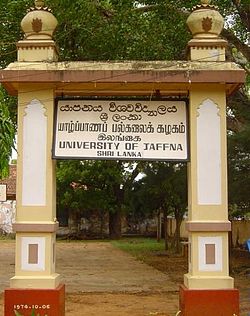
250px-University_of_Jaffna

JUSTA claims it is troubled by decisions of senior academics holding administrative responsibilities to overlook candidates with superior certified academic performances in favour of those with inferior records.
“The major criterion for selection to an academic post is academic excellence. This is because University is the highest seat for learning and its teachers do not teach from text books alone,” JUSTA said in its appeal.
JUSTA warns that selection on subjective criteria such as interview and performance easily becomes the means of abuse to favour those with superior connections and influence at the expense of persons from humbler backgrounds who have shown superior ability.

“Once this abuse takes root, the character of the University suffers, as those selected become increasingly beholden to those in authority,” the appeal said.

The Appeal to the Vice Chancellor has the support of 86 persons of the Jaffna University, including 69 members of the academic staff.

We publish below the letter in full;

University of Jaffna,
4th December 2013.
To:The Vice Chancellor, Members of the Council and Well–wishers of the University,

Selection to Academic Positions in the University

Selection to academic positions is the task of mainly senior academics holding administrative responsibilities: the university community and the public rightly expect that this obligation is discharged conscientiously. Regrettably, we are more and more troubled by justifications from these same senior academics for overlooking candidates with superior certified academic performances, in favour of those with inferior records. The reasons frequently given – the selected candidate performed “superbly” in the interview or the candidate’s presentation was “superb” – point to the selectors trying to cover up something seriously amiss that troubles them. Current selections will determine the academic standing of the University, and its intellectual environment, for many years to come. It is now time to refresh our minds on the criteria for selection to academic positions.

The major criterion for selection to an academic post is academic excellence. This is because University is the highest seat for learning and its teachers do not teach from text books alone. They should continually update their knowledge and prepare their students accordingly. They should capture new outcomes in their research fields and apply them in their own work. A person who had absorbed what was taught over four years and applied it well in answering questions regularly set at examinations should be most suitable for the purposes given.

Hence as the first category for selection to the post of Lecturer (Probationary), the UGC has specified a First or Second Class (Upper Division) specialization in the relevant subject. Other categories are considered only when candidates in the first category are not available. When selections are made from other categories, the Council must justify it to the UGC.

UGC circular 935 states that “If the Selection Committee is not satisfied with the performance of candidate/candidates, but otherwise well qualified, such candidate/candidates be appointed as Temporary Lecturer/Lecturers for a period of one year and at the end of such period of such period they may be appointed as Lecturer (Probationary) having subjected to another interview and presentation”.

The Circular makes it clear that the certified record is the decisive criterion for selection. The presentation and interview are only to ensure that the selected candidate will not be a disaster as a teacher. It further makes it practically mandatory that the candidate having the best certified record be appointed in a temporary capacity, when there is some doubt about his capacity to teach and interviewed a year later. That makes plain the weight placed on qualification as opposed to presentation.

A Special Degree candidate has been tested in 120 credits using some 50 end-of-semester question papers (and numerous in-course assessments) by several tens of examiners. Each answer script has been marked twice by experienced examiners. The candidate had spent several hundred hours answering question papers in the examination hall. A first class is awarded based on this performance. In the selection board only Head of the Department is, in most cases, an expert in the subject. Is it that easy for such a board to reject the result obtained in the above manner and stamp a candidate as being unsuitable on the basis of a few questions fielded inadequately by the candidate during a brief interview lasting a few minutes?
To put it in another way: Whom should a board select to an academic post? A brilliant fresh graduate who did not do well in the presentation or one with an inferior record with better presentation skills?

We must further keep in mind that many years of war and migration have lowered the kind of exposure where students would pick up better English and present themselves more attractively. Under these circumstances it is incumbent on us to give students who have worked hard to overcome some of their handicaps and perform well during their four years at the University, their due opportunity to rise further. Selection on subjective criteria such as interview and performance easily becomes the means of abuse to favour those with superior connections and influence at the expense of persons from humbler backgrounds who have shown superior ability.
Once this abuse takes root, the character of the University suffers, as those selected become increasingly beholden to those in authority. 

01
Dr.A.Sivarupan Zoology
02
S.Selvarajan Maths & Stats
03
S.Arivalzahan Maths & Stats
04
M.R.R.Hoole Maths & Stats
05
N.Sivapalan Chemistry
06
K.Velauthamurthy Chemistry
07
K.Thabotharan Computer Science
08
G.Rajkumar Botany
09
M.Varathan Maths & Stats
10
A.Laheetharan Maths & Stats
11
K.Kannan Maths & Stats
12
Mrs.N.Satkunanathan Maths & Stats
13
Mr.B.Muraleetharan Maths & Stats
14
M.Khokulan Maths & Stats
15
M.Ananthakirishna Maths & Stats
16
A.Nithlavarnan Education
17
K.Sivarajah Marketing
18
K.L.Ramanan ELTC
19
J.Thevananth Financial Mgt
20
S.Anandasangari Financial Mgt
21
S.K.Kannathas ELTC
22
Ms.S.Srisatkunarajah Linguistics and English
23
Mr.N.Pratheeparajah Geography
24
Mr.S.Raveenthiran Geography
25
Mr.P.Akilan Fine Arts
26
Prof.K.Thevarajah Commerce
27
Dr.T.Manoranjan Chemistry
28
Mr.S.Ketheeswaran Library
29
N.Sivakaran Philosophy
30
S.Sivakanthan Sociology
31
R.Rajeshkannan Sociology
32
S.Rajeswaran Geography
33
A.S.Sosai Geography
34
E. Ratnam Marketing
35
T.Karunakaran ELTC
36
Miss.S.Sithamparanathan Physical Education Unit
37
G.D.Mathiyalagan Physical Education Unit
38
Ms.E.Arulmpalam Physical Education Unit
39
Ms.S.Shasiharan Physical Education Unit
40
Dr.C.C.A.Sivapalan Linguistics & English
41
Ms.S.Sivamoorthy Linguistics & English
42
Mr.S.Wimal Linguistics & English
43
Dr.V.Suntharesan ELTC
44
Dr.M.Saravanapavan ELTC
45
Dr.T.Sanathanan Fine Arts
46
D.Arthe ELTC
47
Mrs.J.Rasanayagam Education
48
Mrs.V.Ravishankar Economics
49
Mrs.P.Muraleetharan Accounting
50
Ms.P.Sivapalan Accounting
51
Ms.T.Kanagalingam Accounting
52
Mr.J.Aloy Niresh Accounting
53
Mr.S.Gobinaath Mathematics & Statistics
54
Mrs.K.Hoole Library
55
Ms.S.Arulanantham Library
56
Dr.T.Kalamany Education
57
Prof.M.Sinnathamby Education
58
Prof.K.Sivananthamoorthy Philosophy
59
Mrs.S.Krishnakumar History
60
Mr.T.Arunakirinathan ELTC
61
Dr.K.Arunthavarajah History
62
N.Ravimannan Botany
63
N.Sabananthar Botany
64
C.Arunagirinathan Botany
65
A.W.Jeevanarajah Botany
66
Kothai  Seker Botany
67
T.Poojithreyi Botany
68
P.Auvai Botany
69
S.Subaragini Botany
70
S.Navaneethan Botany
71
A.Revathie Botany
72
P.T.J.Jashothan Botany
73
R.Selvarthnam Botany
74
B.Ragulan Botany
75
S.Ida Botany
76
S.Dalini Botany
77
J.Nandakumar Botany
78
A.C.Thavaranjit Botany
79
Mrs.M.Visakarooban Library
80
A. Ramanan Computer Science
81
J.P.Jeyadevan Chemistry
82
Dr.G. Sashikesh Chemistry
83
Dr.(Mrs).J.Prabagar Chemistry
84
Dr.P.Iyngaran Chemistry
85
Mrs.R.Senthooran Chemistry
86
Dr.P.Abiman Chemistry

Monday, January 13, 2014

SB reverses reason

Reducing of the duration of AHS degree

, the island

article_image
By Dasun Edirisinghe

Higher Education Minister S. B. Dissanayakas yesterday admitted that his decision to reduce the four-year Allied Health Sciences (AHS) degree programme to three years had been made under pressure from the Government Medical Officers’ Association (GEOF).

Minister Dissanayakas told a public meeting in Kandy that the GEOF had opposed the four-year degree and did not allow AHS students to do clinical practices at respective teaching hospitals.

At present, AHS students from the Peradeniya and Ruhuna Universities are staging a Satyagraha at Galaha junction and Galle town respectively and boycotting lectures to protest against the reducing of the duration of the degree.

Minister Dissanayakas said that Vice Chancellors of universities, University Grants Commission (UGC) or Higher Education Ministry could not reverse the decision owing to pressure from the government doctors.

Dissanayakas told The Island few months ago that his ministry had consulted the University of Wales in the United Kingdom when designing the AHS course. The Wales course was also three years. Deaking University of Australia also offered a three-year nursing degree. The Singapore State University’s nursing degree was also a three-year course.

President of the AHS Students’ Union Ranitta Prasad yesterday asked the minister whether a trade union could meddle with the policies of the Higher Education Ministry and the UGC. He accused the minister of simply passing the buck to the GEOF.

"We will not give up our protest until winning the four – year period for our degree," Prasad said.

Meanwhile, Vice Chancellor of the Peradeniya University Prof. Athula Senaratne said that the Allied Health Sciences Faculty would be closed indefinitely if undergraduates did not return to lectures today.

The new degree courses started in 2006 in Peradeniya, Colombo, Sri Jayewardenepura, Eastern, Rajarata and Ruhuna universities were of a four year duration. The UGC and Higher Education Ministry decided to cut it down to three years from 2009, but it was delayed due to students’ protests.

Wednesday, January 8, 2014

The Grade 5 Scholarship Exam and psychological stress What are the alternatives?

A psychiatrist’s point of view

, The Island

article_image
By Dr. Sajeewana Amarasinghe

Psychiatrist, Base Hospital,Puttalam.

The Education Minister’s proposal to do away with the grade 5 scholarship exam created a huge uproar in the country. Apparently the National Educational Commission took this decision taking into consideration the psychological impact of this exam on primary school children. But many thought this was an attempt to block the only pathway available for a talented rural child to enter a prestigious school in a major city. As a provincial psychiatrist working in one of Sri Lanka’s most underprivileged districts I certainly agree that scrapping the scholarship exam will be a drastic step that will have serious socio economic implications. But I believe that we need to make some adjustments to this exam to reduce the immense psychological burden on primary school children.

Many children in grade 4 and 5 present to me with vague physical complaints like headache and abdominal pain. They have been investigated by paediatricians and no medical basis found for their symptoms. The parents will often tell how their easy going and lovable child has recently become irritable and moody. They throw temper tantrums at the slightest provocation. When I interview the child alone it becomes clear that most of them have got anxious due to the impending scholarship exam. Many parents have little idea of their child’s scholastic abilities and push children to achieve unrealistic goals. The child becomes worried that he or she will not be able to fulfill the parent’s high expectations.

During the last two decades the grade 5 scholarship has become extremely competitive. The huge media publicity given to the top scorers has made things worse. Most parents who have missed out at grade 1 try to use the scholarship exam to get admission to a popular school. One cannot blame them as it is the only mechanism available to an ordinary parent with no connections. But, a child needs to score at least 90 percent to enter one of the more popular schools. This is a big task for a 10-year-old child as it leaves very little margin for error.

Therefore, many parents push their kids to the maximum and send themto two or even three tuition classes. All extracurricular and leisure activities are stopped and thechild is forced to cram for long hours. Most 10-year-olds are naturally quite playful and not too keen on studies. Therefore this exam creates a great deal of anxiety and some may actually need psychological intervention. Of course, there will be some very mature kids who will study independently and get good results. But these children are usually the exception rather than the rule. Most children will have to be forced to study at this age!

I think the main cause of the stress for both children and parents is the intense competition to enter a popular school. An increase in the slots available in the popular schools will be a major step to reduce the competition. Most of the leading government schools have around 50 children in a primary class. Therefore, the number of places available for scholars in Grade 6 has declined.

The minister of Education hopes that with the development of 1,000 secondary schools the need to enter popular schools will not arise. But we need to remember the fact that only very few recently established schools have reached the level of the old traditional educational institutions. This too was due to the efforts of their pioneering principals. Many new schools started with much fanfare wither away after a few years. Therefore it is left to be seen whether any of these newly developed 1000 schools can match the old established schools.

I believe that the improvement of the well-established provincialcentral schools and semi urban schools to national standards may help reduce the high demand for city schools. In today’s context this will involve the improvement of facilities for education as well as sports and extracurricular activities. In this context a good example is Rathnavali Balika Vidyalaya, Gampaha which has consistently produced outstanding results at the national level at public examinations in recent years. Now many parents living in Gampaha opt to keep their children in this school even if they get the opportunity of getting admission to a Colombo school. I believe the establishment of around 50 well equipped provincial schools on par with the popular schools will lead to a reduction in the intense competition.

If the government gives continuous support these schools too will gradually develop their own reputations as centres of excellence and start their own old boy and old girl networks! This will probably be more practical than attempting to establish 1,000 popular schools when we consider the limited resources in our country.

The Education ministry decision to simplify the exam seems to be a step in the right direction. But it is left to be seen whether this will actually reduce the stress on children. Giving a very easy paper might result in the cut off marks to enter a popular school reach very high levels. (e.g. 99% or 100%) This will intensify the stress as there will be absolutely no margin for error! It will also make it difficult to pick out the really brilliant kids as many will score very high marks.

Instead the scholarship exam should be modified to reduce the amount of rote learning needed. It should be a test of academic potential rather than of knowledge. The focus needs to be on testing intelligence, language skills and mathematics. This will probably reduce the need for attending multiple tuition classes and long hours of cramming. It will also improve the identification of truly gifted children.

We have to accept that the selection at the current scholarship exam is by no means perfect. Many children who pass the scholarship with flying colours fail to perform well at higher exams. The obverse is also true as there are many who perform poorly at the grade 5 scholarship exam but do well at the Advanced level exam.A look at the top performers at the recent AL examinations will show that many children from rural schools have outperformed their city counterparts. Most of these children have missed out on entering a prestigious school at the grade 5 scholarship.

Some advocate a postponement of the scholarship exam to grade 8. This proposal has some merit as the child will be more mature and ready to face a competitive exam. Hopefully, the involvement of parents, too, will become less intense! Parents may also have a better idea of the child’s academic potential. This will prevent academically average children getting unnecessarily harassed to achieve goals that are way beyond their capabilities.

The education ministry should also consider introducing a formal pathway whereby rural school children who excel in sports and extracurricular activities too could enter a leading school. A certain number places in popular schools could be reserved for children who excel in sports and other extracurricular activities such as music and dancing. This probably needs to be done around grade 8 or 9 in order to pick out the really talented kids. It will create an alternative pathway for children who are not academically inclined. Of course, this already happens in an informal manner even now as some big schools recruit outstanding sportsman from smaller schools by offering scholarships. Even some of the exclusive private schools are known to do this. But it is unfortunately restricted to the glamour sports like Cricket and Rugby.

Although I don’t agree with the proposal to scrap the scholarship exam I am glad that the Education minister and his officials have some understanding of the psychological impact of this exam on children. I hope that they will modify this exam so that primary school children can enjoy their childhood without the undue burden of a highly competitive exam.

Friday, January 3, 2014

FUTA Media Statement on suspending Grade 5 Scholarship

The North’s AL ‘high’ and the ‘gratitude’ factor

 , The Island

article_image
By Lynn Ockersz

May be, if Sri Lankans stop ‘honouring’ politicians and refrain from paying veritable ritual homage to them, politicians may get it into their heads not to expect the public to be beholden to them for whatever reason. An issue bedeviling the Lankan public is that they do not adequately exact accountability from those they vote into public office. May be due to a semi-feudal mindset, sections of our public hero-worship politicians who do not constantly remind them that they are public servants with the mandate to go the extra mile in serving the people. Politicians need to be judged on the basis of how effectively they carry out their duties and they must be seen as succeeding or failing purely on this foundation. None could be viewed even appreciatively merely because they hold public office.

Youngsters of the North are undoubtedly reaping a ‘bountiful harvest’ in these post-conflict times in the form of noteworthy academic achievements. As is known, the highest success rate at the latest GCE Advanced Level examination comes from the Northern Province and it is plain that this should be attributed, to some measure, to the stable law and order situation the military elimination of the LTTE by the Lankan security forces made possible.


But it would be relevant to remember that the youngsters of the North have always enjoyed a reputation for academic distinction. It is possible that they would have scored even more impressively at the AL examination if the ‘ground situation’ permitted unhindered academic activities over the years. These facts need to be borne in mind when assessing the causes that could have led to the Northern Province leading from the front as regards the success rate at the recent AL examination.

But it needs to be accepted that until recently, the highly volatile law and order situation in the North-East rendered sustained academic pursuits by northern primary and secondary students very difficult and credit must be given to the Lankan law-enforcement authorities for the effective management of the security situation in the relevant areas over the years. If not for the currently prevalent stable law and order situation, schools and educational institutions would have encountered continual difficulties in operating in the North, and the noteworthy successes achieved by the secondary school students of the North are substantial proof that a high degree of normalcy has been brought about in Northern civilian life since May 2009.

The right-thinking of this country, to be sure, need to be appreciative of the role the Lankan security forces and police played in improving Sri Lanka’s law and order situation, but it does not follow from this position that the security forces’ presence in the North should not be progressively reduced from now on. In proportion to which normalcy is brought to the North, the troop presence there, for instance, must be brought down and this point must be borne in mind by the authorities. Ideally, law and order functions must revert entirely to the police and it is such a situation which is fully synonymous with normalcy. Until then, it cannot be claimed that absolute normalcy has returned to the North.

Accordingly, the stark contradiction between militarization and normalcy must be recognized by the Lankan state. If ‘terror’ is no more in the North, a state military presence would be meaningless and superfluous. The state should draw the relevant inferences from this anomaly and do what is needed to further ease the lot of northern civilians.

Meanwhile, while it is only right that the state and the Lankan public should be appreciative of the role played by our law-enforcers in establishing internal law and order, it would be questionable, from an ethical viewpoint, to expect the people of the North to be ‘grateful’ to the law-enforcers and connected quarters, for discharging these tasks which they are obliged, in terms of their mandates, to accomplish. While the role of the law-enforcers must be appreciated, it would amount to demeaning any section of the Lankan public to expect it to be ‘grateful’ to an official quarter for services the latter is expected to perform, in terms of its responsibilities. However, the point is taken that most law-enforcers acted selflessly and courageously during the armed conflict in the North-East. Countless numbers of these personnel laid down their lives for the people and for this they must be saluted by the country.

These observations need to be made in view of the opinion in some sections that ‘gratitude’, rather than appreciation, is due to those who handled the law and order situation in the North over the past few years and who, thereby, enabled academic activities to be pursued uninterruptedly.

However, the same line of thought applies to those governmental quarters which wax lyrical about the relief they claim they have brought to the North. It needs to be understood that the governments of Sri Lanka were, and are, obliged to serve the public of this country, wherever the latter may reside. Governments are elected to office to do just that. They are expected to selflessly and impartially serve the public and cannot expect the people of this country to be beholden to them. The services of conscientious political leaders may, perhaps, be appreciated, if there are any among us. This is not synonymous with anyone being ‘grateful’ to them for functions they are duty-bound to perform.

May be, if Sri Lankans stop ‘honouring’ politicians and refrain from paying veritable ritual homage to them, politicians may get it into their heads not to expect the public to be beholden to them for whatever reason. An issue bedeviling the Lankan public is that they do not adequately exact accountability from those they vote into public office. May be due to a semi-feudal mindset, sections of our public hero-worship politicians who do not constantly remind them that they are public servants with the mandate to go the extra mile in serving the people. Politicians need to be judged on the basis of how effectively they carry out their duties and they must be seen as succeeding or failing purely on this foundation. None could be viewed even appreciatively merely because they hold public office.

We, the public, could make some changes to this political culture of near servility to the office bearer and the perceived top decision- makers, by giving them less importance in our consciousness and in our day-to-day lives. To begin with, the public could refrain from inviting politicians and others holding top public office, to our each and every function and public occasion, regardless of the nature of these events. Why, for instance, should politicians and numerous ‘hangers-on’ and officials be invited to religious and cultural events about which they may know nothing or very little? Why should they be asked to ‘sign’ at weddings? Why should they be invited to school events to which they may have no relevance?

Needless acts of this kind on the part of the public, which bespeak an attitude of servility towards politicians and the like, among other things, create an environment of impunity, wherein politicians engage in power abuse and other misdemeanours which progressively disempower citizens and render them pliant tools in the hands of those who are seen as powerful.

Hopefully, civil society would forthrightly address these issues and launch the necessary remedial action. We need to create a political culture which will enable the people to consistently empower themselves in relation to those who are bent on power abuse. However, those persons deserving public recognition and appreciation need to be always given their due. But being beholden to them is clearly an abnormal state of mind.


Tuesday, December 31, 2013

Free education and poverty alleviation


article_image
by Sompala Gunadheera, the island

I admire my colleague, Dr. P. G. Punchiheva’s dedication to our mutual roots as evinced by his letter to The Island of December 28,under the title "Scrapping of Grade 5 Schol Exam: some issues". I have myself expressed my reservations on the proposed move to cancel the Fifth standard scholarship examination in my article on ‘I without FYE’, appearing in The Sunday Island of Dec. 29.

But, I have not dealt with the stipend normally paid to children below the poverty line when they get through the examination. Perhaps, it was called ‘scholarship examination’ because of this payment. Children whose families were above a specified monthly income did not receive the stipend. Others who passed it had only the advantage of moving into a better school.

Speaking for myself, the stipend made no difference until I was admitted to a hostel and scholarship money was used to maintain it. Until such time the award had got lost in my father’s budget, after a part of it was deducted as contributions to the school, thus heralding a practice that is rampant today. In any case, the payment did not make much difference to me. Judging from the rush to go home for the weekend, conditions at home might have been better than at the hostel for most of us. The stipend really stood me in good stead only after I was relocated to a school to which travelling was expensive and inconvenient.

In any case, poor law was in the embryo when the Father of Free Education formulated his Scheme. His principal aim was to make higher education accessible to the poor. He was perceptive enough though, to realise that, the concession would make no difference to a hungry child. Thus, the stipend was calculated to be an ancillary support. Such provision became superfluous after financial support was provided across the board to every family below the poverty line. After Samurdhi the scholarship became a double payment. Such payment would intensify competition causing jealousy in the environment and tension in the child, avoidance of which appears to be a main objective behind the abolition of the FYE.

Under the proposed Scheme the new exam becomes a tool of admission to the Central School. Poverty alleviation is no longer its problem. What comes under the education sector now is provision for the dropouts left in the feeder schools and enhancement of facilities for the successful. In the matter of providing facilities, all who get into the Central School are on an equal footing after getting in there. Their needs have to be dealt with on the merits of each case. They are lucky that such needs have been personally recognized by the Head of State in making provisions in the 2012 Budget.

In an article, "Helping poor children - ensure delivery on target" published in The Island on November 18, 2012, I made the following remark: "It warmed the cockles of my heart to hear the recent Budget offering nourishment, extra clothing and new shoes to the destitute children of schools in the backwoods".

Observing that the budget provision might not be spent efficiently, unless a new and effective setup was established in the concerned schools with an eagle-eyed manager at the top of it to supervise delivery, I suggested a gender representative panel of two to make a joint recommendation after a confidential individual interview for selecting beneficiaries. "Let the budget provisions be credited to a Welfare Fund in each school. It is likely that well-wishers of that institution, particularly its old pupils who are grateful to their alma mater for the positions they now hold in life, would be happy to contribute to the Fund".

More than a year after the budget provision, the Ministry of Education does not appear to have taken any meaningful action to organise a delivery system that could maximise the bonanza for the benefit of deserving children up to now.

In the meantime, I issued a standing order to my bank to remit a certain sum of money from my monthly pension to be paid to five students in the name of five of my favourite teachers and called for a confidential report on the beneficiaries at the end of the year. The annual report stunned me. Payment had been made to children who had failed to win scholarships but they had received double what the successful ones had got. Only one of those selected had come within the first ten in the class. Shockingly, one of them was the last! None had extracurricular attainments.

In the circumstance I suspended my SO and requested the school management to form a Welfare Fund as recommended above to which I could transfer the remittance. One year later, I still await a response. As a result, by now poor children of my old school have lost sixty thousand rupees that could have gone to supply their acute needs.

Friday, December 27, 2013

Why scrap the scholarship examination?

, the island

article_image
It is surprising that the vociferous proponents of free education are silent about the decision of the Minister of Education to scrap the fifth standard scholarship examination. It would seem that because government party politicians fill the prestigious schools with their supporters or those who can influence them, these prestigious schools do not have vacancies to take in those who pass the scholarship examination.

The entire rationale for free education is to ensure equality of opportunity for children from poor families to compete for the better quality education which was available earlier in the denominational schools. These schools were taken over by the government to ensure equality of opportunity. The education imparted in the urban schools with prestigious names is far superior to that in the rural schools despite the claims of government ministers that they will raise thousand schools to the same status.

Schools that are prestigious today gained that position through long years of dedicated service with access to good teachers and facilities. The rural schools are the preserve of political appointments and the teachers are poorly qualified if qualified at all. So there is no question of equating the education provided by the prestigious schools with that in the rural schools or less popular schools.

The question is whether these prestigious schools should be the preserve of the rich and the powerful or available to those who are best fitted to benefit from their education.

Education is just another form of investment: people invest in education, as they invest in anything else, to make more money—in the form of increased earnings in the future. So by providing access to these popular schools to those who pass the scholarship examination we will be providing for fairness and equality of opportunity. The great merit of free education was that it allowed the children from lower income urban and semi-urban families to access these popular schools. But this benefit did not spread to the rural families.

The fifth standard scholarship provided a mechanism for children who are good but whose parents are in lower income brackets to benefit from a superior education- an education which is scarce despite the promises of the politicians since independence to upgrade the schools in the outstations. Income per se should not matter for education decisions: Piyadasa will get less education than John because his parents are poorer and living far from the popular schools even if the income gains from education are the same for both.

Scarce places in popular schools should go to those talented and capable of benefiting from such education rather than those whose parents can afford to pay the fees or live close to the school. If parental income or nearness to a school ( also related to income level) plays such a vital role in determining educational investment, rich children will get a better education even if they are not particularly talented, and talented poor children may be deprived of a superior education.

Education should benefit those who are talented and a society that provides the opportunity for gifted children, deprived for whatever reason, of the benefit from the best education available in the country, will promote both economic benefits since those who can benefit from a superior education will be an asset while those who fill these schools and are unable to benefit from their education will be an economic waste. Similarly there will be social benefits when there is equality of opportunity irrespective of the level of incomes of their parents.

What is required is not to scrap the scholarship examination but to reduce the subjects and make it less dependent on the acquisition of knowledge and more on measuring intelligence and general knowledge.

Barbara Seneviratne says, ‘If the ministers of education past and present had any knowledge of child psychology this very competitive exam could have been considered not of any help to the child. They are made to cram only a few subjects. Those subjects are not relevant for the new class which they would attend the following year.’ Yes, the answer is to change the syllabus and make it more oriented to measuring intelligence and general knowledge.

R.M.B Senanayake


GCE AL 2013 results: NE Provinces gain top results due to four years of peace-UGC chief


article_image
By Shamindra Ferdinando, the island

Prof. Kshanika

Chairperson of the University Grants Commission Prof. Kshanika Hiriburegama yesterday observed that the Northern and Eastern Provinces did so well at the GCE Advanced Level examination in 2013 due to restoration of peace.

Prof. Hiriburegama told The Island that it was a clear sign that schools were able to function without hindrance since the conclusion of the conflict in May 2009.

Northern Province achieved the highest success rate of 63.3 percent while the Eastern Province recorded 60.1 per cent. Sabaragamuwa was placed second.

The Northern Province comprises Jaffna, Kilinochchi, Mullaitivu, Vavuniya and Mannar districts. The Eastern Province consists of Ampara, Batticaloa and Trincomalee districts.

Prof. Hiriburegama said: "Education is the backbone of a country and primary factor for development hence this year’s Advanced Level results is a clear sign of post-war progress in the field of education."

Responding to a query, Prof. Hirimburegama said that education had always been a priority for the northerners, particularly those living in the Jaffna peninsula. Those genuinely interested in post-war stability would be pleased by the Northern Province beating all other provinces to take the top post.

Earlier former Commandant of the elite Special Task Force (STF) Senior DIG Nimal Lewke in an interview with The Island said that the Tamil political leadership, Western powers as well as the LTTE rump should re-examine their position on the post-war situation.

Lewke said that the nation topping examination results meant that the eradication of the LTTE was having a significant positive impact on the northern and eastern communities.

Prof. Hirimburegama expressed the belief those foreign governments much concerned about post-war developments here would see the overall performances of the northern and eastern districts as a positive sign.

Sunday, December 15, 2013

Sri Lankan Universities In Dire Straits

By Darshani Wimalasuriya -

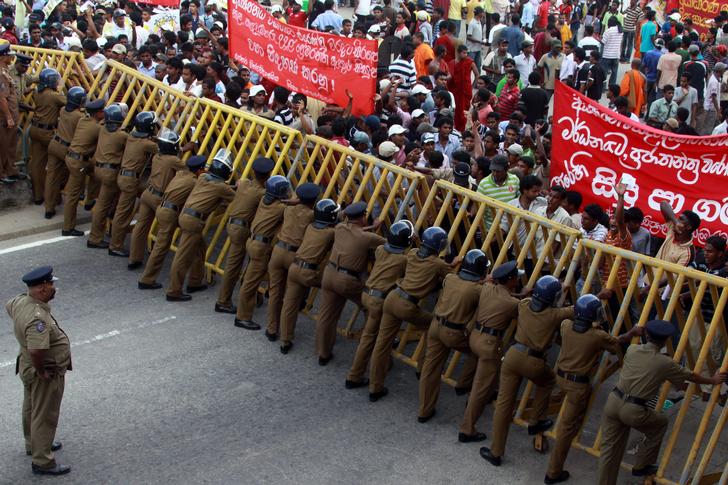
The standard of education, at Sri Lankan universities, is declining rapidly.  According to World ranking, local universities standards, are now below the universities of failed states in Africa. Major universities in Uganda, Ethiopia and Zimbabwe, are now in a superior position, than Sri Lankan universities. Instead of quality education, Sri Lankan universities are now focused on violence, extremist student politics, strikes, low productivity, and moral decay.
srilanka_university_students colombotelegraph

Mr. Navarathna Banda – a senior lecturer attached to the Sri Jayawardhanapura University, cites the reasons that have pushed our university system down, into this deplorable state. According to him, over 90 % of Sri Lankan university professors and senior lectures are under qualified, and inexperienced.
The majority of these university teachers, are working in the same universities where they graduated from, and do not possess any overseas exposure or experience. Academically, their knowledge and experience are stunted, limited and outdated. Therefore these university teachers are incapable of preparing their students, to face the educational challenges of the 21st century.
Over the last 30 years, our universities, failed to carry out any world class research, any validated scientific study, or produce a noteworthy publication, to capture the attention of the international academia. These shortcomings represent the void, in our universities. In order to cover-up these failures, Professor Naleen De Silva, recently carried out a research on Arsenic, at the Kelaniya University, violating all internationally accepted, research standards. It became the laughing stock, of the academic community.

Ragging & Violence in Sri Lankan Universities
Unfortunately, ragging and violence have become part and parcel of local university culture. Ragging involves harassment, abuse and humiliation of new students. It is a serious form of Human Rights violations. We believe that almost all Sri Lankan university students have faced such harassment, either physically or verbally, as first year students. So far, no one has disputed it, and we challenge anyone to come forward, and refute this statement.
For decades, brutal ragging has prevailed in Sri Lankan universities. And throughout, teachers could not, or did not want to put a stop to it. The   reasons are easy to understand; they too were victims of ragging during their days at university, and a majority of them, later turned into perpetrators themselves, as they became senior students. For them, it is a moral challenge, to prevent ragging in our universities. The other reason is that radical political groups are using ragging, as a political weapon, to control new students.
Sexual violence, and brutal physical ragging, is a hidden malaise amongst Sri Lankan universities. The Perdeniya University has the worst, reputation. The most infamous, and horrible case of sexual violence, was reported in 1975, from the Peradeniya University. A 22 year-old female student, Rupa Rathnaseeli, of the Faculty of Agriculture, University of Peradeniya, leapt off the second floor of the hostel -Ramanathan Hall, when a group of seniors, tried to insert a pen, into her vagina, as part of sadistic physical ragging.
Rupa, sustained serious injuries to her spine, became paralyzed, and confined to a wheel chair for many years. Her dreams were shattered, and her young life was wasted. In 1997, Rupa Rathnaseeli committed suicide. After this incident, the Peradeniya University authorities, made-up a story, in order to cover-up and conceal evidence. After her death, they conveniently forgot Rupa Rathnaseeli. Those guilty of committing this crime against Rupa, are administrators of the university today. Some are even Professors!
In 2011, three students from the Faculty of Arts, University of Peradeniya, were arrested by the Police, and produced before the Kandy Additional Magistrate, Mr. Ravindra Premaratne, for sexually assaulting a fresher. In another incident, three second-year female students, of the Faculty of Arts, University of Peradeniya, were charged with ragging a group of female freshers in a toilet. These female freshers, were stripped naked, during the ragging, and forced to perform, indecent sexual acts. The University authorities, imposed a three-week suspension, on these three female offenders.
According to an unofficial internal report, these three senior female students, sexually molested, a newcomer from the Gampaha District. The internal report further reveals, that the victim was afraid to lodge a complaint, with the university authorities, as they adopted a very lethargic approach, to female ragging incidents. Therefore no further charges were brought against, the perpetrators. Although these senior female students, had committed a serious sexual offence, they were able to participate in lectures, soon after the three- week suspension was lifted. Up to date, the authorities of the University of Peradeniya have not taken, any action against the perpetrators, and they mostly covered up, the incidents.
Similar incidents have been reported, from Ruhuna, Sri Jayewardenepura, Kelaniya and Sabaragamuwa Universities. The authorities there too, adopted the Peradeniya policy.
In other incidents; in 1993, an innocent student, named Chaminda Punchihewa, of the Ruhuna University, died, as a result of cruel ragging. He was viciously beaten, and forced to perform vigorous exercises, by senior students. In 1997, a first year female student, of the University of Ruhuna committed suicide following, intolerable ragging. She was subjected, to appalling sexual harassment. In 2011, Professor Susirith Mendis, Head of the Ruhuna University, informed the media, that a group of students, had physically ragged, a female student– Vathsala Kumudini De Silva. As a result of physical ragging, she became semi-paralyzed, in one limb.
In her autobiography, ‘Punarukthi’– (Rebirth), the   award-winning actress, dramatist and writer, Anoma Janadari, states that inhuman and degrading ragging, were imposed on students, at the University of Colombo. She further, writes that most of her female batch mates were subjected to, sexual harassments, by senior students, at the Colombo University.  Another former student, of the University of Colombo, (now completing her post graduate degree, at a university in Michigan) confirms, that in 2011, some senior students, of the Colombo University, splashed buckets of water, containing human feces, on freshers. She, further says, that inhuman and degrading acts, are committed at major universities in Sri Lanka, and no one is held, accountable.
The award-winning, Sri Lankan film and tele-drama actress, Yashoda Wimaladharma, reveals that she had to undergo, such brutal ragging, while at the University of Kelaniya, that it was an emotional shock, for her father, R. L. Wimaladharma, a lecturer, also at the Kelaniya university. According to Yashoda Wimaladharma, her father, could not bear the merciless harassment of his daughter, and suffered a heart attack.

Student Unions  
Sri Lankan Universities have student political groups, manipulated by extremists. When a new batch of students arrives, at the University, they are intimidated and threatened with physical ragging, by the seniors. Often, the new students are not even allowed, to have a dialog with, the university lecturers, not allowed ask questions at lectures, not allowed to take part in English courses, and not allowed to use the university library, by these extremist, student unions.
The freshes, are forced to wear inexpensive clothes, and are not allowed to wear shoes. In some universities, they are not even allowed, to take a shower, nor clean themselves, after using the toilet, for several weeks. In some universities, the students are not allowed to drink beverages, like Coca Cola. This ‘prohibition’, was vigorously implemented, at the Universities of Colombo, and Kelaniya.
The senior students, of the Sri Lankan universities, use physical and sexual harassment, to control newcomers. Commonly used methods, include, sexual violence, forcibly stripping naked, forced masturbation, forced oral or anal sex, sexual simulation, urinating on victims, inserting pens and candles into the victim’s anus or vagina, smearing tooth paste or Marmite, on the victim’s genitals, prohibiting underwear, for both male and female, ‘bucketing’ or throwing water, containing animal, or human feces, insulting with profanity, interrogating  victims, with profane questions, forced to repeat, profane words or sing such songs, in the presence of a group etc.
Although rape, and sodomy are rare, recent reports indicate, that these forms of extreme violence, are gradually emerging, in Sri Lankan Universities.
Student political groups, use ragging as a weapon, to control new students, and to indoctrinate them. There are, unmentionable Human Rights violations, occurring within, the local university system, and many Professors, and other authorities, maintain silence. Most sexual, and physical harassment, are covered up, by the university establishment, and the general public, is unaware, of most of these horrible incidents, that take place, within these educational institutions.
Majority of university lecturers, do not want to get involved, in internal politics, or are fearful of making enemies, with extremist student groups. Most of the above mentioned, inhuman acts of ragging, take place, before their very eyes, and yet, they do nothing to stop it. Therefore many university teachers, turn a blind eye, to these incidents, and move away. Professors, and lecturers who openly opposed ragging, were subjected to numerous types of violence, and some, were compelled to leave the universities, for their safety.

The Poor State of Sri Lankan Medical Faculties  

At one time, Sri Lankan medical schools produced the best doctors, recognized internationally. Unfortunately, this has not been the case, over the past few decades. According to a leading Sri Lankan medical doctor, who is workings, as an associate Professor, in an American university, the standards, of Sri Lankan medical faculties, have declined.
The majority, of Sri Lankan doctors, who graduated over the past few decades, have a very poor knowledge, of English, therefore unable to communicate, effectively and professionally.  He, further says, that Sri Lankan doctors lack attitudinal training, medical ethics and accountability, towards their patients. According to international ranking, of medical schools, many medical schools, of the 3rd world countries, such as Nigeria, Nepal, India, and Tanzania, have surpassed the Sri Lankan, medical faculties.

Sri Lankan Universities are Virtually Dead
“Sri Lankan Universities are virtually dead”, says a senior lecturer, attached to, the University of Colombo. According to him, qualified professors, prefer overseas universities, in their search for, prosperous job opportunities. Only the old and inefficient academics are trapped, in the local university system.
Majority of Sri Lankan University Professors, and senior lecturers, do not have the desire, to improve, the quality of the local universities, or stop sadistic ragging. They refrain, from sending their children, to local Universities. Their children therefore, attend universities in the United Kingdom, United States, Canada, and Australia, New Zealand etc., thus creating a huge academic and intellectual void, in local universities.

Student Heroes
When academics, and university authorities failed, in their responsibility, several student leaders, took courageous measures, to stop ragging and sexual harassment, in the local universities. One such example was, Ovitigala Vithanage Samantha- a third year Management student, of the University of Sri Jayewardenepura. He was, a charismatic student leader, who launched an anti-ragging campaign, at the university, and soon, other universities too, were inspired, by his humane crusade.
A group, of student extremists, killed Ovitigala Vithanage Samantha, on 7th November 2002. He was, viciously assaulted, at the university premises, and his head was smahed, with a computer terminal. One of his killers, who masterminded the murder – Sujith Kuruwita, used his political connections, to evade charges, and today, he is at large. After Ovitigala Vithanage Samantha’s death, his humane campaign, lost its voice, and once again, violence and sadism, overcame Sri Lankan universities.
www.lankauniversity-news.com
Sri Lankan Universities are Below African Universities 
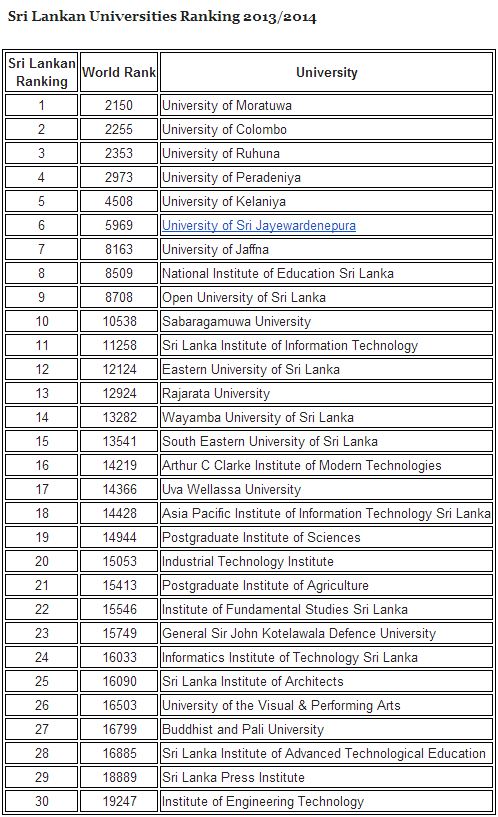
African Universities are, now internationally better recognized, than Sri Lankan Universities. According to 2012 World University Ranking, Makerere University (Uganda), occupies the 1174 place, demonstrating a superior educational quality, than Sri Lankan higher education institutes.  Ironically, Idi Amin’s Uganda, has easily defeated, the leading universities of Sri Lanka. According to the 2012 World Ranking, University of Moratuwa is at 2150, University of Colombo- 2255, University of Ruhuna -2353, and University of Peradeniya -2973. Hence these local universities, now represent, a very low level, of international ranking.
While Sri Lankan universities, struggle with their poor standards of education, Polytechnic of Namibia, has reached the 1319th place, Sudan’s University of Khartoum- 1394, University of Nairobi- 1435, Mansoura University of Egypt-  1685, University of Ghana-Ethiopia’s Addis Ababa University- 1903, Tanzania’s University of Dar Es Salaam- 1977,and Sudan‘s University of Science & Technology- 2020. Most of these African countries have low literacy rates, compared with Sri Lanka. But they have defeated, all our local universities, in the international arena.

Need Action
Regrettably, Sri Lankan Universities have been on the decline, both morally and academically, over the last four decades. There was a time, when Sri Lankan universities, were the shining examples, of higher education, and academic leadership. Unfortunately, the quality of education and research work at these universities, have declined drastically. Today, Sri Lankan universities are, lagging far behind.
Urgent measures are needed, to put an end to, physical and sexual violence, in our universities, and the standard of education, must be improved. Recently, the Minister of Higher Education, S.B Dissanayake told the media that, he intends to invite, overseas students, to Sri Lankan Universities. With the prevailing low standards of education, at our universities, violance and frequent strikes, within our university system, foreign students might think twice, about coming to further their education, in Sri Lanka.
Education is not a privilege. It is a Human Right. Higher education is the only hope and salvation for Sri Lankans, so let it not be destroyed!

Thursday, December 12, 2013

Selection to Academic Positions in the University


University of Jaffna,
4th December 2013.

To: The Vice Chancellor, members of the Council and well–wishers of the University,


Selection to Academic Positions in the University

Selection to academic positions is the task of mainly senior academics holding administrative responsibilities: the university community and the public rightly expect that this obligation is discharged conscientiously. Regrettably, we are more and more troubled by justifications from these same senior academics for overlooking candidates with superior certified academic performances, in favour of those with inferior records. The reasons frequently given – the selected candidate performed “superbly” in the interview or the candidate’s presentation was “superb” – point to the selectors trying to cover up something seriously amiss that troubles them. Current selections will determine the academic standing of the University, and its intellectual environment, for many years to come. It is now time to refresh our minds on the criteria for selection to academic positions.


The major criterion for selection to an academic post is academic excellence. This is because University is the highest seat for learning and its teachers do not teach from text books alone. They should continually update their knowledge and prepare their students accordingly. They should capture new outcomes in their research fields and apply them in their own work. A person who had absorbed what was taught over four years and applied it well in answering questions regularly set at examinations should be most suitable for the purposes given. Hence as the first category for selection to the post of Lecturer (Probationary), the UGC has specified a First or Second Class (Upper Division) specialization in the relevant subject. Other categories are considered only when candidates in the first category are not available. When selections are made from other categories, the Council must justify it to the UGC.

UGC circular 935 states that “If the Selection Committee is not satisfied with the performance of candidate/candidates, but otherwise well qualified, such candidate/candidates be appointed as Temporary Lecturer/Lecturers for a period of one year and at the end of such period of such period they may be appointed as Lecturer (Probationary) having subjected to another interview and presentation”.

The Circular makes it clear that the certified record is the decisive criterion for selection. The presentation and interview are only to ensure that the selected candidate will not be a disaster as a teacher. It further makes it practically mandatory that the candidate having the best certified record be appointed in a temporary capacity, when there is some doubt about his capacity to teach and interviewed a year later. That makes plain the weight placed on qualification as opposed to presentation.

A Special Degree candidate has been tested in 120 credits using some 50 end-of-semester question papers (and numerous in-course assessments) by several tens of examiners. Each answer script has been marked twice by experienced examiners. The candidate had spent several hundred hours answering question papers in the examination hall. A first class is awarded based on this performance. In the selection board the Head of the Department is, in most cases, is an expert in the subject.

Is it that easy for such a board to reject the result obtained in the above manner and stamp a candidate as being unsuitable on the basis of a few questions fielded inadequately by the candidate during a brief interview lasting a few minutes?

To put it in another way: Whom should a board select to an academic post? A brilliant fresh graduate who did not do well in the presentation or one with an inferior record with better presentation skills?

We must further keep in mind that many years of war and migration have lowered the kind of exposure where students would pick up better English and present themselves more attractively. Under these circumstances it is incumbent on us to give students who have worked hard to overcome some of their handicaps and perform well during their four years at the University, their due opportunity to rise further. 

Selection on subjective criteria such as interview and performance easily becomes the means of abuse to favour those with superior connections and influence at the expense of persons from humbler backgrounds who have shown superiorability.

Once this abuse takes root, the character of the University suffers, as those selected become increasingly beholden to those in authority. 

JUSTA