Wednesday, March 5, 2014


Thursday, February 20, 2014
ADYAPANA 2014 with LECS, Higher Education Ministry and S. Thomas College
Absence of Private Universities Act stifling Sri Lanka’s progress - govt.
February 19, 2014, 9:31 pm
, The IslandAbsence of Private Universities Act stifling Sri Lanka’s progress - govt.

by Zacki Jabbar
At the ADYAPANA 2014 launch: From left, Senior Manager LECS, Husnie Rauf, General Manager LECS,Aasim Mukthar,
Treasurer
S. Thomas’ College Mount Lavinia Old Boys Association, Shanil
Jayasekara, Warden, S. Thomas’ College, Mt. Lavinia, Prof. Indra de
Soysa, Ministry of Higher Education Secretary Dr. Sunil Jayantha
Navaratne, Managing Director LECS, Arjun Dharmadasa and Mohammed
Isthiquar, Business Development Manager, BCAS Campus - Gold Sponsor.
Sri
Lanka has the potential to become a hub for educational excellence,
but its inability to introduce a Higher Education Act with provision to
regulate private universities was a huge drawback, a senior government
official said.
Higher Education Ministry Secretary Sunil Jayantha Navaratne, addressing the launch of ADYAPANA 2014,
at the Cinnamon Grand last week, lamented that disruptive forces
including the Government Medical Officers’ Association (GMOA) were
preventing the New Higher Education Act which had already been drafted
from becoming law.
Asked how Sri Lanka could
become a hub of educational excellence when the Malabe Private Medical
College (MPMC) was unable to function even many years after it had been
issued a licence, Navaratne replied that initially there had been a
drawback as the college did not have a hospital of its own, but that
had been overcome and it was now ready to offer medical degrees. "The
GMOA has been unreasonably opposing the MPMC. Around 15,000 students go
abroad annually for higher studies. The establishment of private
universities will help save valuable foreign exchange. The Pali
University has been able to attract around 1,000 foreign students. This
shows that if the right environment and necessary laws are in place,
we could become an international hub for educational excellence."
When
pointed out that there were many other organisations apart from the
GMOA which opposed private universities, Navaratne said: "Protests are
to be expected in a democracy, but we will overcome them and establish
more seats of higher learning. The media has a crucial role to play in
changing negative perceptions."
ADYAPANA 2014
organised by the Presidential Award winner Lanka Exhibition and
Conference Services (LECS),in collaboration with the Higher Education
Ministry, is scheduled to be held for the ninth consecutive year from
September 26 to 28 at the BMICH. The S. Thomas College Old Boys’
Association teamed up with the exhibition from last year. The
Batticaloa Edition has been fixed for later this year. ADYAPANA KALVI was conducted in Jaffna last month.
S.
Thomass College Warden Prof. Indra De Soysa said that flexibility was
the key to progress."ADYAPANA with a wide range of courses to offer,
would not only provide the much needed flexibility that school leavers
looked for, but also provide them with career guidance counselling."
Managing
Director of LECS Arjun Dharmadasa said that they were confident of
attracting students from many countries including the Maldives to the
exhibition which would be held immediately after the conclusion of the
GCE A/L. "It provides immediate higher education opportunities. Around
12,000 students visited ADYAPANA last year. There were well over
150 stalls displaying information of various courses, student
programmes, higher education options and job opportunities. Despite the
high level of competition and options available in the field of
education, many students have continuously patronised our fair which
has helped them pursue their visions successfully."
General
Manager of LECS, Asim Mukthar noted that the Exhibition would feature
specific pavilions for visiting universities and special sessions by
top professionals focused on students and their career decisions.
ADYAPANA
has through the years built a reputation of having one of the highest
student turnover rates, he said. This year’s event will comprise many
other attractions focused on the growing student population and provide
the visitors with value additions, he added
Tuesday, February 18, 2014
Undergrads build up protest momentum
February 17, 2014, 10:11 pm , the islandBy Dasun Edirisinghe
Undergraduates from all universities have planned protests in Galle and Colombo today and on Feb. 20 against reducing the Allied Health Sciences (AHS) degree programme from four years to three and disrupting their agitations.
Addressing a media conference in Colombo yesterday, Convener of the Inter University Students’ Federation (IUSF), Najith Indika said that AHS students attached to the Karapitiya Medical Faculty had been staging a sathyagraha against the reduction of the duration of their degree course opposite the Galle bus stand and it would reach the 50th day today.
"We have organised a protest in Galle to coincide with our Sathyagraha entering its 50th day," he said, adding that the university authorities had not yet heeded the pleas of AHS undergraduates.
Indika said that another sathyagraha was being held at the Galaha Junction by the AHS undergraduates of the Peradeniya University.
The protesters have also organised a protest march to the University Grants Commission (UGC) and a demonstration on Thursday (20).
He said they would not give up the ongoing sathyagraha opposite the Rajarata University in Mihintale against the suspension of 27 undergraduates.
Are Our Universities Keeping Out Our Best?
By Arul K. Selvaratnam -

Prof. Carlo Fonseka in his article admits to encouraging the Hooles
to return and explains, “In a system with many mediocrities those of
exceptional quality make the mediocre look ugly! So the mediocrities do
their damndest to eliminate the truly exceptional.”
At a time when our universities badly lack qualified staff and are
trying to rebuild themzelves, a Selection Committee meeting on Jan. 30
2014 found Prof. S. Ratnajeevan H. Hoole
unqualified for the post of Professor of Computer Science on all the
measures specified by the UGC’s Circular 916. So says the report of the
Selection Committee consisting of Prof. V. Arasaratnam (VC), Prof. S.
Srisatkunarajah (Dean/Science), Dr. E.V.A. Charles (Head/CS), Prof. N.D.
Kodikara of Colombo and Prof. N.G.J. Dias of Moratuwa (Senate
Nominees), Prof. Mrs. Pushpa Wijekoon of Peradeniya and Prof. D.D.S.
Kulatunga of Kelaniya (UGC Nominees) and Mr. P. Thyagarajah and Mr. M.
Balasubramaniam (Council Nominees). Their minute to the University of
Jaffna’s Council on 8 February reads that they do not recommend his
appointment because he has not, to quote exactly, “obtained required
minimum marks for teaching, scholarship & Academic development and
Contribution to University and National/International development.”
Prof S. Ratnajeevan H. Hoole
This is impossible say Prof. Hoole’s students: “Peradeniya assessed
him as passing on the same measures 15 years ago. He has earned many
more points since and even more in the last three years since his
application. London saw fit to give him its D.Sc. degree. The IEEE made
him a Fellow, the first from Sri Lanka. He has taught computer science
at major US research universities. He was University of Jaffna’s,
Eastern University’s and South Eastern University’s moderator and
external examiner in Computer Science. To check I googled “Google
Scholar Hoole.” This independent web site tracking research output lists
861 citations for him. At the 0.5 point per citation under Commission
Circular 916 on recruitment of professors, this gives him 430.5 points
for just one measure in the scheme of recruitment while the total
required for all together in a successful application is 115! How can he
fail on all measures?
The Council minute shows Prof. Hoole’s self-assessment in the three
areas of assessment, namely 1) Teaching scholarship and Academic
Development 2)Research, Scholarship and Creative Work and 3)
Contribution to University and National Development, to be 50, 261.25
and 44, respectively.
A very upset Jaffna University academic had this to say: “We rely on
the Council and the Selection Committee to check there is no wrong-doing
by the administration. But here, senior responsible persons from the
entire system are endorsing wrong doing and giving it the cover of
respectability through their signatures. It then makes administrative
manipulation more difficult to challenge. With such a big discrepancy I
wish someone on the Council had queried how that was. They have failed
us.” He pointed to International Development, not seen anywhere in
Circular 916, as an additional requirement the system has required of
Prof. Hoole.
According to Prof. Carlo Fonseka (“Returned academic excellence vs
entrenched academic mediocrity,” Island, May 12, 2011) the President in
2010 ordered Prof. Hoole’s appointment and his wife’s at Jaffna and the
UGC then asked Jaffna to advertise the post. The Hooles applied early in
2011. Mrs. Hoole was summoned to an interview last year and she came
all the way from the US. She was not selected allegedly for not having
the required points. It is said that they fiddled her categorization
between internal candidate and external to disqualify her although she
could have fitted under either.
Prof. Hoole himself was summoned at the end of January, three years
after his application technically expired under UGC Circular 699 as
amended by Circular 732. Is it a coincidence that the closing date for
VC applications was Feb. 12? Contacted by email for this piece, Prof.
Hoole wrote: “I only want to say that after my wife’s experience I did
not want to cancel my classes and run suddenly for the interview. So I
asked for a Skype interview. I was then asked to be ready between 10 AM
and 2:30 PM which was 11 PM to 4:00 AM in the US. I waited in front of
my computer all dressed up and went to bed at 4:30 when there was no
call. I understand the committee dispersed in a few minutes and left
without a message to me to go to bed. I wish we can cultivate greater
courtesy towards people. The system will automatically get better.”
A student , now a senior engineer, was very sad: “I was in
Trincomalee when the war and curfews prevented my admission letter from
being delivered. I was denied admission because of being late. Prof.
Hoole, a total stranger, befriended me, fought for me, took me to his
home in Colombo to meet some pressmen and got my story published in the
newspapers. The authorities had to change their mind. I am an engineer
today because of him. We need academics like him to be our role models.”
FUTA Condemns Amendment Made To The University Act By An Extraordinary Gazette
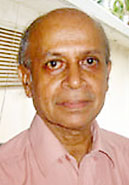
Prof. Carlo Fonseka
FUTA points out that in this scenario the Sri Lanka Medical Council
which has the mandate to uphold and quality and standards of medical
education would not have the power to regulate the content of education
that is being offered at these non-state institutions. Interestingly an
extra ordinary gazette which was amended had made it mandatory for
private institutions to obtain certificates of compliance from
professional bodies responsible for the discipline. The amendment to the
extraordinary gazette which was issued in January this year has taken
out such obligations. This action will severely erode the standards of
medical education in Sri Lanka and could eventually compromise the
wellbeing of the health sector and the lives of the people of this
country.
Read the gazette ; 2013 Amendment and 2014 Amendment
We publish below the FUTA General Secretary’s letter to Prof. Carlo Fonseka;
07.02.2014
Prof. Carlo Fonseka, President,
Sri Lanka Medical Council, 31, Norris Canal road, Colombo 10.
Dear Sir,
Sri Lanka Medical Council, 31, Norris Canal road, Colombo 10.
Dear Sir,
Power and Responsibility of Sri Lanka Medical Council to protect the standards of Medical Education
We, representing more than 95% of the members of the academic
community of Sri Lankan state universities, are gravely concerned about
the recent amendment made to the Universities Act which has specific
consequences for medical education.
The amendment made to the University Act no 16 of 1978 by means of
Gazette notification published on 31st January 2014 is as follows:
An amendment was made to the section 31 of the RULES made under
Section 137 read with Section 70 C and 70 D of the Universities Act, No.
16 of 1978, by the Secretary to the Ministry of the Minister assigned
the subject of Higher Education being the Specified Authority appointed
under Section 70 B of the aforesaid Act.
Previous – Extra ordinary Gazette No. 1824/21 – on 22.08.2013
31. All Non-State Institutes which have been recognized as Degree Awarding Institutes in pursuance to the Report made to the Minister by the Specified Authority under Section 70 C of the Act and which offer study programmes leading to Degrees in Medicine, Engineering, Architecture and other similar professional Degrees shall, obtain compliance certification from the relevant Specified Professional Body and shall submit such certification to the Specified Authority.
Amendment – Extra ordinary Gazette No. 1847/56 – on 31.01. 2014
31. All Non State Institutes recognized as degree awarding Institutes in pursuance to the reports made to the Minister by the Specified Authority under Section 70C of the Act and which offer study programmes leading to Degrees in Medicine, Engineering, Architecture and other similar professional Degrees also may seet* compliance certificates from respective professional bodies.
According to this amendment the pre-requisite of all non state
institutes recognized as degree awarding institutes to obtain a
compliance certificates from professional bodies has become
discretionary. Consequently, the Sri Lanka Medical Council, which has
been mandated to uphold the quality and standards of medical education,
will no longer have the power to regulate the quality of medical
education. It is our view that this is a serious blow to ensuring
educational standards within non-state institutions.
It is our firm belief that professional bodies established under acts of parliament for the purpose of setting standards and marinating professional integrity in their respective areas should continue to fulfill their role without obstruction and interference.
We wish to bring to your attention section 19 (e) of the Medical Ordinance. This section clearly denotes that the Medical Council is the body designated to maintain minimum standards of Medical Education including standards relating to courses of study, examinations, staff, equipment, accommodation, training and other facilities at universities and other institutions which grant or confer any qualification which entitles a person to obtain registration under the ordinance. However, this power of the Sri Lanka Medical Council (as well as other professional bodies) has been undermined through the above mentioned amendment to the University Act.
It is worth emphasising that the Medical Council has the power to make representations to the Government on any matter connected with the medical profession in Sri Lanka in accordance with section 12 (3) of the Medical Ordinance. Yet, we believe amendments which have serious consequences for upholding the standards of the medical profession are being made without consultation with the Sri Lanka Medical Council.
Hence, we urge the Sri Lanka Medical Council to seriously consider this matter and to take all necessary and appropriate actions to challenge the said amendment and to protect the standards of medical education in this country. We pledge our fullest support to the Council in this regard as part of our efforts to protect the standards and quality of state education in Sri Lanka.
Thank You,
Yours Faithfully,
It is our firm belief that professional bodies established under acts of parliament for the purpose of setting standards and marinating professional integrity in their respective areas should continue to fulfill their role without obstruction and interference.
We wish to bring to your attention section 19 (e) of the Medical Ordinance. This section clearly denotes that the Medical Council is the body designated to maintain minimum standards of Medical Education including standards relating to courses of study, examinations, staff, equipment, accommodation, training and other facilities at universities and other institutions which grant or confer any qualification which entitles a person to obtain registration under the ordinance. However, this power of the Sri Lanka Medical Council (as well as other professional bodies) has been undermined through the above mentioned amendment to the University Act.
It is worth emphasising that the Medical Council has the power to make representations to the Government on any matter connected with the medical profession in Sri Lanka in accordance with section 12 (3) of the Medical Ordinance. Yet, we believe amendments which have serious consequences for upholding the standards of the medical profession are being made without consultation with the Sri Lanka Medical Council.
Hence, we urge the Sri Lanka Medical Council to seriously consider this matter and to take all necessary and appropriate actions to challenge the said amendment and to protect the standards of medical education in this country. We pledge our fullest support to the Council in this regard as part of our efforts to protect the standards and quality of state education in Sri Lanka.
Thank You,
Yours Faithfully,
Dr. Rohan Fernando – General Secretary/FUTA
Sunday, February 9, 2014
FUTA expresses ‘grave concern’ over recent amendment to Universities Act
February 8, 2014, 6:32 pm
Dr. Rohan Fernando, SundayIsland
The Federation of University Teachers’ Associations (FUTA) expressed grave concerned over the recent amendment made to the Universities Act which, it pointed out, has specific consequences for medical education.
FUTA General Secretary, Dr. Rohan Fernando says in a communiqué to SLMC President, Prof. Carlo Fonseka:
"The amendment made to the University Act No. 16 of 1978 by means of Gazette notification published on 31st January 2014 is as follows:
"An amendment was made to the section 31 of the RULES made under Section 137 read with Section 70 C and 70 D of the Universities Act, No. 16 of 1978, by the Secretary to the Ministry of the Minister assigned the subject of Higher Education being the Specified Authority appointed under Section 70 B of the aforesaid Act.
"Previous - Extra ordinary Gazette No. 1824/21 – on 22.08.2013
31. All Non-State Institutes which have been recognized as Degree Awarding Institutes in pursuance to the Report made to the Minister by the Specified Authority under Section 70 C of the Act and which offer study programmes leading to Degrees in Medicine, Engineering, Architecture and other similar professional Degrees shall, obtain compliance certification from the relevant Specified Professional Body and shall submit such certification to the
Specified Authority.
"Amendment - Extra ordinary Gazette No. 1847/56 – on 31.01. 2014
31. All Non State Institutes recognized as degree awarding Institutes in pursuance to the reports made to the Minister by the Specified Authority under Section 70C of the Act and which offer study programmes leading to Degrees in Medicine, Engineering, Architecture and other similar professional Degrees also may seet* compliance certificates from respective professional
bodies. (*as in the Gazette, probably a printing mistake for ‘seek’)
"According to this amendment, the pre-requisite of all non-state institutes recognized as degree awarding institutes to obtain a compliance certificates from professional bodies has become discretionary.
"Consequently, the Sri Lanka Medical Council, which has been mandated to uphold the quality and standards of medical education, will no longer have the power to regulate the quality of medical education. It is our view that this is a serious blow to ensuring educational standards within non-state institutions.
"It is our firm belief that professional bodies established under acts of parliament for the purpose of setting standards and marinating professional integrity in their respective areas should continue to fulfill their role without obstruction and interference.
"We wish to bring to your attention section 19 (e) of the Medical Ordinance. This section clearly denotes that the Medical Council is the body designated to maintain minimum standards of Medical Education including standards relating to courses of study, examinations, staff, equipment, accommodation, training and other
facilities at universities and other institutions which grant or confer any qualification which entitles a person to obtain registration under the ordinance. However, this power of the Sri Lanka Medical Council (as well as other professional bodies) has been undermined through the above mentioned amendment to the University
Act.
"It is worth emphasising that the Medical Council has the power to make representations to the Government on any matter connected with the medical profession in Sri Lanka in accordance with section 12 (3) of the Medical Ordinance. Yet, we believe amendments which have serious consequences for upholding the standards of the medical profession are being made without consultation with the Sri Lanka Medical Council.
"Hence, we urge the Sri Lanka Medical Council to seriously consider this matter and to take all necessary and appropriate actions to challenge the said amendment and to protect the standards of medical education in this country. We pledge our fullest support to the Council in this regard as part of our efforts to protect the standards and quality of state education in Sri Lanka".
Friday, February 7, 2014
Notice issued on VC of Sri Jayewardenepura University
February 6, 2014, 9:50 pm , the island
By Chitra Weerarathne
The
Court of Appeal yesterday issued notice on Vice Chancellor of the Sri
Jayewardenepura University Professor L. M. N. A. Karunaratne, the Dean
of the Faculty of Social Sciences and Humanities, Professor C. L. K.
Navaratne and 18 other respondents, ordering them to be present in Court
or be represented by a lawyer on March 11, 2014.
The aforesaid notice was in respect of a Writ Application filed by a student, Ven. Kimbulawe Chandrarathana Thera.
The
petitioner student has said that his studentship was cancelled by
letter dated January 24, 2013 from the Vice Chancellor, who had said
that the petitioner had been found guilty of assaulting the Head of the
University and some staff members. The VC cancelled the studentship of
the student monk, the petition says. But, he was allowed to sit the
final year examination in February 2013.
The results of the other students were released. But, the results of the petitioner has not been released.
The
petitioner has requested the Court to quash the cancellation of his
studentship. He has said that the disciplinary board had not allowed him
the right to explain his position.
The petitioner has also requested the Court to order the respondents to release his results.
Wijedasa Rajapakshe P.C. appeared for the petitioner.
Monday, February 3, 2014
Higher Education Ministry goes for two novel concepts
The Higher Education Ministry will introduce two novel concepts named
student-outcome based education and student-centred learning in 15
universities from this month to produce skilled graduates with
theoretical and practical knowledge to suit the present day needs.
 The Ministry will conduct a dialogue among university professors and
lecturers to implement these concepts. An Inter-University Academic
Program Conversion Competition will also be conducted among university
departments and faculties to seek proposals to make this endeavour a
success, Higher Education Ministry Secretary Dr. Sunil Jayantha
Nawaratne told the Sunday Observer yesterday.
The Ministry will conduct a dialogue among university professors and
lecturers to implement these concepts. An Inter-University Academic
Program Conversion Competition will also be conducted among university
departments and faculties to seek proposals to make this endeavour a
success, Higher Education Ministry Secretary Dr. Sunil Jayantha
Nawaratne told the Sunday Observer yesterday.
On a directive by Higher Education Minister S.B. Dissanayake, the
three departments which present the best project proposals will be
selected from each university and each department will be given a cash
prize of one million rupees.
Five million rupees will be given to the faculty selected from each
university which presents the best proposal. In addition, the best
university selected under this program will be given Rs. 10 million, he
said. Dr. Nawaratne said the key component of the student outcome-based
education is to shift the present paradigm of input-based education to
outcome based education.
The present teacher-centered teaching system will be shifted to
student-centered learning. Guidelines have been given to each department
and faculty in universities to compile a graduate profile.
The aim of the Ministry is to produce skilled graduates with
theoretical and practical knowledge by developing their communication
skills, team work, confidence, innovativeness and decision-making. The
classroom environment in universities will be subjected to a
comprehensive change.
Each classroom in universities will be given a multimedia projector
and a laptop computer to help students do their power-point
presentations. According to the student-centered learning program,
university teachers would become students’ mentors or guides
Sunday, January 19, 2014
JUSTA Faults Selection Procedure For Academic Positions On Campus
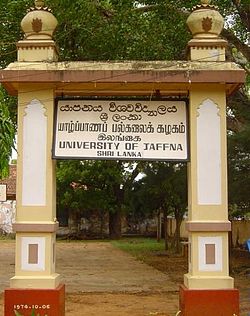
JUSTA
claims it is troubled by decisions of senior academics holding
administrative responsibilities to overlook candidates with superior
certified academic performances in favour of those with inferior
records.
“The major criterion for selection to an academic post is academic
excellence. This is because University is the highest seat for learning
and its teachers do not teach from text books alone,” JUSTA said in its
appeal.
JUSTA warns that selection on subjective criteria such as interview
and performance easily becomes the means of abuse to favour those with
superior connections and influence at the expense of persons from
humbler backgrounds who have shown superior ability.
“Once this abuse takes root, the character of the University suffers,
as those selected become increasingly beholden to those in authority,”
the appeal said.
The Appeal to the Vice Chancellor has the support of 86 persons of
the Jaffna University, including 69 members of the academic staff.
We publish below the letter in full;
University of Jaffna,
4th December 2013.
To:The Vice Chancellor, Members of the Council and Well–wishers of the University,
Selection to Academic Positions in the University
Selection to academic positions is the task of mainly senior
academics holding administrative responsibilities: the university
community and the public rightly expect that this obligation is
discharged conscientiously. Regrettably, we are more and more troubled
by justifications from these same senior academics for overlooking
candidates with superior certified academic performances, in favour of
those with inferior records. The reasons frequently given – the selected
candidate performed “superbly” in the interview or the candidate’s
presentation was “superb” – point to the selectors trying to cover up
something seriously amiss that troubles them. Current selections will
determine the academic standing of the University, and its intellectual
environment, for many years to come. It is now time to refresh our minds
on the criteria for selection to academic positions.
The major criterion for selection to an academic post is academic
excellence. This is because University is the highest seat for learning
and its teachers do not teach from text books alone. They should
continually update their knowledge and prepare their students
accordingly. They should capture new outcomes in their research fields
and apply them in their own work. A person who had absorbed what was
taught over four years and applied it well in answering questions
regularly set at examinations should be most suitable for the purposes
given.
Hence as the first category for selection to the post of Lecturer
(Probationary), the UGC has specified a First or Second Class (Upper
Division) specialization in the relevant subject. Other categories are
considered only when candidates in the first category are not available.
When selections are made from other categories, the Council must
justify it to the UGC.
UGC circular 935 states that “If the Selection Committee is not
satisfied with the performance of candidate/candidates, but otherwise
well qualified, such candidate/candidates be appointed as Temporary
Lecturer/Lecturers for a period of one year and at the end of such
period of such period they may be appointed as Lecturer (Probationary)
having subjected to another interview and presentation”.
The Circular makes it clear that the certified record is the decisive
criterion for selection. The presentation and interview are only to
ensure that the selected candidate will not be a disaster as a teacher.
It further makes it practically mandatory that the candidate having the
best certified record be appointed in a temporary capacity, when there
is some doubt about his capacity to teach and interviewed a year later.
That makes plain the weight placed on qualification as opposed to
presentation.
A Special Degree candidate has been tested in 120 credits using some
50 end-of-semester question papers (and numerous in-course assessments)
by several tens of examiners. Each answer script has been marked twice
by experienced examiners. The candidate had spent several hundred hours
answering question papers in the examination hall. A first class is
awarded based on this performance. In the selection board only Head of
the Department is, in most cases, an expert in the subject. Is it
that easy for such a board to reject the result obtained in the above
manner and stamp a candidate as being unsuitable on the basis of a few
questions fielded inadequately by the candidate during a brief interview
lasting a few minutes?
To put it in another way: Whom should a board select to an
academic post? A brilliant fresh graduate who did not do well in the
presentation or one with an inferior record with better presentation
skills?
We must further keep in mind that many years of war and migration
have lowered the kind of exposure where students would pick up better
English and present themselves more attractively. Under these
circumstances it is incumbent on us to give students who have worked
hard to overcome some of their handicaps and perform well during their
four years at the University, their due opportunity to rise further.
Selection on subjective criteria such as interview and performance
easily becomes the means of abuse to favour those with superior
connections and influence at the expense of persons from humbler
backgrounds who have shown superior ability.
Once this abuse takes root, the character of the University
suffers, as those selected become increasingly beholden to those in
authority.
01
|
Dr.A.Sivarupan | Zoology |
02
|
S.Selvarajan | Maths & Stats |
03
|
S.Arivalzahan | Maths & Stats |
04
|
M.R.R.Hoole | Maths & Stats |
05
|
N.Sivapalan | Chemistry |
06
|
K.Velauthamurthy | Chemistry |
07
|
K.Thabotharan | Computer Science |
08
|
G.Rajkumar | Botany |
09
|
M.Varathan | Maths & Stats |
10
|
A.Laheetharan | Maths & Stats |
11
|
K.Kannan | Maths & Stats |
12
|
Mrs.N.Satkunanathan | Maths & Stats |
13
|
Mr.B.Muraleetharan | Maths & Stats |
14
|
M.Khokulan | Maths & Stats |
15
|
M.Ananthakirishna | Maths & Stats |
16
|
A.Nithlavarnan | Education |
17
|
K.Sivarajah | Marketing |
18
|
K.L.Ramanan | ELTC |
19
|
J.Thevananth | Financial Mgt |
20
|
S.Anandasangari | Financial Mgt |
21
|
S.K.Kannathas | ELTC |
22
|
Ms.S.Srisatkunarajah | Linguistics and English |
23
|
Mr.N.Pratheeparajah | Geography |
24
|
Mr.S.Raveenthiran | Geography |
25
|
Mr.P.Akilan | Fine Arts |
26
|
Prof.K.Thevarajah | Commerce |
27
|
Dr.T.Manoranjan | Chemistry |
28
|
Mr.S.Ketheeswaran | Library |
29
|
N.Sivakaran | Philosophy |
30
|
S.Sivakanthan | Sociology |
31
|
R.Rajeshkannan | Sociology |
32
|
S.Rajeswaran | Geography |
33
|
A.S.Sosai | Geography |
34
|
E. Ratnam | Marketing |
35
|
T.Karunakaran | ELTC |
36
|
Miss.S.Sithamparanathan | Physical Education Unit |
37
|
G.D.Mathiyalagan | Physical Education Unit |
38
|
Ms.E.Arulmpalam | Physical Education Unit |
39
|
Ms.S.Shasiharan | Physical Education Unit |
40
|
Dr.C.C.A.Sivapalan | Linguistics & English |
41
|
Ms.S.Sivamoorthy | Linguistics & English |
42
|
Mr.S.Wimal | Linguistics & English |
43
|
Dr.V.Suntharesan | ELTC |
44
|
Dr.M.Saravanapavan | ELTC |
45
|
Dr.T.Sanathanan | Fine Arts |
46
|
D.Arthe | ELTC |
47
|
Mrs.J.Rasanayagam | Education |
48
|
Mrs.V.Ravishankar | Economics |
49
|
Mrs.P.Muraleetharan | Accounting |
50
|
Ms.P.Sivapalan | Accounting |
51
|
Ms.T.Kanagalingam | Accounting |
52
|
Mr.J.Aloy Niresh | Accounting |
53
|
Mr.S.Gobinaath | Mathematics & Statistics |
54
|
Mrs.K.Hoole | Library |
55
|
Ms.S.Arulanantham | Library |
56
|
Dr.T.Kalamany | Education |
57
|
Prof.M.Sinnathamby | Education |
58
|
Prof.K.Sivananthamoorthy | Philosophy |
59
|
Mrs.S.Krishnakumar | History |
60
|
Mr.T.Arunakirinathan | ELTC |
61
|
Dr.K.Arunthavarajah | History |
62
|
N.Ravimannan | Botany |
63
|
N.Sabananthar | Botany |
64
|
C.Arunagirinathan | Botany |
65
|
A.W.Jeevanarajah | Botany |
66
|
Kothai Seker | Botany |
67
|
T.Poojithreyi | Botany |
68
|
P.Auvai | Botany |
69
|
S.Subaragini | Botany |
70
|
S.Navaneethan | Botany |
71
|
A.Revathie | Botany |
72
|
P.T.J.Jashothan | Botany |
73
|
R.Selvarthnam | Botany |
74
|
B.Ragulan | Botany |
75
|
S.Ida | Botany |
76
|
S.Dalini | Botany |
77
|
J.Nandakumar | Botany |
78
|
A.C.Thavaranjit | Botany |
79
|
Mrs.M.Visakarooban | Library |
80
|
A. Ramanan | Computer Science |
81
|
J.P.Jeyadevan | Chemistry |
82
|
Dr.G. Sashikesh | Chemistry |
83
|
Dr.(Mrs).J.Prabagar | Chemistry |
84
|
Dr.P.Iyngaran | Chemistry |
85
|
Mrs.R.Senthooran | Chemistry |
86
|
Dr.P.Abiman | Chemistry |
Monday, January 13, 2014
SB reverses reason
Reducing of the duration of AHS degree
January 12, 2014, 10:12 pm , the island
By Dasun Edirisinghe
Higher Education Minister S. B. Dissanayakas yesterday admitted that his decision to reduce the four-year Allied Health Sciences (AHS) degree programme to three years had been made under pressure from the Government Medical Officers’ Association (GEOF).
Minister Dissanayakas told a public meeting in Kandy that the GEOF had opposed the four-year degree and did not allow AHS students to do clinical practices at respective teaching hospitals.
At present, AHS students from the Peradeniya and Ruhuna Universities are staging a Satyagraha at Galaha junction and Galle town respectively and boycotting lectures to protest against the reducing of the duration of the degree.
Minister Dissanayakas said that Vice Chancellors of universities, University Grants Commission (UGC) or Higher Education Ministry could not reverse the decision owing to pressure from the government doctors.
Dissanayakas told The Island few months ago that his ministry had consulted the University of Wales in the United Kingdom when designing the AHS course. The Wales course was also three years. Deaking University of Australia also offered a three-year nursing degree. The Singapore State University’s nursing degree was also a three-year course.
President of the AHS Students’ Union Ranitta Prasad yesterday asked the minister whether a trade union could meddle with the policies of the Higher Education Ministry and the UGC. He accused the minister of simply passing the buck to the GEOF.
"We will not give up our protest until winning the four – year period for our degree," Prasad said.
Meanwhile, Vice Chancellor of the Peradeniya University Prof. Athula Senaratne said that the Allied Health Sciences Faculty would be closed indefinitely if undergraduates did not return to lectures today.
The new degree courses started in 2006 in Peradeniya, Colombo, Sri Jayewardenepura, Eastern, Rajarata and Ruhuna universities were of a four year duration. The UGC and Higher Education Ministry decided to cut it down to three years from 2009, but it was delayed due to students’ protests.
Subscribe to:
Posts (Atom)