By Dinidu de Alwis, The Sunday Leader
 |
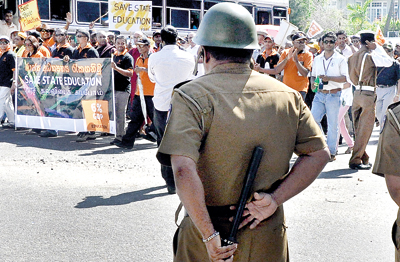
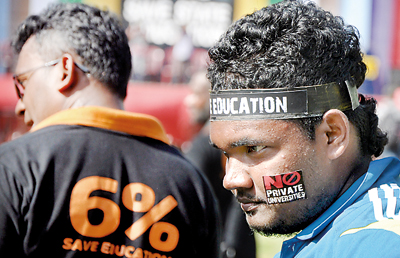
T-shirts, caps and placards in black and orange
carry
a figure – 6%., Sri Lanka’s education spending is low: no question can
be raised about it. and University students, academics, civil society
activists and politicians congregated at Lipton Circus |
Thousands of university students, academics, civil society activists
and politicians congregated at Lipton Circus on Friday, marking an end
to a long march which university teachers began just a few days prior.
The Federation of University Teachers Association (FUTA) was the driving
force behind the entire movement, and they have been – for the last
months or so – calling for increased spending by the government on the
education sector.
The t-shirts, caps and hundreds of placards in black and orange carry a
figure – 6%. For the academics, the fraction 6% marks the amount from
Sri Lanka’s Gross Domestic Product that they want spent on education.
This represents around USD 3.8 billion for this year, considering Sri
Lanka expects a 6.8% growth over its 2011 GDP of US$ 59.2 billion.
The 6% figure which FUTA speaks of stems from the repeated commitments
that Sri Lanka has made over the recent past to increase the island’s
education spending. Whilst Sri Lanka’s commitment has not been met –
ever – Sri Lanka’s education sector spending has been suffering over the
recent past as a result of increased expenditure on the defence sector.
However, even following the end of the war in 2009, expenditure on the
defence sector has risen, and education spending has continued to
decline.
But this was not the initial demand of the university teachers.
Academics demanded a hike in their pay, citing regional and
international salary structures. In a comparison that FUTA made, Sri
Lanka ranked among the lowest in academic salaries, and FUTA warned that
unless the salary structure was given a complete overhaul, the
education sector would continue to suffer.
Sri Lanka’s education spending is low: no question can be raised about
it. Whilst the United Kingdom spent 11.3% of its public expense
allocation on education in 2009, the United States spent 13.1%,
Singapore spent 11.6%, Pakistan spent 11.2% and Cuba a whopping 17.5%.
Even comparing the spending as a portion of the GDP, Sri Lanka still
ranks quite low. The United Kingdom’s figure stands at 5.6%, US’s at
5.4%, Singapore’s at 3.1% and Pakistan’s at 2.7%. Cuba again ranks
highest at 13.1%, compared to Sri Lanka’s fractional 2.1%.
When FUTA started their union action however, this was not the cause,
nor was it the demand. The demand for higher pay shifted to a demand of
increased spending on education when the academics’ union began to take
flak from the government about their demands, considering the body was
given a healthy pay rise just the previous year.
Sri Lanka’s education sector spending priorities are however, a bit
skewed. Even though the number of state funded schools dropped from
9,723 in 2005 to 9,714 in 2011, the number of Pirivena’s rose from 653
to 716 over the same period. The number of teachers grew from 189,234 to
271,112 from 2005 to 2011 marking a 14% increase, but the number of
Pirivena teachers grew from 5,481 to 6,457 – marking a dramatic 18%
increase.
The World Bank, in a report on Sri Lanka’s education sector, also noted
that Sri Lanka has been spending only around 2-3% of the GDP on the
education sector, compared to a 3.5% average in the rest of the region.
Whilst Sri Lanka had 85 private schools in 2005, this number grew to 97
in 2011. The number of students who are attending private schools too
grew from 106,000 in 2005 to 120,000 in 2011. As the state education
sector drifts slowly into chaos, the private sector – as the market
usually does – moves in to fill the gap.
It is the same private sector that FUTA is now also opposing. Among
FUTA’s demands is one to abolish private sector universities in the
country, the controversial South Asia Institute of Technology and
Medicine being the poster-child villain of the movement. Even though
FUTA has not been able to rationally argue out why the private sector is
the enemy of free education (and it has to be noted that the term free
education does not refer to free as in state funded, but free as in free
to choose – the Sinhala word, Nidahas as opposed to Nomile, encompasses
the spirit with which the sector was founded in modern history).
The state-funded education system has however, helped Sri Lanka attain
an adult literacy level comparable to those of developed nations.
“However, literacy alone will no longer suffice in the knowledge era. It
will be increasingly important for educated individuals to supply the
workforce with market-oriented skills needed to create rapid economic
growth and national development,” the World Bank stated in a report.
This mismatch between the education system’s outputs and the employment
market in Sri Lanka was highlighted during a recent panel discussion
held at the economic issues think tank, the Institute of Policy Studies.
During a discussion on education and employment in Sri Lanka, the
general opinion that prevailed with the private sector employers who
were present at the discussion was that the island’s education system –
specifically the tertiary education system – does not produce the
necessary skills required for the booming private sector in Sri Lanka.
As a country develops, both in its basic social indicators and on the
economic front, more money is pumped into the market by the private
sector. Even in Sri Lanka, the private sector has been booming – despite
flawed macroeconomic fundamentals such as widespread graft, corruption,
nepotism, energy instability and relatively high inflation – after the
three-decade war came to an end. The private sector however, is still
struggling to find individuals who are both knowledgeable and skilled,
and the finger is invariably pointed at the government.
The unemployment levels are disproportionately divided between the
various sectors, and whilst unemployment for medical, engineering,
computer science and technology-based graduates are almost unheard of,
it is the more abstract study areas that see graduates who are without
jobs. The responsibility – after truckloads of water and numerous
canisters of tear gas – shifts to the government, and due to political
pressure, thousands are absorbed into the state sector, oft into
positions specifically created for the purpose.
It is the same students which the private sector refuse to accept due to
lack of employability who oppose the move for private universities. In
their eyes, the charity and foundation driven model of private
universities will not work in Sri Lanka, and they see the private
sector’s entry into the education system as one that will harm the state
education structure.
Following FUTA’s call for the abolishing of private universities, the
academics’ union has cozied up to the Marxist-party backed
Inter-University Student Federation, who also oppose the move for
private universities. Along with them, various opposition parties,
including the idealistically-capitalist United National Party, have also
joined the movement. Many tend to have politically-left leaning
tendencies, including Dr. Wickramabahu Karunaratne, who joined the march
during its final stages.
After months of protest, the long march by the FUTA has now come to an
end. Their spokesman, Dr. Mahim Mendis from the Open University of Sri
Lanka, as a passing remark says that even though the march has finished,
their movement will not. They have successfully managed to shift
attention from the salary hikes that they requested to the fact that Sri
Lanka’s education is broken. Large scale overhauls are required and
Prof. Rajiva Wijesinha, an academic-turned politician with the ruling
United People’s Freedom Alliance, accepts this fact (see inset).
FUTA’s struggle for better pay, even though now sugar-coated in a call
for educational reforms, has brought this issue into the spotlight.
Their demands however, cannot be flimsy and short-sighted like Dr.
Nirmal Ranjith Devasiri’s remarks made during a recent panel
discussion. If fundamental changes are to be made, they have to also be
supported by FUTA, and for FUTA’s call for higher spending on education
to be taken more seriously by the current government, the demands
should be accompanied by a detailed plan of where they want the money
spent. Long walks would otherwise only take the academics’ union so far.