Sunday, October 21, 2012


Universities in race to catch up with missed lectures

Semester extended, extra classes held, new lecture rooms to accommodate more students


Extra classes and semester extensions are among the measures university authorities are adopting to overcome the backlog of academic activities – a result of the three-month-long academics’ strike which ended last week.�But, students said these moves had put them under pressure for no fault of theirs.
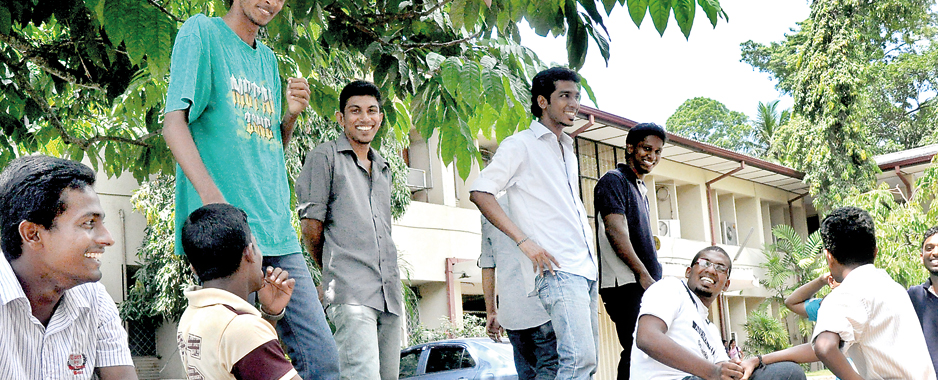
Back to university after three months: Kelaniya students share a light moment. Pix by Mangala Weerasekera
“Three months were an utter waste. We couldn’t join even a private course because we weren’t sure when the universities will be opened again. Now the administration has taken a decision to extend the semester by three months.
This means that the degree will be delivered with a three month’s delay,” said C. L. Edirisooriya, a science faculty student at the University of Kelaniya.
Endorsing his views, Thisarani Jayasinghe, another student from the same faculty, said it was the students who suffered the most from the dispute between the academics and the authorities. However, she said she was happy that the university system was back to normal with lectures being held without any disruptions.
Jayewardenepura University’s management faculty student Tharini de Silva said students were forced to learn six months of work in three months.�But vice chancellors said these new measures were being taken to ensure the smooth functioning of universities and they were careful not to cause hardship to the students.
Rajarata University Vice Chancellor K. A. Nandasena said lecturers from the four of the five faculties in his university joined the strike and at a meeting with the deans of all the faculties, a decision was taken to conduct extra classes to cover the missed lectures. He assured these extra classes would be held without harming the qualitative aspect of the course.
Prof. Nandasena said the strike started just prior to the management faculty examinations and moves were underway to conduct the exams as early as possible.
Covering the missed lectures is not the only problem the universities face. Adding to their problems is the extra intake of new students following the Supreme Court ruling in the case over Z-score disputes.�Prof. Nandasena said the extra intake of students meant extra expenditure for the universities. The university had worked out the extra costs and sought more funds from authorities.
Jayawardenapura University Vice Chancellor N. L. A. Karunaratna said his university would also conduct extra classes to cover the syllabus without burdening the students with extra work or adding to their pressure. Asked about the extra intake, he said his university was prepared to handle it as it was not the first time when universities had been asked to accommodate more students.
He said the request to take in more students was an opportunity for university authorities to show they were capable of facing challenges.�University officials said they were building temporary lecture rooms and renovating existing facilities to accommodate the extra students and Peradeniya University Vice Chancellor Athula Senarathne said that with the semester extended, academic were going on without any hindrance. He said some buildings and facilities were being renovated and extended to accommodate the extra students.

Saturday, October 20, 2012

FUTA to evaluate progress

Dailymirror

Federation of University Teachers Association (FUTA) today said a meeting to evaluate the progress of resolutions provided by the government will be held during the coming week.

FUTA General Secretary Dr. Terrance Madhujith speaking to Daily Mirror online said they are expecting the government to fulfill the promises made to the academics on policy related matters concerning education and the salary hike.

“The trade union action of 100 days was suspended based on three documents provided by the government – a cabinet paper issued with reference to the policy related matters on education, promise of the salary hike as well as the joint statement issued by the FUTA and the government. We are awaiting the implementation of these policy decisions,” he said.

However, he said certain decisions that were supposed to come into effect following the suspension of the trade union action are still in limbo. “We demanded the annulment of eight circulars, we believed posed a threat to university autonomy. They were supposed to be repealed by the University Grants Commission (UGC) following the suspension of our trade union action. But they are still in the process of implementing the decision,” he added. (Lakna Paranamanna)


Comrade Bala, CMU and FUTA

, The Island

article_image
In early 1970s, I had the honour of serving as a general councillor, at Ceylon Mercantile Union, representing the staff at European managed multinational, Shaw Wallace & Hedges and learn the intricacies of industrial disputes and labour struggles, by closely following the quick-witted maestro, comrade Bala Tampoe. CMU was then an exclusively a white collar worker's union catering to the European managed sterling companies. The staunch Marxist-Troskyte Bala, was our General Secretary and undisputed leader. He broke his links with the LSSP, when the party stalwarts decided to align with what he termed a 'capitalist government' of Sirimavo in 1964, and since then remained unbound to any traditional political powers. While 'Bala' steadfastly remained faithful to his Troskyte leanings, he converted CMU into a unique entity, devoid of race, cast, religious, political thought, as its membership was a mixture of an equally proportioned different racial, religious and political groups, who were united under a common banner and cause, for the welfare of members through continuous struggle against a repressive management collectively acting through the powerful Employer's Federation of Ceylon.

I was highly disappointed reading your correspondent's interview with the FUTA spokesman, published on October 15, where I learnt they, what I would call, 'grabbed' half a million rupees from the veteran, nonagenarian trade unionist as a grant. (Was it his personal money or donation drawn out of CMU funds, was not clear).

Running its office in a rented space on the first floor of a Chatham Street building, the 88-year-old trade union pioneered by Labour leader A E Goonesinghe, came under young rebellious LSSP lawyer, Bala in 1948, who took over and remained as its general secretary to date.

Realising the importance of having its own premises, Bala, convinced the 32,000 strong membership in late 70's to contribute two rupees per month for two years towards a building fund. The sprawling three story building with a huge auditorium at 22nd lane Colpetty stands testimony to this man's farsighted visionary. (My total contribution was 48 Rupees, which spread over a period of 24 months, drawing an average monthly pay of 450 Rupees).

FUTA, instead of visiting him for funds, (perhaps an unconvincing attempt to counter the allegation of receiving NGO Dollars, made by the pro-government buffoons), after carrying millionaire political opportunists on their shoulders from Galle to Hyde park, the home ground for seven decades of our quick-witted national icon Bala; the 'Dons' should have sought his advise and blessings prior to launching their show. If they did, sure FUTA would have received wise, trusted guidance and advice from the skeptic man who possesses an ability to grasp difficult situations with his brilliant skills. The somewhat flimsy, 6% of the GDP, (just one among many 'mistakes' committed), could have been made on a more rational launching pad, thus avoiding the suspicious character of the demand, especially among the intelligent sectors.

However, let me say this please, dear learned academics, I have a right and an obligation to do so. The CMU unlike in our time today is open to minor grades of workers as well, a category, who's pathetic life styles, which your spokesman who proudly claimed at the interview as a 'social democrat', would understand better. They are the people who contribute to the coffers of the union. The struggle is either partially settled or that the authorities had 'pulled the wool over somebody's eyes', whichever the case and reality, now that you are entitled for full emoluments as back wages, a luxury we as CMU members never enjoyed in the late 60's in a 90-day strike, please do return the half a million rupees, but continue to visit the literate thinker, Bala before planning any future action, for thoughtful, sophisticated brilliant ideas.

K. K. S. Perera

Panadura

Friday, October 19, 2012

Can Central Bank salaries be compared with those of Universities ?

, The Island

article_image
Economic Development Minister Basil Rajapaksa President of Federation and Federation of University Teachers’ Associations Dr. Nirmal Ranjith Dewasiri greeting each other prior to their successful talks recently. (File photo)

By Sunil Jayasinghe

In an article published in The Island on 2nd October 2012, Dr Usvatte-aratchi made an attempt to estimate wages of central bankers in order to make a case for higher wages for university dons. The purpose of this article is to show his analysis is not valid because it is like comparing apples with oranges.

Salaries of central bankers are usually linked to salaries of banking sector employees in Sri Lanka. This is a usual practice in many countries. It has also been a practice that wages and perks of banking sector employees are set at a higher level than those of public sector employees due to several reasons. This was perhaps one of the reasons why Dr Usvatte-aratchi also decided to join the Central Bank even in those olden days after earning a degree with a first class or second class upper division despite the Civil Service and the University being more attractive and respectable professions back then compared to these days. All of a sudden he seems to have forgotten his own reasons for joining the Central Bank in the first place and has decided that it was unfair that he was paid a higher salary than his colleagues in the university.

Wages of any sector depends on how funds flow into that sector to pay wages. For example, the banking sector makes profits and pays taxes to the government while using a part of their profits to pay wages. Therefore they have a little more discretion in deciding wages of their employees than the public sector when the salaries are paid out of tax payers’ money. This is one of the reasons why wages of various non-public sector institutions are different to that of public sector employees’ wages. For example, a graduate with a first class degree employed in telecom sector could be paid a higher salary than his counterpart in the electricity sector. This may be true even in state-owned public corporations because these corporations are supposed to operate on a commercial basis and earn their wages after paying taxes to the government. If Dr Usvatte-aratchi’s argument that university dons should be demanding more wages than their counterparts in other sectors is valid; professors in Ivy League universities such as Colombia and Yale must demand for their salaries to be on-par with those of their counterparts with similar qualifications working in nearby Wall Street firms. I am sure those professors are well aware that even their students working at the Wall Street firms earn multiple incomes compared to their salaries in those Ivy League universities. However, they have the common sense to understand that if they demand such salaries they will be kicked out of the job the next day irrespective of how academically qualified they are in their own fields. They are also well aware that even if they join Wall Street firms after quitting universities they will have to start at a much lower wage than their students there until such professors acquire the skills necessary to work in Wall Street firms. Therefore, Dr Usvatte-aratchi’s comparison of wages between bankers and university dons are invalid. This is why one can’t find comparison of wages between central bankers and university dons in any other country or any other literature even for academic purposes. In this regard, the medical doctors’ union made a valid point by objecting to the proposal to treat university dons separately for wage setting because all are paid by tax payers’ money. One should not be treated differently from another because they are doctors, judges, civil servants or any other public sector employee. If Dr Usvatte-aratchi’s argument is valid, judges, civil servants, doctors, accountants and all other such professionals in the public sector should be demanding higher wages than those earned by their counterparts with similar qualifications in the private sector and public corporations. It is an acceptable fact that public sector wages in any country are subject to budget constraints and depends on tax payers’ money. For example, since the Lehman Brother crisis, all public sector wages in the US were frozen irrespective of the profession whereas wages of similar professions in the private sector have varied depending on the profitability of each sector.

I am surprised that an analysis by an eminent economist like Dr Usvatte-aratchi didn’t find it useful to discuss issues and problems relating to why public sector professionals are paid lower than others. Even in this debate he has not expressed his views about whether the government can spend 6% of GDP for education now or in the future. Instead he has made an attempt to estimate an average salary of a Central Bank staff officer and failed miserably. I know for a fact that his estimated salary of a staff officer for the year 2011 is higher than even the salary of a Deputy Governor of the Central Bank who is supposed to be placed at the highest point in the Bank’s salary structure. Level of competence of an economist is usually measured by his or her ability to estimate or predict outcomes based on most accurate assumptions. Dr Usvatte-aratchi’s estimate reflects either his level of incompetence in estimating figures or his ignorance by intention to mislead the general public.

I am also surprised by the fact that Dr Usvatte-aratchi had the common sense to find out the salary of one of his friends in a university for his analysis but did not make any attempt to talk to many of his Central Bank colleagues and friends. He had been recruited to the Central Bank twice, firstly as a staff officer after his graduation in the early days and secondly as a consultant after his retirement from his UN job. His poor analysis suggests that he has compromised his intellectual capacity to hate Central Bankers perhaps because he was unceremoniously kicked out from his consultant position due to his failure to make a useful contribution as expected from an intellectual of his calibre, despite the fact that he was given perks and privileges similar to as a deputy governor when he was hired as a consultant.

Since the comparison is invalid, I will not waste my time to compare the other benefits and perks between bankers and academics. Those must be different due to vast difference between those two sectors. Due to recent trade union action, the general public has seen wages, perks and other benefits university dons enjoy compared to their responsibilities and workload. Fortunately for the country, we haven’t seen an analyst like Dr Usvatte-aratchi from other sectors making new demands for similar benefits as university dons. Perhaps the majority of analysts have a lot more common sense!

I also don’t agree with Dr Usvatte-aratchi on his argument that a bright academic with a good first degree and a PhD from a good faculty has every incentive to take the first plane out of Katunayake because they are paid a lower salary than a Central Banker. In an increasingly open and highly integrated global labour market, migration of labor searching for better opportunities is a common phenomena not only in many countries but also in many different sectors of any economy. This is not necessarily a bad thing in terms of economic benefits and it could happen both ways. For example, when management trainees are recruited to the Central Bank, positions are open to graduates from both local and foreign universities with equal qualifications through an open, transparent and highly competitive process. I understand that the last time more than 10,000 applicants sat the competitive exam conducted by the Examination Department. Candidates who obtained the highest marks were interviewed and selected on the basis of merit. There were several university dons that also applied through this process and some may have succeeded. Does it mean that those who did not succeed or perhaps the other 10,000 odd aspirants should also be offered the same salary in other sectors as a management trainee at the Central Bank? Does it mean that because the Central Bank recruited only 50-75 out of such a large pool of talent, the universities are deprived of attracting equally talented graduates?

In my view, the quality of university academic staff has been deteriorating mainly due to the non-transparent, non-competitive recruitment process. It is a well-known fact that to become a university don one has to be a buddy of a head of department or have some sort of influence within the university staff irrespective of talent, competence or skills. I have met several very talented graduates that have been deprived of opportunities to join the academic staff merely because they have not been favourites of heads of departments or professors. There are a lot of talented Sri Lankan graduates from foreign universities who are interested in joining local universities to pursue academic careers. When will they be given an opportunity to compete with local buddies on a level playing field for recruitment? It seems like our university dons are moving in an increasingly backward direction in this regard. This is why they demand more autonomy in the recruitment process. They don’t like giving up their authority to abuse their positions instead of recruiting the best available talents like the banking sector does. If we continue to move in this direction we are going to see further deterioration of the quality of the academic staff in universities and more politicized trade union activity in the future. So the solution lies more in the hands of university dons than the government. Matching salaries of university dons with all other sectors of the economy or raising expenditure in education to 6% of GDP wouldn’t solve inherent problems in the system.

(The writer is a former Central Banker currently working at a Wall Street firm. He can be reached at slmarketmonitor@gmail.com)

Thursday, October 18, 2012

Dons told not to fall prey to NGO agenda


by Dasun Edirisinghe, the island

The Patriotic University Teachers’ Alliance called upon academics not to fall prey to the agendas of several NGO-type university lecturers canvassing for the Oct. 18 Hyde Park rally of Gen. Sarath Fonseka.

Convener of the PUTA senior lecturer Nemsiri Jayathilake said that there were two groups of university dons in the recently suspended trade union action. There was a group of lecturers who were with the NGO clique during the war in support of the Tigers’ cause.

Their demand was to take the Federation of University Teachers’ Associations (FUTA) struggle to international level so that the countries which funded their NGOs to intervene in country’s internal matters, could capitalise on the problem, he said adding that this attempt was defeated and now they have ganged up to take to the stage with Gen. Fonseka on Oct. 18 at Hyde Park.

"Recently we saw FUTA spokesman Dr. Mahim Mendis calling upon academics to support Fonseka’s cause. We request academics not to join them against the motherland," he said.

Meanwhile, Higher Education Minister S. B. Dissanayake said that some university teachers who participated in the 100-day FUTA strike did so with a political agenda in mind.

When the government claimed that a political agenda was behind the FUTA strike, they vehemently denied it but now it has been proved by its spokesman’s invitation to join Sarath Fonseka’s rally, he said.

However, FUTA denied the claim.

FUTA President Dr. Nirmal Ranjith Dewasiri said that it was personal views of Dr. Mahim Mendis.

"Anyone has freedom to express their views," he said adding it was absolutely not the views of the FUTA.

FUTA unhappy with plan to begin leadership training on Nov. 15

, the island


by Dasun Edirisinghe

The Federation of University Teachers’ Associations (FUTA) is unhappy with the Higher Education Ministry’s decision to commence the leadership training programme, for university freshers, on Nov. 15 without consulting the faculty boards and the university senates.

FUTA President Dr. Nirmal Ranjith Dewasiri told The Island that according to the assurance given by the Economic Development Minister Basil Rajapaksa for them to end the recent strike, the higher education authorities would consult the university senates and faculty boards before commencing the next leadership training programme.

"The Higher Education Ministry has still not consulted the relevant university boards, but has decided on the date to commence the leadership training programme," he said.

The senior academic said that it was a violation of the agreement.

Dr. Dewasiri said that they would discuss it with the Higher Education Ministry in the next few days.

The higher education ministry has planned to start the leadership training programme on Nov. 15 in three batches. The Ministry will accommodate 9,000 students in each batch to be trained at the tri-forces and police establishments.

According to ministry sources, it had decided to obtain the opinion of the Attorney General’s Department prior to embarking on the latest exercise to avoid any future problems over the training programme.

When contacted by The Island for comments, Secretary to the Higher Education Ministry Dr. Sunil Jayantha Navaratne said the ministry was still planning the programme.

"We expect to have a discussion on the programme and later we would consult faculty boards and senates," Dr. Navaratne said.

UGC to discuss  cancellation of circulars


by Dasun Edirisinghe, the island

The University Grants Commission (UGC) would today (18) hold discussion on some of the earlier issued circulars, which Economic Development Minister Basil Rajapaksa had promised the Federation of University Teachers’ Associations (FUTA) would be cancelled.

UGC Chairman Prof. Gamini Samaranayake told The Island that the commission would meet today at the UGC boardroom to discuss the issue

Commenting on FUTA’s claim that although the secretary to the higher education ministry had sent a letter asking the UGC to cancel those circulars, the UGC was still delaying to do so, he said that he received the secretary’s letter regarding only on Tuesday evening.

"We cannot withdraw the circulars over night," Prof. Samaranayake said adding that it would have to go through the due process.

The UGC issued some circulars according to the government’s requirements, he said adding that those would be widely discussed.

The senior professor said that university academics must be considered on accountability not only the autonomy as they are paid from public funds.

Salaries for the last three months of university teachers would be paid by the relevant universities and it is not handled by the UGC, Prof. Samaranayake said.

FUTA President Dr. Nirmal Ranjith Dewasiri said that some universities, including the Colombo University, had paid only a Rs. 100,000 as a salary advance.

However, the full amount for last three months would be paid at the end of this month with the October salary, he said.

Dr. Dewasiri said that only the Sri Jayewardenepura University paid the salaries for last three months in full.

University teachers launched the strike on July 04 and it was ended on the assurance of Minister Rajapaksa on Oct. 11.

Wednesday, October 17, 2012

Leadership training for new undergrads from Nov.15

, The Island

The leadership training programme for the next batch of university students will begin on November 15 in three batches, according to a decision of the Higher Education Ministry.

The Ministry plans to accommodate 9000 students in each batch to be trained at tri-forces and police camps.

In order to avoid any future problems over the training programme, it had decided to obtain the opinion of the Attorney General’s Department prior to embarking on the latest exercise, a senior official of the Ministry said.

Following the Z-score fiasco, the Supreme Court ordered the University Grants Commission to admit additional students to the universities with the next intake so that no student would be victimized by it and because of the additional students the Ministry has been forced to divide the training into three batches.

Six per cent GDP on education: From a fantasy to a real programme

, The Island

article_image
By Sumanasiri Liyanage

Of the four trade union actions, the Federation of University Teachers’ Association (FUTA) has been so far engaged in, in its about three decades of history, the one that came to conclusion last week was the first that ended with no tangible material results. On the other hand, the last trade union action was of great significance for two reasons. First, it was the first strike action by the university teachers. FUTA had resorted to different kinds of protests, namely resigning from voluntary positions that the university teachers held in normal situation. Secondly, extending its 2011 strategy of taking the issue of education reforms beyond the boundaries of the university to the general masses, FUTA this time highlighted more general issues of education reforms than the specific demands of its members. Hence FUTA was able to generate a broader discussion on the educational reforms that the country is badly in need of. Ending a TU action with no concrete results is not an uncommon thing in the trade union history since the trade union action means a struggle between two opposite forces with substantially different interests. Just because the TU action failed to secure concrete and tangible gains, it does not necessarily mean that it was a failure. Similarly, even it is a failure, it is not a ground for a discontent or disappointment if the union membership and its leaders are able to decode the reasons of the failure and take necessary actions not to repeat them in future trade union actions. So it is imperative that FUTA have a critical reflection on the past union actions. Why did it fail to win its demands notwithstanding the fact that it was the trade union action which received the participation and the support of more than 90% of the university teachers and generated support of the significant layer of the society? Was it because that some of the FUTA demands are not achievable in the prevailing economic and social context without far reaching changes? Was there a basic flaw in the frame of struggle? Can the failure be attributed to the fact that although the FUTA was able to build pressure through mass action, FUTA negotiation team had failed at the negotiation table? In my opinion, these are the issues FUTA should discuss and reflect on if it wants to continue as a trade union? Although I have my own views on the above issues, I do not intend to discuss them in this article. My intention here is to redraw the boundaries of the discussion on FUTA demand on 6% of GDP on education.

Fantasies are of great importance and useful in building social movements. It is interesting to note that the FUTA was able to fantasize the demand of 6% of the GDP on education especially among the Sri Lankan internet community that is growing. Keeping the demand at the level of fantasy during the time of trade union action might also have facilitated the trade union action. Nonetheless, in the post-strike phase, it is imperative to reread the demand in the light of the ideas that were flagged in the discussion. There were two criticisms of FUTA demand to which I intend to turn shortly.

1. Critique of the Economists and the FUTA’s failure to respond: The economists reacted negatively to the demand for 6% of GDP on education focusing on the demand’s practicality. They correctly pointed out that the state’s contribution to the GDP had greatly reduced with the introduction of neo-liberal economic policies since 1977. The total government expenditure as a proportion of the GDP has come down to 22 per cent in recent years. So, spending 6 per cent out of this total government expenditure, according to them, is not practically possible. This may be the reason why many economists attached to the department of economics, University of Colombo refused take part in the trade union action. The answer to this criticism of the side of FUTA was not satisfactory. FUTA argued that 6% can be spent if the government was ready to reduce defence expenditure substantially and/or curtail corruption and waste. This argument does not hold water. The main portion of the current defence expenditure is of recurrent nature. If the proposal for substantial reduction of it is not linked with decommissioning with alternative employment, the implementation of such a proposal would create so many new problems. So, in order materialize FUTA’s demand for 6 percent of GDP on education, the demand should be linked with the expansion of the public economy. In other words, it means a reversal of the 1977 neo-liberal economic policies. Without moving towards an economy that is substantially dominated by the public sector, 6 per cent is just an empty signifier. Only such an economy can provide adequate expenditure on education, health, public transport etc. Not allowing room for misunderstanding let me explain what I meant by public economy that is qualitatively different from the statist economy and/ private economy. Services such as health, education, public transport should not be allowed to be controlled either by state bureaucracy or by surplus-seeking capital. Having based on the past experience, it is necessary t design a new system of management for these sectors. FUTA’s demand would be meaningful if and only if it is linked with such far-reaching changes in the prevailing economic system.

2. Teachers would have learned from the students: In the course of the FUTA struggle, a clear difference emerged between the position of FUTA and that of the Inter-University Students Federation (IUSF). While FUTA stood for the defence of ‘state education’, IUSF had the slogan of defending ‘free education’. Is this mere a semantic difference? In my view, two demands are qualitatively different. FUTA’s position implies that it has no objection for the presence of private sector education controlled by the logic of surplus-seeking capital with the state education. Secondly, it also means the continuance of the present system as a system controlled by the state bureaucracy especially in school education. On the other hand, IUSF wanted to continue the free education system originally initiated by C. W. W. Kannangara. In Sri Lankan education discourse, the term widely used to denote public education system has been free education. Why did FUTA change it? No explanation was given. Although IUSF demand is not clear about the system of management of free education system or how the free education system should be freed from the state bureaucracy and put under a democratic control of the educationists, its demand at least emphasize the need of inversing the changes that are now clearly visible in the education system.

What I have said above on public education system can be equally applicable to other sectors like health that need to be freed from two dominant control mechanisms, namely, capitalist and statist. Humankind has come to a stage where it should discover new mechanisms to govern their lives.

The writer is a co-coordinator of the Marx School, Colombo, Kandy and Negombo.

The Brahmins and the springs


article_image
By Nalin de Silva, The Island

A reader commenting on my statement at a public meeting that I would be against a decision by the government to increase the salaries of academics had asked why need enemies when there are friends like me. Probably, the reader thought that I was a friend of the trade union struggle of FUTA that ended on last Thursday after hundred days. The strike by the academics that began on July 04 ended on Oct. 11, after long marches, public rallies, exhibition of T-shirts with the symbol 6% printed on them, and more than anything else statements by various fora, that constitute fifteen to twenty people well known especially among the English educated public, and various trade unions supporting the strike. I was never a friend of this particular trade union struggle that began more than two years ago with token strikes, resignation of heads of departments etc. The struggle culminated in, or rather began to decline with, a continuous strike. The Brahmins supported the strike probably dreaming of Springs. However, when they awoke temporarily from their deep slumber they had a nightmare experience of a fall and a winter. They think that they are active but they act only in their dreams. As far as the general non-Brahmin public is concerned they are far away from the people. With respect to the non Brahmin public the Brahmins are in a deep slumber. The particular reader has to be excused as the public had been given the impression by the FUTA leadership that the strike would be over after a couple of discussions with Minister Basil Rajapaksa. The reader must have thought that I was obstructing the Minister and the leadership of FUTA coming to an amicable solution probably with a salary increase with my statement. The government had an understanding of the Brahmins and their Springs, and it was clear to non-Brahmin public that FUTA was not going to get anything as a result of the strike.

I find Dr. Mahim Mendis making the following statement to The Island. "The IUSF (The Inter University Student Federation) was not physically with us but IUSF was with us spiritually. And there was no party which was not with us. It is no exaggeration. Except SB Dissanayake and few fellows, some cronies - people like Nalin De Silva — all the people were with us." This implies that even the SLFP was with the FUTA! Dr. Mendis may think that I am a crony of the minister S. B. Dissanayake. However, it has to be placed on record that the Minister and the Ministry was against giving me an extension when a request to that effect was made to him by the University of Kelaniya. I opposed the FUTA trade union struggle while the ministry was opposing my extension in 2010. For, I could see the Brahmins were up to various schemes. I do not have to go into details as these have been discussed by me and others in newspapers including The Island and at various discussions over the electronic media in the last few months. In any event with all that support FUTA had from the political parties, trade unions, various fora, IUSF and others why did the strike fail to achieve anything other than a letter from Dr. P B Jayasundera that did not promise anything effectively. If all the people other than a few of us were with the FUTA an Arab spring would have been there for the asking as they say. In Arab countries the westerners were able to topple the governments that they did not like with so called uprisings as there were enough and more disgruntled people opposed to the incumbent governments. The trouble with some of the academics and other Brahmins is that they think that their acquaintances constitute the people.

There is a caste system in Sri Lanka that pervades ethnic, religious and the usual Govigama, Karawa, Salagama, Durawa, Vellala cast systems. It is a caste system that depends on the western education that has been with us for the last two hundred years or so. The Brahmin cast spreads from those who have had an education up to the GCE A/L to those with degrees and professional qualifications. The Brahmin class in general has two layers. The Upper Brahmins are usually English educated and are professionals university lecturers etc. Some of them have worked for foreign institutes including the UN and are looked up to by the lower Brahmins who are usually Sinhala or Tamil educated and have had a western education in universities and schools including the so-called Buddhist schools, at least up to the GCE A/L. The Brahmins try to maintain their social status above the others and in general do not support the SLFP. The upper Brahmins in general support the UNP while the lower Brahmins in general support the leftist political parties. The upper Brahmins, and the lower Brahmins who do not support the leftist parties in the government, in general oppose the UPFA. The upper Brahmins who tolerate all the undemocratic acts of the UNP governments are up in arms against the SLFP-led governments with their usual slogans on good governance, freedom of speech, independence of judiciary etc. These concepts have been created within the western modernistic hegemony, and again in general the western educated elite are trapped in these concepts. It is not wrong to say that those who receive a western education are consciously or subconsciously used by the west to maintain the western hegemony. They cannot think outside the framework given by their education and are manipulated by the west through agents and/or education to achieve what the latter wants.

The Arab Spring was not merely an uprising by the people in the relevant countries. It is very clear that the West wanted to replace the governments that they did not like with their puppet governments. The so-called mass uprisings were manipulated for that purpose whether finally the west achieved what they wanted or not. In Sri Lanka, it is obvious that the West does not like the faces of two Rajapaksas. Though there may be a number of Rajapaksa associated with the government, including provincial councils, only Mahinda Rajapaksa and Gotabhaya Rajapaksa have incurred the wrath of the west. The politics in Sri Lanka, as far as the West is concerned is all about removing these two Rajapaksas from office. In this connection, various fora sponsored by some western embassies are being used to create a so-called educated opinion against the government. The FUTA trade union struggle that commenced over a mere salary issue, which was all about the take home pay was converted into a fight for a hike in the basic salary which no government is in a position to grant, with a view to creating instability in the country so that a wave of strikes would sweep across the country. However, the leadership of FUTA could not justify the demand for a pay hike and soon the so-called 6% demand was introduced. The Brahmins, both upper and lower, gave a push to this demand with rhetoric on freedom of education university autonomy etc. It is interesting to note how some of the former vice chancellors who project themselves as saints once went behind presidents and other powerful politicians in order to be appointed to their posts. The university autonomy has remained the same during the last thirty five years and these elites did not find anything wrong with system when they were going behind politicians.

The FUTA was being used by the anti-government Brahmins to make the government unstable and very soon the government realized what was happening. The academics are the highest paid in the public and corporate sector excluding those institutes that generate income, and enjoy much more freedom at the work place than any other employees in the public sector. It is clear that the government has not promised any salary increase to the academics and they would have to be satisfied with what Dr. P. B. Jayasundera has called a middle term solution, which is nothing but allowances given to the public sector in the annual budget of the government. The Arab Spring has failed miserably for the Brahmins and their mentors in the west, and now they are looking forward for a Pakistan type spring by promoting a crisis in the relationship between executive and the judicial. However, the majority of the non-Brahmins are with the government and this spring will also fall through like the other Springs.