Tuesday, October 23, 2012

Teachers led by ‘colonels’ to march on Edu. Ministry


article_image
by Dasun Edirisinghe, The Island

Principals and teachers of the State-run schools are scheduled to march to the Education Ministry with several demands tomorrow, according to a JVP affiliated trade union.

The government recently enlisted 30 Class 1 Principals Brevet Colonels.

General Secretary of the Ceylon Teachers’ Service Union Mahinda Jayasinghe told The Island the protest march would start from the Ayurveda roundabout Rajagiriya and end with a demonstration opposite the Education Ministry, Isurupaya.

He said that they would hold the protest march and demonstration to force education authorities to grant their six demands.

"Our main demand is the implementation of the recommendations made by the Cabinet of ministers in 2008 to rectify the anomalies in salaries of principals and teachers," Jayasinghe said.

He said that they also demanded immediate solutions to problems as regards their promotions and salary arrears, implementation of the national teachers’ transfer policy, allocation of funds for disaster loans and property loans, allocation of 6 per cent of the GDP for education and an end to political interferences in the education field.

Jayasinghe said that they had held a meeting with Deputy Education Minister Vijithamuni Zoysa and two additional directors on Oct. 18, but it had ended inconclusively.

"We held another discussion with the Deputy Education Minister and Secretary of the Ministry yesterday," he said, adding it, too, had ended without a solution.

The Teachers’ and Principals’ Trade Union Joint Committee has organised the protest march. The TPTUJC includes Ceylon Teachers’ Union, Ceylon Teachers’ Service Union, Independent Teachers’ Union, All Ceylon United Teachers’ Union, National Education Employees Union, Common Education Professionals Union, All Ceylon Principals’ Union and Sri Lanka National Principals’ Union.

FUTA strike: Some issues


article_image
By Eric J. de Silva, The Island

The university teachers’ strike that the government told us had been called off has only been suspended according to FUTA, with every prospect of being resumed - a temporary truce with all the forebodings it has for those who want the universities to function without disruption.

The FUTA strike, which began when negotiations with government for a salary increase for university teachers broke down, took a totally different turn when FUTA deftly tagged on a demand for a 6% allocation of GDP for education to obtain wider support for their struggle. This they succeeded in doing with teachers’ unions and other groups rallying round the 6% banner though many of them did not have a clue as to what it really meant in rupees and cents (if cents do matter)! The fact that the FUTA move paid ample dividends was seen in the haste in which not only mainstream political parties but also nondescript (no insult meant) politicians in search of an identity jumped the FUTA bandwagon as described in a piece I wrote to The Island on 4/10/12 (Jumping the FUTA bandwagon).

6% of GDP for education

Spokespersons for FUTA insisted that the target of ‘6% of GDP for education’ should be reached by 2015 as a Millennium Development Goal which Sri Lanka had subscribed to in 2000, as a member of the United Nations. However, neither the report prepared by the World Bank in 2005 titled ‘Attaining the Millennium Development Goals in Sri Lanka’ (a copy of which I found in my bookshelves) nor relevant websites I checked with gave any indication of there being a MDG to that effect. The Millennium Development Goals subscribed to by 193 member nations of UN and 23 international organizations in 2000 simply read as follows:

1. Eradicating extreme poverty and hunger

2. Achieving universal primary education

3. Promoting gender equality and empowering women

4. Reducing child mortality rates

5. Improving maternal health

6. Combating HIV/AIDS, malaria, and other diseases

7. Ensuring environmental sustainability, and

8. Developing a global partnership for development.

It will be observed that these goals are more oriented towards eradicating illiteracy, alleviating poverty, improving health, empowering women and protecting the environment. As far as education is concerned, only primary education receives specific mention – obviously as a means of eradicating illiteracy. A meeting held in September 2010 at UN Headquarters in New York had conducted a progress review and concluded with the adoption of a global action plan to achieve the above goals by 2015, the targeted year. Thus the FUTA claim does not hold water, unless they can produce documentary evidence to the effect that there is, in fact, a Millennium Development Goal requiring member counties to allocate 6% of GDP for education.

Much has been said about the remark made by the renowned Pakistani scientist, educator, policy maker and former Minister of Science and Technology Prof. Atta ur Rahman about being in a position to advise President Rajapakse as to how 6% of GDP could be allocated to education, if requested to do so. He made this remark in answer to a question posed to him after the excellent lecture he delivered at the SLAAS auditorium on 27th September while the FUTA march from Galle was wending its way to Colombo. There was thunderous applause when he said this, and I too joined in it due to the exhilarating effect his speech had on me! I was naturally curious to know how much Pakistan spends on education and, when I checked the figures later, I found that their expenditure had been 1.9% in 2001, 2.9% in 2009 and 2.4% in 2010. These figures are obviously higher than ours, but nowhere near the 6% mark which had by then virtually become the FUTA trade mark!

What most people forget is that, as Prof. Rahman himself was quick to point out, Pakistan has over the years given greater attention to the apex of the pyramid (higher education) rather than to the base (primary and secondary education). As a result, despite their advances in the area of science and technology which he so graphically described, Pakistan remains among the Low Human Development Countries in terms of the Human Development Index occupying the 145th place out of 187 countries (with 50% of the population deprived of basic necessities of education and health) while Sri Lanka is among the Medium Human Development Countries occupying the 97th place, clearly showing that we have chosen one path and they another!

Pakistan

In this connection, my memory takes me back to a visit I made to Pakistan in the mid eighties when I was invited to join a Sri Lankan delegation led by the then Education Minister with the Secretary of the Ministry and a couple of others in the team. (I was working then as head of a Unesco Project in Sri Lanka). At a brief meeting the delegation had with Prime Minister Junejo (General Zia ul Huq was President at the time) which was more in the nature of a courtesy call than a substantive discussion, he was full of praise for the high standards of literacy (87% in SL as against 30% in Pakistan in 1985) that we had achieved thanks to our school system, and said that Pakistan had a lot to learn from us. He, however, inquired whether we did not see a link between it and youth unrest and the insurrection that followed due to employment opportunities not keeping pace with rising expectations that education brings along with it. While agreeing that there certainly was, we also brought to his attention the benefits that a high rate of literacy had brought about in areas such as health, women’s empowerment and the spread of family planning.

Developments in Pakistan since then are too well-known to bear repetition here. Despite Pakistan’s significant achievements in the field of higher education, science and technology that Prof. Rahman referred to, Pakistan’s present literacy rate of 58% remains among the lowest in the world (while ours is around 94%), and keeping half the population illiterate has not helped to keep violence and terrorism out of the way. What we all know is that these have taken such a heavy toll on Pakistan that their cricket team has to go outside Pakistan’s national boundaries to Abu Dhabi or Dubai to play their matches against visiting teams following the violent attack mounted on our cricketers a few years back, showing that there is no relationship between literacy and insurgent activities.

Need for more funds

It is beyond question that our education sector needs more funds if we are to adequately meet present needs as well as challenges that lie ahead. But funds alone are not sufficient without a proper policy framework, well formulated projects, proper implementation strategies and a competent and professional administration capable of getting the job done, none of which we can claim to have today. Usvatte (The Island 22/8/12) has pointed out that we spend 121 billion rupees per year on education (equivalent to 2% of GDP) at present and that tripling this amount to reach the 6% target would mean an additional 242 billion rupees of government expenditure. Even if, by some miracle, the government is able to considerably increase the government budget for education annually so as to reach the 6% target by 2015, it is my contention that we will not be able to spend so much, unless ‘spending’ means running through the money on ill-conceived projects and hare-brained schemes providing, in the process, ample opportunity for predators of all sorts to line their pockets at public expense. This, surely, is not what we want!

Sunday, October 21, 2012

FUTA action ends to be resumed if promises not kept

View(s):

The 100-day long trade union action by university academics fizzled out on Friday amidst protests of section of the academics, but eventually bringing relief to students and parents.�There was disappointment among sections of the academics as they failed to gain clear commitments on the demands of the Federation of the University Teachers Association (FUTA).

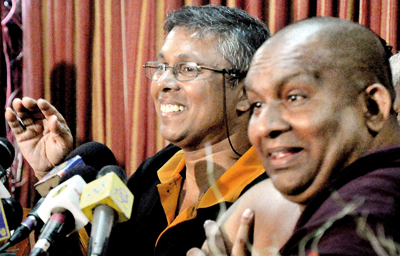
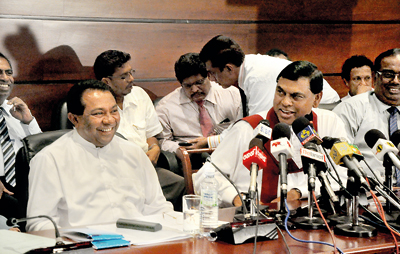
The two news conferences held yesterday: One convened by the Govt. and the other by FUTA. Pix by Mangala Weerasekera
University of Moratuwa FUTA branch President Dr. Rangika Halwathura said that even though an agreement was made to halt the trade union action, the majority of the membership is disappointed in the obdurate stand of the Government on the demands.

“None of the universities frankly wanted to conclude their trade union action but now we have come to the distressing realization that nothing can be gained from this Government and since there is no point on carrying out trade union action on a lost cause, we are concluding it,” he said.

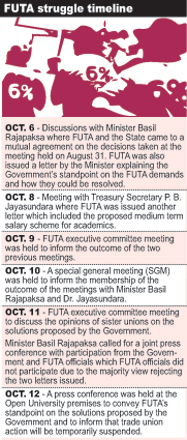
He that the majority at the executive committee meeting rejected the two letters given by Minister Basil Rajapaksa and Treasury Secretary P. B. Jayasundara regarding the solutions to the issues raised.

He said in one way FUTA has achieved victory as it has been able to create a dialogue in the country on the issues of education where 6 per cent of the GDP should be set apart for education became a common slogan among the general public.

He further added that the struggle to save State education will continue even though the trade union action was halted and the strike will be resumed again if the given promises are not kept.

The trade union action which was carried out by FUTA came to a conclusion of Friday as both FUTA and the Government came to a mutual agreement on the former’s demands.

The strike continued for almost 100 days since it began on July 4 crippling the functioning of 14 State universities island-wide.

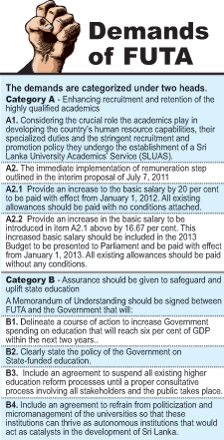
After the consideration of six demands of FUTA which were categorized under enhancing recruitment and retention of highly qualified academics and safeguarding and uplifting State education, FUTA has been issued two letters with regards to salary increments and a promise to increase the budgetary allocation for education.

These letters were issued by Dr. Jayasundara and Minister Basil Rajapaksa respectively, said Dr. FUTA Secretary Terrance Madujith.

He added the academics were presented a proposal by which a medium term salary scheme is to be implemented with effect from the 2013 Budget through a period of five years. �He also said that in Minister Basil Rajapaksa’s letter, it is mentioned that the budgetary allocation on education will be increased but a time frame as to how it will be implemented has not been given by the Government.

However the Sunday Times learns the majority of the sister unions in FUTA believe these two letters are unacceptable but they are compelled to suspend trade union action due to financial difficulties undergone by the membership and inconveniences undergone by the students due to disrupted academic activities.
Meanwhile, FUTA President Dr. Nirmal Ranjith Dewasiri said on the plus side, the negotiations carried out prove that the struggle carried out by FUTA to save State education and the FUTA demands are justified.
He added there are unfinished discussions among the membership within FUTA on whether or not the documents issued by the Government are acceptable or whether to reconsider trade union action.
He also said it is a victory for FUTA that the association has been able to create a dialogue about these issues in society helping to bring the attention of the relevant authorities to these issues.

Adding that university academics will participate in paper marking of the Advanced Level examination scripts commencing from tomorrow, he said university dons will work hard to revive the university system.
Minister Basil Rajapaksa said the responsibility for the disruption caused by this issue to the proper functioning of the university has to be borne by all the stakeholders to the issue. He added the Government has agreed to increase the percentage of GDP allocation for education and pay the salary arrears to the academics.

Universities in race to catch up with missed lectures

Semester extended, extra classes held, new lecture rooms to accommodate more students


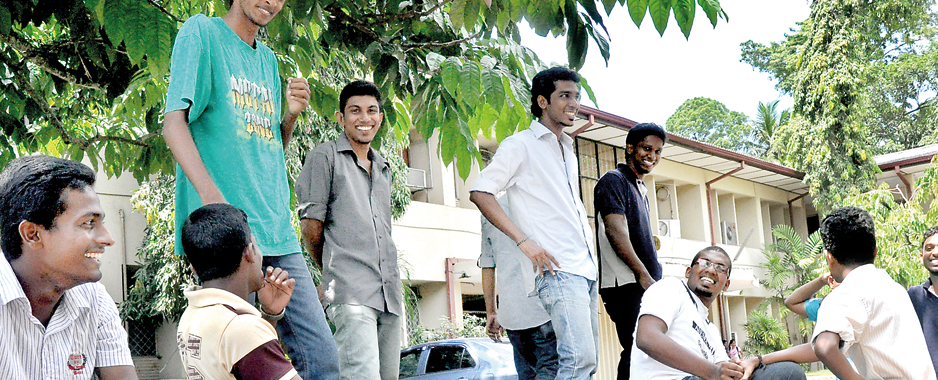
Extra classes and semester extensions are among the measures university authorities are adopting to overcome the backlog of academic activities – a result of the three-month-long academics’ strike which ended last week.�But, students said these moves had put them under pressure for no fault of theirs.
Back to university after three months: Kelaniya students share a light moment. Pix by Mangala Weerasekera
“Three months were an utter waste. We couldn’t join even a private course because we weren’t sure when the universities will be opened again. Now the administration has taken a decision to extend the semester by three months.
This means that the degree will be delivered with a three month’s delay,” said C. L. Edirisooriya, a science faculty student at the University of Kelaniya.
Endorsing his views, Thisarani Jayasinghe, another student from the same faculty, said it was the students who suffered the most from the dispute between the academics and the authorities. However, she said she was happy that the university system was back to normal with lectures being held without any disruptions.
Jayewardenepura University’s management faculty student Tharini de Silva said students were forced to learn six months of work in three months.�But vice chancellors said these new measures were being taken to ensure the smooth functioning of universities and they were careful not to cause hardship to the students.
Rajarata University Vice Chancellor K. A. Nandasena said lecturers from the four of the five faculties in his university joined the strike and at a meeting with the deans of all the faculties, a decision was taken to conduct extra classes to cover the missed lectures. He assured these extra classes would be held without harming the qualitative aspect of the course.
Prof. Nandasena said the strike started just prior to the management faculty examinations and moves were underway to conduct the exams as early as possible.
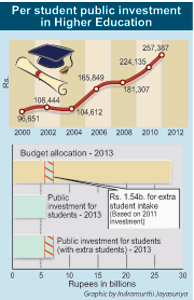
Covering the missed lectures is not the only problem the universities face. Adding to their problems is the extra intake of new students following the Supreme Court ruling in the case over Z-score disputes.�Prof. Nandasena said the extra intake of students meant extra expenditure for the universities. The university had worked out the extra costs and sought more funds from authorities.

Jayawardenapura University Vice Chancellor N. L. A. Karunaratna said his university would also conduct extra classes to cover the syllabus without burdening the students with extra work or adding to their pressure. Asked about the extra intake, he said his university was prepared to handle it as it was not the first time when universities had been asked to accommodate more students.
He said the request to take in more students was an opportunity for university authorities to show they were capable of facing challenges.�University officials said they were building temporary lecture rooms and renovating existing facilities to accommodate the extra students and Peradeniya University Vice Chancellor Athula Senarathne said that with the semester extended, academic were going on without any hindrance. He said some buildings and facilities were being renovated and extended to accommodate the extra students.

Saturday, October 20, 2012

FUTA to evaluate progress

Dailymirror

Federation of University Teachers Association (FUTA) today said a meeting to evaluate the progress of resolutions provided by the government will be held during the coming week.

FUTA General Secretary Dr. Terrance Madhujith speaking to Daily Mirror online said they are expecting the government to fulfill the promises made to the academics on policy related matters concerning education and the salary hike.

“The trade union action of 100 days was suspended based on three documents provided by the government – a cabinet paper issued with reference to the policy related matters on education, promise of the salary hike as well as the joint statement issued by the FUTA and the government. We are awaiting the implementation of these policy decisions,” he said.

However, he said certain decisions that were supposed to come into effect following the suspension of the trade union action are still in limbo. “We demanded the annulment of eight circulars, we believed posed a threat to university autonomy. They were supposed to be repealed by the University Grants Commission (UGC) following the suspension of our trade union action. But they are still in the process of implementing the decision,” he added. (Lakna Paranamanna)


Comrade Bala, CMU and FUTA

, The Island

article_image
In early 1970s, I had the honour of serving as a general councillor, at Ceylon Mercantile Union, representing the staff at European managed multinational, Shaw Wallace & Hedges and learn the intricacies of industrial disputes and labour struggles, by closely following the quick-witted maestro, comrade Bala Tampoe. CMU was then an exclusively a white collar worker's union catering to the European managed sterling companies. The staunch Marxist-Troskyte Bala, was our General Secretary and undisputed leader. He broke his links with the LSSP, when the party stalwarts decided to align with what he termed a 'capitalist government' of Sirimavo in 1964, and since then remained unbound to any traditional political powers. While 'Bala' steadfastly remained faithful to his Troskyte leanings, he converted CMU into a unique entity, devoid of race, cast, religious, political thought, as its membership was a mixture of an equally proportioned different racial, religious and political groups, who were united under a common banner and cause, for the welfare of members through continuous struggle against a repressive management collectively acting through the powerful Employer's Federation of Ceylon.

I was highly disappointed reading your correspondent's interview with the FUTA spokesman, published on October 15, where I learnt they, what I would call, 'grabbed' half a million rupees from the veteran, nonagenarian trade unionist as a grant. (Was it his personal money or donation drawn out of CMU funds, was not clear).

Running its office in a rented space on the first floor of a Chatham Street building, the 88-year-old trade union pioneered by Labour leader A E Goonesinghe, came under young rebellious LSSP lawyer, Bala in 1948, who took over and remained as its general secretary to date.

Realising the importance of having its own premises, Bala, convinced the 32,000 strong membership in late 70's to contribute two rupees per month for two years towards a building fund. The sprawling three story building with a huge auditorium at 22nd lane Colpetty stands testimony to this man's farsighted visionary. (My total contribution was 48 Rupees, which spread over a period of 24 months, drawing an average monthly pay of 450 Rupees).

FUTA, instead of visiting him for funds, (perhaps an unconvincing attempt to counter the allegation of receiving NGO Dollars, made by the pro-government buffoons), after carrying millionaire political opportunists on their shoulders from Galle to Hyde park, the home ground for seven decades of our quick-witted national icon Bala; the 'Dons' should have sought his advise and blessings prior to launching their show. If they did, sure FUTA would have received wise, trusted guidance and advice from the skeptic man who possesses an ability to grasp difficult situations with his brilliant skills. The somewhat flimsy, 6% of the GDP, (just one among many 'mistakes' committed), could have been made on a more rational launching pad, thus avoiding the suspicious character of the demand, especially among the intelligent sectors.

However, let me say this please, dear learned academics, I have a right and an obligation to do so. The CMU unlike in our time today is open to minor grades of workers as well, a category, who's pathetic life styles, which your spokesman who proudly claimed at the interview as a 'social democrat', would understand better. They are the people who contribute to the coffers of the union. The struggle is either partially settled or that the authorities had 'pulled the wool over somebody's eyes', whichever the case and reality, now that you are entitled for full emoluments as back wages, a luxury we as CMU members never enjoyed in the late 60's in a 90-day strike, please do return the half a million rupees, but continue to visit the literate thinker, Bala before planning any future action, for thoughtful, sophisticated brilliant ideas.

K. K. S. Perera

Panadura

Friday, October 19, 2012

Can Central Bank salaries be compared with those of Universities ?

, The Island

article_image
Economic Development Minister Basil Rajapaksa President of Federation and Federation of University Teachers’ Associations Dr. Nirmal Ranjith Dewasiri greeting each other prior to their successful talks recently. (File photo)

By Sunil Jayasinghe

In an article published in The Island on 2nd October 2012, Dr Usvatte-aratchi made an attempt to estimate wages of central bankers in order to make a case for higher wages for university dons. The purpose of this article is to show his analysis is not valid because it is like comparing apples with oranges.

Salaries of central bankers are usually linked to salaries of banking sector employees in Sri Lanka. This is a usual practice in many countries. It has also been a practice that wages and perks of banking sector employees are set at a higher level than those of public sector employees due to several reasons. This was perhaps one of the reasons why Dr Usvatte-aratchi also decided to join the Central Bank even in those olden days after earning a degree with a first class or second class upper division despite the Civil Service and the University being more attractive and respectable professions back then compared to these days. All of a sudden he seems to have forgotten his own reasons for joining the Central Bank in the first place and has decided that it was unfair that he was paid a higher salary than his colleagues in the university.

Wages of any sector depends on how funds flow into that sector to pay wages. For example, the banking sector makes profits and pays taxes to the government while using a part of their profits to pay wages. Therefore they have a little more discretion in deciding wages of their employees than the public sector when the salaries are paid out of tax payers’ money. This is one of the reasons why wages of various non-public sector institutions are different to that of public sector employees’ wages. For example, a graduate with a first class degree employed in telecom sector could be paid a higher salary than his counterpart in the electricity sector. This may be true even in state-owned public corporations because these corporations are supposed to operate on a commercial basis and earn their wages after paying taxes to the government. If Dr Usvatte-aratchi’s argument that university dons should be demanding more wages than their counterparts in other sectors is valid; professors in Ivy League universities such as Colombia and Yale must demand for their salaries to be on-par with those of their counterparts with similar qualifications working in nearby Wall Street firms. I am sure those professors are well aware that even their students working at the Wall Street firms earn multiple incomes compared to their salaries in those Ivy League universities. However, they have the common sense to understand that if they demand such salaries they will be kicked out of the job the next day irrespective of how academically qualified they are in their own fields. They are also well aware that even if they join Wall Street firms after quitting universities they will have to start at a much lower wage than their students there until such professors acquire the skills necessary to work in Wall Street firms. Therefore, Dr Usvatte-aratchi’s comparison of wages between bankers and university dons are invalid. This is why one can’t find comparison of wages between central bankers and university dons in any other country or any other literature even for academic purposes. In this regard, the medical doctors’ union made a valid point by objecting to the proposal to treat university dons separately for wage setting because all are paid by tax payers’ money. One should not be treated differently from another because they are doctors, judges, civil servants or any other public sector employee. If Dr Usvatte-aratchi’s argument is valid, judges, civil servants, doctors, accountants and all other such professionals in the public sector should be demanding higher wages than those earned by their counterparts with similar qualifications in the private sector and public corporations. It is an acceptable fact that public sector wages in any country are subject to budget constraints and depends on tax payers’ money. For example, since the Lehman Brother crisis, all public sector wages in the US were frozen irrespective of the profession whereas wages of similar professions in the private sector have varied depending on the profitability of each sector.

I am surprised that an analysis by an eminent economist like Dr Usvatte-aratchi didn’t find it useful to discuss issues and problems relating to why public sector professionals are paid lower than others. Even in this debate he has not expressed his views about whether the government can spend 6% of GDP for education now or in the future. Instead he has made an attempt to estimate an average salary of a Central Bank staff officer and failed miserably. I know for a fact that his estimated salary of a staff officer for the year 2011 is higher than even the salary of a Deputy Governor of the Central Bank who is supposed to be placed at the highest point in the Bank’s salary structure. Level of competence of an economist is usually measured by his or her ability to estimate or predict outcomes based on most accurate assumptions. Dr Usvatte-aratchi’s estimate reflects either his level of incompetence in estimating figures or his ignorance by intention to mislead the general public.

I am also surprised by the fact that Dr Usvatte-aratchi had the common sense to find out the salary of one of his friends in a university for his analysis but did not make any attempt to talk to many of his Central Bank colleagues and friends. He had been recruited to the Central Bank twice, firstly as a staff officer after his graduation in the early days and secondly as a consultant after his retirement from his UN job. His poor analysis suggests that he has compromised his intellectual capacity to hate Central Bankers perhaps because he was unceremoniously kicked out from his consultant position due to his failure to make a useful contribution as expected from an intellectual of his calibre, despite the fact that he was given perks and privileges similar to as a deputy governor when he was hired as a consultant.

Since the comparison is invalid, I will not waste my time to compare the other benefits and perks between bankers and academics. Those must be different due to vast difference between those two sectors. Due to recent trade union action, the general public has seen wages, perks and other benefits university dons enjoy compared to their responsibilities and workload. Fortunately for the country, we haven’t seen an analyst like Dr Usvatte-aratchi from other sectors making new demands for similar benefits as university dons. Perhaps the majority of analysts have a lot more common sense!

I also don’t agree with Dr Usvatte-aratchi on his argument that a bright academic with a good first degree and a PhD from a good faculty has every incentive to take the first plane out of Katunayake because they are paid a lower salary than a Central Banker. In an increasingly open and highly integrated global labour market, migration of labor searching for better opportunities is a common phenomena not only in many countries but also in many different sectors of any economy. This is not necessarily a bad thing in terms of economic benefits and it could happen both ways. For example, when management trainees are recruited to the Central Bank, positions are open to graduates from both local and foreign universities with equal qualifications through an open, transparent and highly competitive process. I understand that the last time more than 10,000 applicants sat the competitive exam conducted by the Examination Department. Candidates who obtained the highest marks were interviewed and selected on the basis of merit. There were several university dons that also applied through this process and some may have succeeded. Does it mean that those who did not succeed or perhaps the other 10,000 odd aspirants should also be offered the same salary in other sectors as a management trainee at the Central Bank? Does it mean that because the Central Bank recruited only 50-75 out of such a large pool of talent, the universities are deprived of attracting equally talented graduates?

In my view, the quality of university academic staff has been deteriorating mainly due to the non-transparent, non-competitive recruitment process. It is a well-known fact that to become a university don one has to be a buddy of a head of department or have some sort of influence within the university staff irrespective of talent, competence or skills. I have met several very talented graduates that have been deprived of opportunities to join the academic staff merely because they have not been favourites of heads of departments or professors. There are a lot of talented Sri Lankan graduates from foreign universities who are interested in joining local universities to pursue academic careers. When will they be given an opportunity to compete with local buddies on a level playing field for recruitment? It seems like our university dons are moving in an increasingly backward direction in this regard. This is why they demand more autonomy in the recruitment process. They don’t like giving up their authority to abuse their positions instead of recruiting the best available talents like the banking sector does. If we continue to move in this direction we are going to see further deterioration of the quality of the academic staff in universities and more politicized trade union activity in the future. So the solution lies more in the hands of university dons than the government. Matching salaries of university dons with all other sectors of the economy or raising expenditure in education to 6% of GDP wouldn’t solve inherent problems in the system.

(The writer is a former Central Banker currently working at a Wall Street firm. He can be reached at slmarketmonitor@gmail.com)

Thursday, October 18, 2012

Dons told not to fall prey to NGO agenda


by Dasun Edirisinghe, the island

The Patriotic University Teachers’ Alliance called upon academics not to fall prey to the agendas of several NGO-type university lecturers canvassing for the Oct. 18 Hyde Park rally of Gen. Sarath Fonseka.

Convener of the PUTA senior lecturer Nemsiri Jayathilake said that there were two groups of university dons in the recently suspended trade union action. There was a group of lecturers who were with the NGO clique during the war in support of the Tigers’ cause.

Their demand was to take the Federation of University Teachers’ Associations (FUTA) struggle to international level so that the countries which funded their NGOs to intervene in country’s internal matters, could capitalise on the problem, he said adding that this attempt was defeated and now they have ganged up to take to the stage with Gen. Fonseka on Oct. 18 at Hyde Park.

"Recently we saw FUTA spokesman Dr. Mahim Mendis calling upon academics to support Fonseka’s cause. We request academics not to join them against the motherland," he said.

Meanwhile, Higher Education Minister S. B. Dissanayake said that some university teachers who participated in the 100-day FUTA strike did so with a political agenda in mind.

When the government claimed that a political agenda was behind the FUTA strike, they vehemently denied it but now it has been proved by its spokesman’s invitation to join Sarath Fonseka’s rally, he said.

However, FUTA denied the claim.

FUTA President Dr. Nirmal Ranjith Dewasiri said that it was personal views of Dr. Mahim Mendis.

"Anyone has freedom to express their views," he said adding it was absolutely not the views of the FUTA.

FUTA unhappy with plan to begin leadership training on Nov. 15

, the island


by Dasun Edirisinghe

The Federation of University Teachers’ Associations (FUTA) is unhappy with the Higher Education Ministry’s decision to commence the leadership training programme, for university freshers, on Nov. 15 without consulting the faculty boards and the university senates.

FUTA President Dr. Nirmal Ranjith Dewasiri told The Island that according to the assurance given by the Economic Development Minister Basil Rajapaksa for them to end the recent strike, the higher education authorities would consult the university senates and faculty boards before commencing the next leadership training programme.

"The Higher Education Ministry has still not consulted the relevant university boards, but has decided on the date to commence the leadership training programme," he said.

The senior academic said that it was a violation of the agreement.

Dr. Dewasiri said that they would discuss it with the Higher Education Ministry in the next few days.

The higher education ministry has planned to start the leadership training programme on Nov. 15 in three batches. The Ministry will accommodate 9,000 students in each batch to be trained at the tri-forces and police establishments.

According to ministry sources, it had decided to obtain the opinion of the Attorney General’s Department prior to embarking on the latest exercise to avoid any future problems over the training programme.

When contacted by The Island for comments, Secretary to the Higher Education Ministry Dr. Sunil Jayantha Navaratne said the ministry was still planning the programme.

"We expect to have a discussion on the programme and later we would consult faculty boards and senates," Dr. Navaratne said.

UGC to discuss  cancellation of circulars


by Dasun Edirisinghe, the island

The University Grants Commission (UGC) would today (18) hold discussion on some of the earlier issued circulars, which Economic Development Minister Basil Rajapaksa had promised the Federation of University Teachers’ Associations (FUTA) would be cancelled.

UGC Chairman Prof. Gamini Samaranayake told The Island that the commission would meet today at the UGC boardroom to discuss the issue

Commenting on FUTA’s claim that although the secretary to the higher education ministry had sent a letter asking the UGC to cancel those circulars, the UGC was still delaying to do so, he said that he received the secretary’s letter regarding only on Tuesday evening.

"We cannot withdraw the circulars over night," Prof. Samaranayake said adding that it would have to go through the due process.

The UGC issued some circulars according to the government’s requirements, he said adding that those would be widely discussed.

The senior professor said that university academics must be considered on accountability not only the autonomy as they are paid from public funds.

Salaries for the last three months of university teachers would be paid by the relevant universities and it is not handled by the UGC, Prof. Samaranayake said.

FUTA President Dr. Nirmal Ranjith Dewasiri said that some universities, including the Colombo University, had paid only a Rs. 100,000 as a salary advance.

However, the full amount for last three months would be paid at the end of this month with the October salary, he said.

Dr. Dewasiri said that only the Sri Jayewardenepura University paid the salaries for last three months in full.

University teachers launched the strike on July 04 and it was ended on the assurance of Minister Rajapaksa on Oct. 11.