Friday, November 16, 2012

NANO technology: SL lagging behind others

, The Island

By Franklin R. Satyapalan

Former Deputy Governor of the Central Bank and President of Business Management School Dr. W. A. Wijewardena says successful Sri Lankan expatriates, in the fields of mathematics, chemistry and physics should be invited to return to the country to help re-build its human capital.

Elaborating on views he had expressed in a recent TV interview, Dr. Wijewardena told The Island in a brief interview yesterday that at present Sri Lanka did not have enough scientists and engineers to attend to its development needs. For, the Sri Lankan university system did not have any degrees in Bio-Medical Science to produce Bio–Medical Scientists.

 "The application of NANO technology is so widespread that it will encompass every aspect of human life in the future and those who have knowledge in NANO Technology are set to rule the world in the future," the retired Deputy Governor said.

He said that all students who wished to study Bio –Medical Science had to go overseas. But, on their return they did not have jobs. Therefore, they had to stay in other countries.

"Compared to world resources Sri Lanka does not have sufficient natural resources except for the human resource. There are only 20 million people. The major part of the Sri Lankan population is ageing and the population is expected to decline after 2030. It is high time mathematics, Physics and Chemistry were made compulsory for all students. Singapore could develop its economy as its focus had been on genetic engineering, NANO technology, Information and communication technology and entertainment."


Thursday, November 15, 2012

University leadership training starts on Dec. 27

, The Island

by Dasun Edirisinghe

The much-delayed leadership training programme for the next batch of university entrants would start on Dec. 27 at 25 centres countrywide, Secretary to the Higher Education Ministry Dr. Sunil Jayantha Navaratne said.

He told The Island that the duration of the programme had to be reduced from three weeks to two due to an additional 5,000 students being added to the next intake on a Court order.

This year the leadership training programme had to be postponed twice, in May and November, due to university teachers demanding that it be delayed until they submitted their recommendations.

Dr. Navaratne said that the Federation of University Teachers’ Associations (FUTA) had finally informed them that they would submit their proposals from next year and this time the programme could go as scheduled.

"We planned to start this year’s leadership training programme in three batches consisting of 9,000 students each," Dr. Navaratne said.

He added that this time 26,721 students would undergo the leadership training programme in military and police establishments countrywide from Dec. 27 to Jan. 13.

According to Dr. Navaratne, there was an increase of 5,609 students over that of the previous year.

The Secretary said that they had submitted a detailed report on the leadership training programme to the Vice Chancellors and Faculty Boards of universities countrywide and obtained their opinion.

"We made several changes in this year’s programme according to the comments of VCs," Dr. Navaratne said.

Wednesday, November 14, 2012

Competition or Monopoly in Education?

, The Island

article_image
By Muttukrishna Sarvananthan

There is considerable opposition from the university students as well as university teachers to the establishment of national or international private universities in Sri Lanka. The Federation of University Teachers’ Associations (FUTA) and the Inter University Students’ Federation (IUSF) are at the forefront of this opposition. This opposition is based on the false pretence that such private universities would erode the so-called "free education" in Sri Lanka. The hearts and minds battle against and for private universities, in my view, is a battle for and against monopoly in education.

As we have argued in the previous think piece titled The Myth of Free Education, the so-called "free education" (free health as well) in Sri Lanka remains only metaphorically and not literally. Behind the contrived threat to free education remains chilling insecurity of university students and teachers who detest competition to their future or current professions and jobs resulting from potentially better quality student output from the private universities. We could discern this fear psychosis from the fact that students passing-out of private (English-medium) international schools in Sri Lanka are legally barred admission to public-funded universities or higher education colleges (such as the Sri Lanka Law College) or to public sector employment (such as the Sri Lanka Administrative, Foreign, or Planning Services, for example), which has not elicited protest from university students or university teachers.

The paranoia against students of international schools (beginning with the agitation against the erstwhile North Colombo Medical College during the 1980s) is part of the much larger POLITICS OF ENVY towards citizens who are entrepreneurial, independent (of public ‘free’ hand-outs), and upwardly mobile. According to this politics of envy, only the students passing-out of public schools and graduating from public universities are ‘bhumiputras’ (daughters and sons of the soil) and "patriots" who deserve the patronage and privileges of the state. This is also part of the political narrative of the Rajapaksa regime itself typified by the anti-Western and anti-UN (occasionally anti-Indian, as well) hysteria whipped-up regularly for parochial political gains. Ironically, while the University Grants Commission (UGC) has been eager to recruit a handful of students from overseas to some of the universities in Sri Lanka in the past couple of years, hitherto it has not even considered permitting students from international schools to the local universities. Why is this duplicity?

Nonetheless, many academics, senior bureaucrats, politicians (of all political persuasions including the new left, old left, and Islamist), and trade unionists send their children to private English medium international schools and/or foreign universities or misappropriate some of the foreign scholarships available to the country for their own children or next-of-kin thereby overriding fairness and merit. The foregoing examples are indications of lack of confidence in the public schools and universities among the pseudo champions of free education.

It is true that education in Sri Lanka, at primary, secondary and tertiary levels, is chronically under-funded. However, additional public (state) funding is not the appropriate way to enhance the quality of education at all levels because such public funding will only perpetuate the insular, lethargic, and deliberate dumping-down of quality at schools in order to increase the school and university teachers’ earnings in private tutories. Since university teachers are the ones who set the question papers for the G.C.E. A/L examinations and evaluate answer scripts they have a captive market in the private tutories throughout the country. If the FUTA and IUSF are altruistic about protecting free education by increasing public funding to schools and tertiary educational institutions they should also campaign for the abolishment of private tutories because most of the tutories are fleecing innocent students and their parents. Therefore, desperately needed additional investments in the education sector should come from the private sector and NOT the public sector in order to improve the quality of education.

Many people argue that the government should clamp down on corruption (which drains public finances) and wasteful public expenditures and investments (such as the huge and rising defence budget, the Hambantota air and sea ports, Mihin Air, etc) and commit that money for public education and public heath, inter alia. I do agree that there is rampant corruption and astronomical wasteful expenditures by the Rajapaksa government and those have to be tamed. However, the call for stamping out corruption and wasteful public expenditures in order to commit more public money for public education and public health is a negative argument; one wrong cannot justify another. Instead, the champions of free education should convince the general public by positively arguing how and why enhanced public expenditures on education will improve the quality of primary, secondary, and tertiary education in Sri Lanka.

In my view, the policy debate on the admission of private universities in the country should not be framed in terms of preservation/protection versus dilution of free education; instead it should be framed in terms of competition versus monopoly for increasing the accessibility to prospective students and at the same time improving the quality of university education.

Competition was the bedrock of human civilization according to the Darwinian Theory of human evolution. Of course, not everyone on earth may agree with Charles Darwin’s theory of human evolution. Monopoly, either private or state, is detrimental to human welfare according to the fundamentals of economic science. According to a Tamil dictum keerai kadaikum aethir kadai vendum (even a shop selling green leaves need a competitor). In political principle and practice state monopoly is inherently anti-democratic that would lead to autocracy.

The state monopoly in education in Sri Lanka has dumped down the quality of primary, secondary, and tertiary education in the post-independence period. In fact, the admission of private hospitals in Sri Lanka since the late 1970s has improved the quality of free public health service throughout the country because of greater choice that has diminished the pressure on free public health service. In the same way, I believe that the admission of private universities could improve the quality of public universities as a result of competition for student admissions that would diminish the pressure on non-fee-levying public universities.

In the present circumstances, state monopoly is synonymous with monopoly of the Rajapaksa family. How come those who oppose monopoly of political power by the Rajapaksa family champion the cause of state monopoly in education (and indeed in other sectors as well)?

Muttukrishna Sarvananthan Ph.D. (Wales), M.Sc. (Bristol), M.Sc. (Salford), B.A. (Hons) (Delhi) hails from Point Pedro, Northern Sri Lanka, and a Development Economist by profession and the Principal Researcher of the Point Pedro Institute of Development (PPID). He has been an Endeavour Research Fellow at the Monash University (Melbourne, Australia) and Fulbright Visiting Research Scholar at the George Washington University (Washington D.C, USA.) as well. He can be contacted at sarvi@pointpedro.org

Teachers, principals to strike on Dec. 04

, The Island

by Dasun Edirisinghe

Principals and teachers of government schools yesterday announced that they would stage a token strike on Dec. 04 if the education ministry failed to grant their demands immediately.

Spokesman for the Principals and Teachers Trade Union Joint Committee Mahinda Jayasinghe said that they had taken the decision to strike at a special convention held at the Public Library in Colombo with the participation of teachers and principals countrywide. "The Education Ministry invited us to a discussion on the eve of our convention," he said.

Jayasinghe said that they would participate in the discussion on Nov. 16, but go ahead with scheduled trade union action if an acceptable solution was not given.

Principals and teachers marched to the Education Ministry on Oct. 22 to force authorities to grant their six demands, he said.

Their main demand, Jayasinghe said, was the implementation of the recommendations made by the Cabinet in 2008 to rectify anomalies in the salaries of principals and teachers.

He said that they also demanded immediate solutions to problems as regards their promotions and salary arrears, implementation of the national teachers’ transfer policy, allocation of funds for distress and property loans, allocation of six per cent of the GDP for education and an end to political interferences in the education sphere.

"We held two rounds of discussions with Deputy Education Minister Vijithamuni Zoysa, Education Secretary Gotabhaya Jayaratne and two additional secretaries during the last two months, but those discussions had ended inconclusively," Jayasinghe said.

Jayasinghe said that Education Minister Bandula Gunawardena had repeatedly denied them a hearing, but finally invited the alliance to a discussion in a bid to stop their trade union action.

Principals and teachers had expected solutions to their problems from Budget 2013, but in vain, he said.

When contacted for comment, Education Ministry Secretary Gotabhaya Jayaratne said, his ministry had invited the teachers to a meeting with the minister.

"We expect to arrive at a solution at the meeting," the Secretary said.

The Teachers’ and Principals’ Trade Union Joint Committee, includes Ceylon Teachers’ Union, Ceylon Teachers’ Service Union, Independent Teachers’ Union, All Ceylon United Teachers’ Union, National Education Employees Union, Common Education Professionals Union, All Ceylon Principals’ Union and Sri Lanka National Principals’ Union.

Tuesday, November 13, 2012

EDUCATION: WHERE ARE WE HEADING? ARE WE MISSING THE WOOD FOR THE TREES?

By Dr Uvais Ahmad, Dailymirror

The Federation of University Teachers’ Associations (FUTA) has ended its three month old strike action ostensibly demanding higher salaries for the university teachers. How futile or otherwise this entire FUTA exercise had been will be debated for sometime by all stake-holders who were affected by this action. The spokesman for FUTA while announcing the calling off of the strike had said that it was done in order to ensure that the students are not affected adversely by their Trade Union action. Ironically he also went on to state that if the concerned authorities do not live up to the promises made at discussions held to resolve the issues which led to the strike, action will be taken to resume the struggle until a satisfactory solution is brought about.
The fact that universities in the country constitute a very important factor in the preparation and training of resources that are necessary for development, university teachers have to be cared for, and all inducements provided to get on with their undoubtedly daunting tasks in this age and time in order to deliver education efficiently. They need to be abreast of developments taking place around the world in their fields of specialty. This is absolutely necessary to ensure that their products will be able to face the modern day challenges in a technology driven world. The authorities should be sensitive to these needs. Every endeavour must be made to meet their legitimate demands so that they could carry on their unenviable tasks in a way that would prove useful to the country at large.

" Brain–drain has been a term quite in vogue from the time when our education system was able to produce talented intellectuals who found plenty of opportunities to make a significant contribution in various fields of human endeavour both in Sri Lanka and outside our country "

Brain–drain has been a term quite in vogue from the time when our education system was able to produce talented intellectuals who found plenty of opportunities to make a significant contribution in various fields of human endeavour both in Sri Lanka and outside our country. It is very well known that the best of our brains are now functioning with great acceptance and recognition in many parts of the world, not only in the western hemisphere but also across Asia and the Pacific right up to the Fiji islands and Tonga. Several of them had been eminent professors and lecturers and other highly distinguished people who once served in our own universities and other national establishments.


Quite a few of them went onto serve with distinction as international civil servants with the UN and other international Organizations. We are indeed proud that our intellectuals found international acclaim and brought immense honour to our nation, but it is absolutely necessary for the authorities in the country to ensure that we do not become the poorer by the exodus of brains which are necessary to bring about qualitative improvement in the delivery of education. This makes it incumbent on those in charge of education to accept the fact that since the university teachers constitute the cream of our intelligentsia saddled with the task of nurturing acutely needed resources to take the country forward, should be an adequately motivated lot. It should, however, be clearly understood that strike action in the education sector should as far as possible be avoided and all efforts taken to resolve outstanding issues through negotiation and compromise. This is especially because teachers are not only responsible to impart knowledge but also to instill values that would make children to grow as responsible and peaceful citizens.

The Mahinda Chinthanaya, which is by and large an expression of national priorities in respect of all activities that impart the country as a whole, declares in no uncertain terms the goal of making Sri Lanka the educational hub in the region. When I read about this a few years ago I was overwhelmed by the thought that we are on the right track and will be pursuing a realizable objective given the fact that we have had a splendid track record in the field of education ever since we received independence in 1948. It has to be noted that Singapore, Malaysia and India have also made steady progress in developing themselves as Centres of Excellence in the field of education.

It is pertinent to recall that when Lee Kwan Yew became head of the state of Singapore about 50 years ago, Singapore was only a small hamlet surrounded by sea and comprising of three ethnicities – Chinese, Malays and Tamils of Indian and Sri Lankan origin. Fishing was their main occupation. Except the sea they had no other resources to talk about. At that time Lee Kwan Yew held Sri Lanka (Ceylon at that time) as a role model and declared his intention to make Singapore another Ceylon. Today we find this futuristic and persevering statesman of Singapore had made this country the envy of entire Asia.

From the outset he relied upon the creation of an educated and informed citizenry. He targeted the schools as the starting point to impart a sound value based education to the new generation of Singaporeans who have subsequently given their shoulders for the development of their country. Lee Kwan Yew never relented until the country had a sound education system with committed teachers and an energetic student population driven by an urge to excel in their studies and serve their nation. It is indeed strange that now we may have to look at Singapore for inspiration to develop our own educational programmes.

" Unfortunately, when we consider the chaotic condition in which we find our education system at all levels from the pre-school to university, one cannot but wonder whether making Sri Lanka the regional educational hub is only a distant dream "

A large number of Sri Lankan students are undergoing higher studies in Singapore and Malaysia along with countries like Australia, U.K. and the United States of America. This is done by draining away valuable foreign exchange, a sizable portion of which had been earned by unskilled workers both men and women, sometimes under extremely trying and exacting circumstances. If the Mahinda Chinthanaya objective of making our country an educational hub in the region is to become a reality we should not only retain our students in the country but also entice a large number of foreign students to pursue their studies here.


Unfortunately, when we consider the chaotic condition in which we find our education system at all levels from the pre-school to university, one cannot but wonder whether making Sri Lanka the regional educational hub is only a distant dream.

Some of the events that have unfolded before us in recent times are indeed disturbing and unless measures are taken to arrest such trends our children will face a bleak future.  
  • Teacher pupil ratio has become staggeringly high especially, in the smaller classrooms making it virtually impossible for teachers to provide individuals attention to students.
  • Prolonged and enforced delays are experienced in the correction of answer scripts.
  • Question papers set by the concerned authorities for the terminal examinations are replete with errors.
  • The university teachers supported by the university students went on strike and they are poised to strike again.
  • Evaluation criteria are found faulty.
  • Discipline in schools leave much to be desired.
  • Tuition has become a must for most of the students from primary to G.C.E A/L classes. It is also a fact that most teachers depend on private tuition to augment their small salaries to make ends meet at a time where the cost of living is rising by the day. It has also to be noted that some teachers reserve their energy during class hours in order to expend it at tuition classes. This is a dangerous trend and the authorities must find a way out of it by reviewing salaries of teachers and adopting strategies like performance based inducements.
  • There is also a severe threat of Principals and teachers going on strike and taking to the streets demanding promotions and wage increases.  
This is certainly not a comfortable or attractive educational scenario for any country aspiring to become an educational hub in the region. It is an absolute necessity to first put our house in order, in respect of education in its entirety. We need to have a holistic approach to educational development. Although education has been compartmentalized into various segments like primary, junior, secondary, tertiary and university for the sake of convenience, we need to look at education as a whole and ensure that no weak links exist.  All those involved in education must bear in mind that a weak and disabled education system as we witness today cannot produce the right calibre or undergraduates to the universities and a discontented set of university academics cannot produce graduates of high calibre from the students who are not disciplined, irresponsible and ill-prepared when they enter the portals of high learning.

" This is certainly not a comfortable or attractive educational scenario for any country aspiring to become an educational hub in the region. It is an absolute necessity to first put our house in order, in respect of education in its entirety "

One of the eye catching slogans of the recent FUTA strike was the demand for a 6% increase of in budgetary allocation for education. This is a reasonable demand and would have won a lot of sympathy and support from the general public. Facilities in the universities for both teachers and students have to improve. Senior lecturers have to be supported financially to do their research work on a regular basis. They should have sufficient exposure in other developed countries through attendance at seminars and other educational conferences. The students too should be provided with facilities conducive for learning. Large allocation of funds are needed not only to improve the quality of education but also to effect improvements at all levels within the school system. But what happens to this demand for a higher allocation for education. A recent editorial in the Daily Mirror recently titled “Into the valley of death, marched the 6%” tells it all…

Shakespeare in his play Hamlet says “something is rotten in the state of Denmark. Those who critically examine the education system in the country cannot be faulted if they borrow a few words from Shakespeare and declare that “something is rotten in the state of education in this country”. It is this “something” that has to be identified and addressed. The sooner this is done the better.

The writer was a Principal of two leading colleges, Director of teacher education in the Ministry of Education and UNESO educational advisor for the Asia Pasific region

Science & Technology: What for?

, The Island

article_image
By Dr.C.S. Weeraratna

World Science Day fell on Nov. 10. This article examines to what extent Science and Technology has been effectively used in Sri Lanka to alleviate poverty and to advance the socio-economic development of the country.

The Science and Technology status of a country is the backbone of its development strategy. Most of the South and South East Asian countries, during the last two decades, have developed considerably by effective use of Science and Technology. In Sri Lanka, during the last decade, perhaps billions have been spent on Research and Development (R&D) but, what were the benefits the country received from all the money spent?

The General President of Sri Lanka Association for the Advancement of Science (SLAAS), in the year 2005, in his inaugural address said, ‘What has bothered me over the years is the insignificant, almost negligible impact on economic, industrial and agricultural development that we have had from research that has been conducted over the past fifty years……." The president of the Sri Lanka Economic Association, at the SLEA annual meeting held last month, too highlighted the very low level of Science and Technology in Sri Lanka.

Scientific institutions

In Sri Lanka, there are around 30 institutions, in addition to the 14 universities, that carry out research on various aspects related to socio-economic development. The National Science Foundation (NSF), the Council for Agricultural Research Policy (CARP) and National Research Council (NRC) are expected to promote research. According to NSF data, in 2008, there were nearly 4000 scientists in Sri Lanka , 1025 in Natural Sciences, 939 in Agricultural Sciences, 927 in Engineering, 768 in Medical and 111 in Social Sciences. Almost 61% of the scientists are in universities. Out of the 4,000 scientists around 2200 have postgraduate qualifications.

NSF during 1995-2000, funded 217 research projects involving a sum of Rs. 102 millions. The details of the research projects funded by NSF since 2000 are not available .Council for Agricultural Research Policy (CARP), since its inception in 1988 to 2005, has funded about 500 projects related to agriculture, fisheries and animal husbandry, involving around Rs. 550 million. There is hardly any information available on the expenditure by NSC in promoting research. A large number of papers are presented by our scientists at numerous seminars, symposia etc. For example, during the period 2004-2008, around 1,100 papers were presented at the SLASS annual sessions. However, in spite of all these organizations and qualified scientists, Science & Technology appears to have not played a significant role in the socio-economic development of the country.

Many in S&T institutions lament that the expenditure on S&T is very low. They are of the view that a higher % of the GDP needs to be spent on development of Science and Technology. This is very true, but it is also important that the money spent is utilized properly. Various institutions spend large sums of money to purchase very expensive equipment but little is used. We do not have a centralized scientific equipment repair centre. As a result, research equipment bought at high costs is not used, may be for want of a simple repair.

In 2004, National Academy of Science of Sri Lanka held a workshop titled ‘Impediments to Science and Technology in Sri Lanka’. In the paper on "Science and Technology Development in South and Southeast Asia - A Review" presented by Dr.K.A. de Alwis, (the present President of National Academy of Science of Sri Lanka ), at this workshop highlighted a number of reasons for poor performance of S&T in Sri Lanka.

Challenges

The socio=economic problems and the challenges which we face in Sri Lanka are many, and have increased considerably during the last decade. For example, the trade deficit which was Rs. 588 billion in 2010 has almost doubled to Rs 910 billion in 2011. It is estimated that this will exceed Rs. 1,000 billion in 2012. High trade deficit is one of the factors contributing to increasing govt. debt which stands at around Rs. 6,000 billion.

A major problem we are facing is the fuel crisis. The cost of importing petroleum in 2009 was around Rs 300 billion. In 2012, it is likely to be Rs. 600 billion. A high expenditure on petroleum will widen our annual trade deficit. There have to be short, medium and long term plans to overcome the issues related to fuel crisis. The Ministry of Finance and Planning and other relevant organizations, such as, the Ministry of Power and Energy, need to formulate a plan, in consultation with relevant scientists to mitigate the increase in expenditure on fuel imports. There are similar issues which warrant the involvement of scientists and technologists.

Relevant research

The primary objective of use of Science and Technology in a developing country, such as Sri Lanka, must be the conduct of appropriate studies on critical issues and advice the authorities on relevant action to be taken. Science and Technology needs to be used to utilize locally available resources. The research efforts need to be directed more towards those aspects, which have a direct impact on the socio-economy of the country.

Vidya Jyothi Late Dr Ray Wijewardene, former Chancellor of Moratuwa University, in his presentation at the workshop on " Impediments to Science and Technology in Sri Lanka" organized by the NASSL, said, " I must admit that our scientists in Sri Lanka have failed to take a lead in helping exploit the vast resources with which this country is blessed…  and not only to the extent of ‘ writing a paper’  for some foreign journal… or publishing pious recommendations; but ensuring that their research is both socially and financially sound in the context of this (their) country."

The organizations which are involved in scientific research have the responsibilities to promote research that is needed by the country. This is why the Minister of Science & Technology, in his message to the 62nd Annual Sessions of the Sri Lanka Association for the Advancement of Science said that. " the research effort should place more emphasis on development. Relevant research is critical for development and has a positive impact on the other development processes.

Last year, NSF very correctly initiated National Thematic Research Programme (NTRP), where the themes are decided as per the national priorities. The NSF identified ‘Energy Security’, ‘Food Security’, ‘Water Security’ and ‘Climate Change’ as the priority areas to start with under the NTRP. This programme is expected to promote research, the results of which can be harnessed for national development. Up to now the NTRP has not got off the ground.

Socio-economic development depends on a number of factors, among which is availability of appropriate technologies. The technologies developed by research need to be effectively utilized/ commercialized, for which investments have to made. Institutions, such as, Ministry of Industries, the Board of Investments etc. need to coordinate with the scientific organizations to attract investments on commercialization of proven technologies.

In fact, one of the proposals of Mahinda Chintanaya in relation to Science and Technology (Chapter 12 of Mahinda Chintanaya : Vision for News Sri Lanka) is to recognize the key role of Science and Technology as an important and essential item in national development by carrying out a number of activities such as:

a. Establishing Inter-Ministerial Co-ordination Committees

b. Including scientific and technological planning in the ministerial, sectoral and national level plans of the country

c. Integrating scientific and technological planning into the national level plans of the country and

d. Involving scientists and technologists in all relevant sectors

The National Science and Technology Policy (NSTP) of 2008, too emphasizes application of Science and Technology for national development. Among the 10 objectives of NSTP, one was to enhance Science and Technology capability for national development by making use of Science and Technology expertise in the national

planning process, and strengthening governance and policy implementation mechanisms. One of the strategies to achieve this objective was to include scientists and technologists in the formulation of national development policies and plans, review strategies, legislation in decision-making and implementation, at the national and provincial levels, properly utilizing relevant scientific data. The proposed main agencies for implementation of strategies/initiatives in relation to this objective are Ministry of Science and Technology, Ministry of Finance and Planning , NSF, NRC, CARP, University Grants Commission, SLAAS and NASTEC. Three years have passed since this NSTP was brought to light, but no action appears to have been taken by any of the organizations indicated. The Ministry of Science and Technology (MST) should give leadership in implementing this strategy.

A few years ago, when current Speaker Chamal Rajapaksa was the Minister of Agriculture, an advisory council consisting of a number of scientists was established. The scientists who were in this council made several recommendation towards development of the agricultural sector. These recommendations were brought to the notice of the present Minister of Agriculture, but no action appears to have been taken to implement these recommendations.

Role of institutions

To make use of Science and Technology effectively, it is important that the private sector interacts with the scientists/technologists to improve their output quantitatively and qualitatively and also to reduce their COP. It is also necessary that scientific organizations in the country play appropriate roles. Sri Lanka Association for the Advancement of Science (SLAAS) has around 4,000 members representing a number of scientific fields, such as, Medical, Dental and Veterinary Sciences, Agricultural Sciences and Forestry, Engineering, Architecture and Surveying, Life & Earth Sciences, Physical Sciences, Chemical Sciences and Social Sciences. National Academy of Science of Sri Lanka (NASSL) has around 125 scientists who have achieved excellence in their respective scientific / technological fields. One of the objectives of NASSL is to act as a consultative body to the government of Sri Lanka on all matters and activities related to the application of Science and Technology in national development. There are many other professional associations which could play a prominent role in making Science & Technology beneficial to the country.

It is also important that the chairmen/ directors of the numerous government research/technological organizations are scientists qualified in the respective fields. We have a number of research related organizations, such as, CARP, Agrarian Research & Training Institute, Institute for Post Harvest Technology, Rubber Research Institute manned by non-scientists. According to the Sugarcane Research Act, the minister responsible for the Sugarcane Research Institute should nominate three eminent scientists to the board. But, the minister’s nominees are not eminent scientists, making the SRI Board illegal.

It is up to the Secretaries of ministries, chairmen of Boards and other institutions to make use of the human resources available in the country in the formulation of national development policies and plans, review strategies, legislation, and in decision-making and implementation, at the national and provincial levels, as proposed in Mahinda Chintanaya. The Advisor on Science Technology to the President, and the Minster of Science & Technology, need to take the lead in getting the scientists / technologists involved in the formulation and implementation of development plans, if Sri Lanka is going to be the Miracle of Asia.

csweera@sltnet.lk

Sunday, November 11, 2012

Former financial fiddler playing budgetary blues


5th Column

the SUNDAYTIMES

My dear PBJ,
I thought I should write to you to congratulate you on this year’s budget because we know that you are responsible for it even though Mahinda maama read it out in Parliament. Ah, what a change of fortunes it has been for you!

It was only a few years ago that you gave an undertaking to the courts that you would not be holding public office again but here you are presiding over the fiscal fortunes of our country while those who judged you are now themselves being hounded!

Anyway, it must have been quite a difficult task for you to prepare a budget at a time when everyone is asking for a pay hike and all we see are hundreds of ministers going about in flashy cars surrounded by bodyguards-but you seem to have pulled it off!

I suppose the highlight of your budget was the one thousand five hundred rupee salary increase you gave public servants. Considering today’s prices, one thousand five hundred rupees will buy people at least twenty five loaves of bread, so I suppose that is a very substantial increase!

You haven’t forgotten pensioners either because you have increased their allowances by five hundred rupees a month. That would have gone a long way if they were allowed to buy goods at prices that were prevailing before they retired but I’m sure they will still be grateful to you.

I notice, PB, that you have also increased the tax on liquor and that shows how concerned you are about our health although some people would argue that more liquor is needed to drown our sorrows these days!
I see that you have allocated four billion rupees to enroll an additional 5000 students to universities because of the mistakes of Bandula and SB. You know, you could have recovered that through monthly deductions from what they earn-and it wouldn’t have taken long to recover that amount!

You have also raised taxes on vehicle imports. I am sure what you are trying to do is encourage our own car makers to realize their true potential instead of allowing Japanese and Indian cars to flood our market and that is a noble intention.

However, because we don’t really have a car of our own what will happen is that all cars will become more expensive and fewer people will be able to afford cars now. But then, who knows, that might spur someone to make a car of our own-and they could call it the ‘Mihindu’ or some such name!

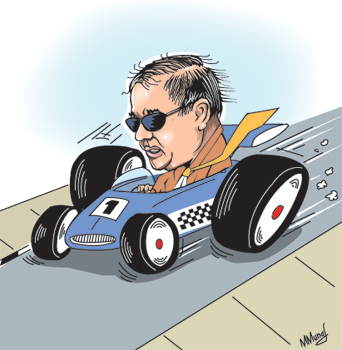
What is most praiseworthy is your decision to reduce taxes on racing cars and go-karts, PB. That was simply a stroke of genius that only you could think of and I am sure it made a lot of people extremely happy-and that is the type of budget proposal which will keep you in employment for years to come!
Just imagine how this proposal would transform our transport sector: because ordinary cars are more expensive, more and more people will now buy go-karts and racing cars and what is more, because everyone will be using racing cars, we will get to our destinations even faster!

Of course, PBJ, you could have gone one step further and scored a few more brownie points if you had reduced duties on spacecraft for would-be astronauts and also reduced taxes on imported racehorses for racing enthusiasts, but unfortunately you seem to have missed out on that one!

You have also increased taxes on casinos, PB, in an attempt to raise revenue. Now if you had imposed a new tax on individuals who go to nightclubs and casinos and get into brawls that would have really helped you generate some extra money!

It was also a smart move to increase the allowances granted to judges, university academics and doctors. We know what a lot of bother judges are causing these days and both university academics and doctors strike at the drop of a hat-so it was good thinking to pacify them.

Now, with you being an old hand at budget tricks, you haven’t told them how much of an increase they would be getting. So, when they start complaining and staging protest marches a few months later, you could give them a tiny pay hike and always tell them that you kept your promises!

You must also be congratulated, PB, for your proposal to give a free pair of shoes to schoolchildren. Now we give our children free education, free uniforms, and free shoes-so I am sure the entire crisis in education will be settled by next year and all tuition masters will go out of business!

And anyway, it is a good idea to give schoolchildren a free pair of shoes because the pair of shoes they already own would be worn out by having to wait longer for ‘A’ level results and then having to trudge to the courts to get their results authorized.

So, PB, you have done your job well. And needless to say, it will be passed by those sitting near the Diyawanna Oya because these days anything that is presented there gets passed without a whimper, no matter what its impact on the country is. We will see more of that in the coming weeks, I guess.

Yours truly,
Punchi Putha

PS-You must have felt like the race horse watching the jockey being handed the cup for winning the race when you saw Mahinda maama doing the honours and getting all the applause last week. But you can’t complain, because, if not for Mahinda maama, you would still be languishing in retirement, wouldn’t you?

Saturday, November 10, 2012

Honour pledges or face consequences, dons tell govt.

, The Island

article_image
The Federation of University Teachers’ Associations (FUTA) yesterday urged the government to honour the agreements reached consequent to negotiations between FUTA and the government or face the consequences.

FUTA President Dr. Nirmal Ranjith Dewasiri, in a letter to Economic Development Minister Basil Rajapaksa, dated Nov. 7, accused the government of failing to honour the agreements, though FUTA had suspended trade union action on Oct. 12. The FUTA chief sought a clarification from Minister Rajapaksa as regards the status of the implementation of the agreements.

Full text of Dr. Dewasiri’s letter: "As you know, the FUTA’s decision to suspend its trade union action from Oct 12 was made in good faith and was based on several agreements reached during the negotiations conducted with government officials, including yourself and the Treasury. These agreements were communicated through:

1. The note to the Cabinet and the Cabinet decisions taken on 29th September 2012 Matters pertaining to Education and Higher Education.

2. A letter dated, 9th October 2012 from the Secretary of the Ministry of Finance and Planning.

3. Letter dated 10th October 2012 from the secretary to the ministry of higher education regarding payment of unpaid salaries for the period of the trade union action.

4. Letter dated 10th October 2012, from the. Minister of Higher Education, pledging to refrain from taking any punitive action against University academics who took part in the trade union action.

5. The joint Press Statement between the government and the FUTA issued on 12th October 2012.

However, it is with grave concern that we note the following:

1. The validity and the very existence of the joint statement have been questioned by sections of the government and several Vice-Chancellors. Several Vice Chancellors have stated that they are unaware of such an agreement and therefore are not bound to adhere to any agreements (such as the agreement to conduct a special senate and a meeting with all academics).

2. The agreement that circulars named by the FUTA would be rescinded as soon as academics return to work has not been honoured. Instead, a committee has been appointed by the UGC to look into this matter. This action by the UGC is a total violation of the agreement between the government and the FUTA.

3. Academics have not been paid their salaries in full for July, August and September 2012 as promised by the aforesaid letter by the minister of higher education. For example, allowances and salaries of several heads of department’s and academics who had held acting posts are yet to be paid.

Under these circumstances, we are compelled to question the sincerity of the government in honouring its publicly made commitments to FUTA at the time of suspension of the trade union action. Thus, we kindly request you to clarify the status of the implementation of the said agreements and the validity of the documents referred above that express the government’s commitment.

We would also like to point out that we are closely monitoring the situation and that weare very disappointed and disturbed with the government’s apparent lack of sincerity. Thus, the FUTA will be compelled to review its decision to suspend trade union action in the weeks to come unless there is progress from the side of the government with regard to implementing the agreements it reached during the negotiations with the FUTA.

I kindly request you to look into these concerns in order to avoid unnecessary consequences.

Friday, November 9, 2012

Dons, docs studying the budget

, The Island

by Dasun Edirisinghe

University teachers, who sought a pay hike from the budget, yesterday said they could not comment on the academic allowance increment, proposed by President Rajapaksa, until they study it at length.

President of the Federation of University Teachers’ Associations (FUTA) Dr. Nirmal Ranjith Dewasiri told The Island that President Rajapaksa had promised an increment in the allowance for university teachers, doctors and judges within affordable limits.

Dr. Dewasiri said that they were still to know what the amount of the increase was and it was still too early to comment on it.

President Rajapaksa also promised a 15 per cent increase in expenditure on education and had now set aside 4.1 per cent of the GDP for it against their demand to allocate 6 per cent of GDP for education, Dr. Dewasiri said.

The senior academic said that they did not know how the government’s figure had been calculated.

"Currently, only 1.9 per cent of the GDP is allocated for education according to our calculations," Dr. Dewasiri said, adding that government’s calculations were different.

Meanwhile, the Government Medical Officers’ Association (GMOA) said they needed time to analyse the budget.

GMOA spokesman Dr. Naveen Zoysa said that their membership expected much relief from the budget.

"Our executive committee will analyse the budget during this weekend," he said, adding they would announce their decision by Monday.

Budget geared for growth

The Island
* Rs. 1,500 for public workers
* Rs. 5,000 for July strikers over 65 yrs
* Rs. 1 bn for drought relief
* Free education to be protected
* Expected growth rate 7.5 %
* Projected budget deficit 5.8 %
* Expenditure on education up by 15%
* Rs. 500 for senior citizens
*  Rs. 750 and Rs. 500 for pensioners
* Tax exemptions for racing cars
* Allowances for judges, dons, docs et al revised


article_image
By Saman Indrajith

President Mahinda Rajapaksa, presenting his government’s eighth consecutive budget in Parliament yesterday, offered a 1,500-rupee monthly allowance for each state sector employee, Rs. 1,000 million to ease the burden of drought battered farmers, a 5,000-rupee monthly allowance for the July strikers over 65 years of age and an import tax exemption for racing cars.

He invited Opposition parties to cooperate with the government to solve problems confronted by the people.

Summarising the macro-economic vision of his government for the next two years, the President said that budget 2013 had been framed to ensure that the economy would bounce back at an average growth rate of 7.5 percent next year and eight percent thereafter.

"The underlying fiscal strategy will contribute to a budget deficit of 5.8 percent in 2013 and move towards a deficit of 4.5 percent by 2015, with public debt below 75 per cent of the GDP," President Rajapaksa said.

"I assure children and parents of this nation, through this August assembly, that this government under no circumstance will compromise its commitment to deepen the scope of free education."

Against this backdrop, the President said that the expenditure on education would be increased by 15 percent in 2013.

He proposed to exempt businesses having an annual turnover less than Rs. 12 million from the Nation Building Tax and Value Added Tax with effect from January 2013.

"I propose to raise the Airport Tax by US$ 10 and the Online Visa Fee by US $ 5 from January 2013. I also propose to update several administrative fees and charges which have not been updated for several years. I also propose to introduce amendments to the Finance Act requiring all regulatory agencies and government departments to transfer revenue in excess of the required establishment expenditure and a three month working capital requirement, to the Consolidated Fund, once in three months. "I propose to increase duties by 10-20 percent on all vehicles imported under concessional schemes," he said.

"I propose to allocate Rs. 300 million annually to grant a monthly living allowance of Rs 5,000 to July strikers who complete 65 years of age on January 1, 2013.

"I propose to increase the allowances given to public sector servants by a minimum of Rs 1,500 per month from next year. A Cost of Living allowance of Rs. 750 per month will be paid from January to all public servants. The balance will be provided by granting a further five percent of the basic salary subject to minimum of Rs 750 and a maximum of Rs 2,500 as an additional allowance, to all public servants. I propose to grant 50 percent of the proposed 5 percent increase from May 2013 and the balance from September. All those in staff categories will be given 50 percent from July and the balance from October 2013. I also propose to revise the service related allowances formulated for judges, university academic staff, medical practitioners, and specialised categories, recognising their special role within the affordable limits in the budget and capacity to sustain them over the medium term and grant 50 percent of the increase from January 2013 and the balance from July."

It is also proposed to increase the registration fees on betting businesses to Rs. 2 million and on gaming activities to Rs 100 million. "I also propose to impose a 5 percent tax on the turnover of a gaming business," he said.

In order to provide some relief to retired public servants, the President said it was proposed to grant a special allowance of Rs 750 per month to those who retired before 2004, and Rs 500 per month to those who retired from 2005 to 2006. "I propose to grant 50 percent of this increase from January 2013 and the balance from July 2013. I also propose to increase the cost of living allowance to all pensioners by Rs 500 per month from January 2013."

He proposed an allocation of Rs 200 million to finance the continuance of the interest free loan scheme for media personnel and artistes.

The second reading on the Appropriation Bill will commence today (9) and will continue until November 17 (seven allotted days). The second reading vote will be taken at 6.00 p.m. on November 17. The committee stage debate will begin on November 19 and continue until December 8 (16 allotted days). The third reading vote will be taken on December 8.