Monday, October 29, 2012

The Myth of Free Education

Monday, 22 October 2012 00:00, Dailymirror
By Muttukrishna Sarvananthan
The Federation of University Teachers’ Association (FUTA) and the Inter University Students’ Federation (IUSF) in Sri Lanka have been on a long campaign to “protect free education”. I will be dealing with both the semantics and substance of “free education” in Sri Lanka in this think piece.

The fundamental truth is that NOTHING IS FREE IN THE WORLD of human beings. Every single citizen of Sri Lanka pays several taxes to the government for the provision of public goods (for e.g.infrastructure) and services (for e.g. education, health). Since between 70-75% of the total revenue of the government accrues from indirect (consumption) taxes every single citizen pays various taxes to the government daily during their entire lifetime. Therefore, every household pays for the education of their children albeit indirectly through the payment of direct (income) and indirect taxes to the government.
Besides, there is rampant corruption in admissions to popular schools throughout Sri Lanka which makes a mockery of the free education system because of payment of bribe to secure admission. In addition, almost all the parents pay to send their children to private tutories from grade one onwards because most schools in the country hardly teach anything worthwhile despite being nominally free-of-cost.

According to the latest Household Income and Expenditure Survey (HIES) 2009/10, out of the total non-food expenditure of the households, the average monthly household expenditure on education amounts to 5.6% of the total (following personal care & health expenses 41.5%, housing 19.1%, transport 12.8%, and fuel & light 7.1%). The average monthly household expenditure on education is higher than on clothing, textiles & footwear (5.0%) and Communication (4.2%), for example. With expenditures on education and health consuming 47% of the total household expenditures, how legitimate is the claim of “free” education and health in Sri Lanka?

The public-funded universities and other public-funded tertiary educational institutions produce mostly UNEMPLOYABLE graduates. Barring Engineering and Medical degrees, most degrees awarded by the fifteen universities in Sri Lanka are not worthy of recognition. Public universities in Sri Lanka are infested with under-qualified and abysmal quality teachers; especially in the arts, humanities, and social sciences, disciplines which together accommodate more than two-third of the total university student population in the country. The fact that many university teachers in Sri Lanka send their children abroad for higher education is a testimony to the abysmal quality of university education in Sri Lanka.

According to the HIES 2009/10, only 14.7% of the population has passed the G.C.E. O/L examination and another 11.2% has passed the G.C.E. A/L examination or beyond, out of which little over 1% have an undergraduate degree or above. Hence, in total only 26% of the population has passed the G.C.E. O/L or beyond in the country. In other words, the eulogised free education in Sri Lanka has failed three-quarters of the population. The fact that many members of parliament (from all political parties) send their children to the fee-levying private ‘international schools’ is a testimony to the abysmal quality of school education (private and public) in the country.

" Almost all the parents pay to send their children to private tutories from grade one onwards because most schools in the country hardly teach anything worthwhile "

According to a Ministry of Education source, even the foregoing pass rates are achieved by lowering the pass mark at the G.C.E. O/L examination to 30 in the past five-years or so from the historic pass mark of 40 in order to fulfill a commitment made in the “Mahinda Chinthana”. Such fudging of numbers as a way of attaining policy goals and targets has become a hallmark of the Rajapaksa regime and perhaps their policy instrument to make Sri Lanka a “knowledge hub” in Asia. Besides, a significant part of the 1% of the population with degrees is unemployed or under-employed because of the poor quality of their degree. Is this the result envisioned by the champion of free education Mr. C.W.W. Kannangara when he introduced free education in 1945?
The FUTA and IUSF may contend that the foregoing pathetic results of our free education system are due to under-funding. However, I would contend that with similar or lesser amount of public funding many other developing countries have achieved much better results than Sri Lanka has. Money is a necessary but insufficient ingredient for attaining quality education both at the school and higher education levels.

It is high time for educationists to do soul-searching regarding the outcome of the sixty seven years (1945-2012) of free education. The entire education sector in Sri Lanka, from cradle to crematorium (lifelong learning), has been in crisis for a very long time. The low salaries of the school and university teachers and the declining share of the Gross Domestic Product (GDP) devoted to the education sector are minor problems in my view. The major problems afflicting the education sector in my view are (a) dated and irrelevant curriculum (b) predominance of culture of teaching (spoon feeding) as opposed to culture of learning (c) lack of performance-based remuneration for teachers which has resulted in low-level of motivation (d) nepotism and favouritism in awarding scholarships for postgraduate study abroad to academics, and (e) ragging of students by students and sexual exploitation of female students by male teachers which are endemic in further and higher education institutions. The Universities’ Grants Commission (UGC) and individual universities have the legal right and responsibility to rectify the foregoing core problems (except the common salary scale) without government interference. What has FUTA done to address these problems?

In this ground reality, what is the logical, moral, or rational economic imperative for the demand to allocate 6% of the GDP for the education sector when only 1% of the population has earned a degree (that too of unemployable quality)? In my view, even if the government allocates 10% of the GDP for education, the quality of our university graduates and teachers will not improve unless and until the aforementioned core issues afflicting the education sector are corrected. Thus, any resolution of the salary issue should be tied to resolving severe qualitative problems highlighted above. Is the holy grail of “free education” in Sri Lanka worthy of protection?

Education will follow. Muttukrishna Sarvananthan Ph.D. (Wales), M.Sc. (Bristol), M.Sc. (Salford), B.A. (Hons) (Delhi) hails from Point Pedro, Northern Sri Lanka, and a Development Economist by profession and the Principal Researcher of the Point Pedro Institute of Development (PPID). He has been an Endeavour Research Fellow at the Monash University (Melbourne, Australia) and Fulbright Visiting Research Scholar at the George Washington University (Washington D.C, USA.) as well. sarvi@pointpedro.org

Sunday, October 28, 2012

பல்கலையை உலுப்பி எடுக்கும் அரசியல் தலையீடு,
 http://onlineuthayan.com/ news
யாழ்.பல்கலைக்கழகத்துக்கு கணினி பிரயோக உதவியாளர்கள் மற்றும் எழுதுவினைஞர்களை நியமிப்பதற்கான நடவடிக்கைகள் அரசியல் தலையீடு காரணமாக நேற்று மீண்டும் தடுத்து நிறுத்தப்பட்டன. இதனை எதிர்த்து பீடாதிபதிகள் கூட்டத்தில் இருந்து வெளிநடப்புச் செய்தனர்.
"தியேட்டரில் இருந்து காலையில் கிடைத்த உத்தர வுக்கு அமைய நியமனப்பட்டியல் பேரவைக் கூட்டத்தில் முன்வைக்கப்படாமல் தவிர்க்கப்பட்டது'' என்று நம்பகமான தகவல்கள் உதயனுக்குத் தெரிவித்தன.
இந்த விடயத்தில் தீர்மானகரமாக, தனது அதிகாரங்களைப் பயன்படுத்தி முடிவு எடுக்கக் கூடியவரான துணைவேந்தர் வசந்தி அரசரட்ணம் எதுவும் பேசாமல் வாளாவிருந்தார் என்றும் அந்தத் தகவல்கள் மேலும் கூறுகின்றன.
நேற்று நடைபெற்ற, பல் கலைக்கழகத்தின் மாதாந்தப் பேரவைக் கூட்டத்தில் இந்த விடயம் ஆராயப்படும் என்று தீவிரமாக எதிர்பார்க்கப்பட்டது. அதற்கான பத்திரங்களும் தயார் நிலையில் இருந்தன. ஆனால் கூட்டம் ஆரம்பமான பின்னரும் அது கூட்டத்தில் முன்வைக்கப்பட வில்லை. 
கல்விசாரா ஊழியர்களின் நியமனங்கள் குறித்த விடயம் கூட்டத்தில் விவாதத்துக்கு எடுக்கப்பட்ட போது, பீடாதிபதிகள் இந்த நியமனம் பற்றிக் கேள்வி எழுப்பினர். ஆனால் "காலையில் அமைச்சரிடமிருந்து வந்த உத்தரவை அடுத்து இந்த நியமனப் பட்டியல் பேரவையின் அங்கீகாரத்துக்காகச் சமர்ப்பிக்கப்படவில்லை'' என்று பல்கலைக்கழகப் பதிவாளர் வி.காண்டீபன் தெரிவித்தார்.
கூட்டத்துக்குத் தலைமை வகித்தவர் துணை வேந்தர் வசந்தி அரசரட்ணம். பதவி நிலை வழியாக அவரது செயலராகப் பதிவாளர் பணியாற்றுகிறார். இருப்பினும் இந்தக் கூட்டத்தில் நியமனப் பட்டியலை முன்வைக்கத் தான் அனுமதி வழங்கியிருந்தார் என்றும் அதற்கான ஆவணங்கள் தயார் நிலையில் வைக்கப்பட்டிருந்தன என்றும் துணைவேந்தர் தெரிவித்தார்.
இந்த விடயத்தை பேரவையின் முடிவுக்கு விட்டுவிடுவதாகவும் அவர், பந்தைத் தள்ளிவிட்டார். இதனை தொடர்ந்து காரசாரமான வாதங்கள் இடம்பெற்றன. பேரவையின் முடிவுக்கு விடுவதாகத் துணைவேந்தர் தனது பொறுப்பைத் தட்டிக் கழிக்கக்கூடாது என்று பீடாதிபதிகள் வாதிட்டனர்.
அதேநேரத்தில் பேரவைக் கூட்டத்தில் வாய் மொழி மூலமான உத்தரவுகளைச் செயற்படுத்த முடியாது என்று சுட்டிக்காட்டிய பீடாதிபதிகள், அமைச்சரின் உத்தரவு எழுத்தில் இருந்தால் அதனைக் காட்டுமாறு கோரினர். 
ஆனால், அத்தகைய உத்தரவுகள் எவையும் எழுத்து வடிவில் இல்லை என்றும் காலை 8 மணிக்கு தொலைபேசி வழியாகவே வழங்கப்பட்டது என்றும் பதிவாளர் பதிலிறுத்தார். 
அமைச்சரும் ஆளுநரும் இவ்வாறு வாய்மொழி உத்தரவுகள் பலவற்றையும் இடும் பழக்கத்தைக் கொண்டவர்கள் என்று தெரிவித்த, கூட்டத்திலிருந்த அரசியல் வழி நியமனங்களான பேரவை உறுப்பினர்கள் சிலர், அவ்வாறான வாய் மொழி உத்தரவுகளை ஏற்றுச் செயற்படுத்தலாம் என்று வக்காலத்துப் பாடினர். 
இதனைத் திட்டவட்டமாக மறுத்த பீடாதிபதிகள், பல்கலைக்கழக நிர்வாகம் என்பது சட்டங்களையும் அமைச்சின் சுற்றறிக்கைகளையும் மதித்தே நடத்தப்படுகின்றது; நடக்கின்றது என்று அழுத்திக் கூறியதுடன் வாய் மொழி மூலம் சொல்வதை ஏற்றுக் கொள்ள முடியாது என்று உறுதியாக நின்றனர். 
இதற்கு இணங்க மறுத்த, அரசியல் நியமன பேரவை உறுப்பினர்கள் அதனை ஏற்றுக்கொள்ளத்தான் வேண்டும் என்று வலியுறுத்தினர். இதனை அடுத்து பீடாதிபதிகள் கூட்டத்தில் இருந்து வெளிநடப்புச் செய்தனர். விஞ்ஞான பீடாதிபதி கே.கந்தசாமி மற்றும் கலைப் பீடாதிபதி வி.பி.சிவநாதன் ஆகியோர் முதலில் கூட்டத்தில் இருந்து வெளியேறினர். அவர்களைத் தொடர்ந்து ஏனைய பீடாதிபதிகளும் வெளியேறினர். 
ஆனால் அவர்கள் சமாளிக்கப்பட்டு மீண்டும் தமது ஆசனங்களுக்கு திருப்பப்பட்டனர். 
இன்னும் இரண்டு வாரங்களுக்குள் அமைச்சருடன் பேசி, இந்தப் பிரச்சினைக்கான தீர்வைப் பெற்றுத் தருவதாக பேரவை உறுப்பினரான முன்னாள் துணைவேந்தர் சமாளித்தார். 
இவர் கடந்த கூட்டத்தின் போதும் இப்படித்தான் தெரிவித்தார் என்று பேரவை உறுப்பினர்கள் சிலர் உதயனிடம் சுட்டிக்காட்டினர். "அமைச்சருக்கு நெருக்கமான  புலிகளின் ஆதரவாளர்களால் வடமராட்சி சுடலை ஒன்றில் வைத்து நையப்புடைக்கப்பட்ட அதிபர் ஒருவரின் புதல்விக்கு இந்தப் பட்டியலில் நியமனம் வழங்கப்படாததன் காரணத்தால்தான் இவை தடுத்து நிறுத்தப்படுகின்றன'' என்று பேரவை உறுப்பினர் ஒருவர் உதயனிடம் தெரிவித்தார். 
இருப்பினும் கடந்த மாத இறுதியில் தியேட்டருக்குச் சென்று அமைச்சரைச் சந்தித்துப் பேசிய பீடாதிபதிகள் இந்த விவகாரத்தை எடுத்து விளக்கியிருந்தனர். 
அதற்கு, தான் அதற்காக இந்தப் பிரச்சினையைக் கையில் எடுக்கவில்லை என்று பதிலளித்திருந்த அமைச்சர், தனது ஆதரவாளர்கள் பலருக்கு நியமனம் கிடைக்கவில்லை என்று அவர்கள் தெரிவித்த முறைப்பாட்டுக்கு அமைவாகவே தான் அதனைத் தடுத்து நிறுத்தியிருந்தார் எனச் சப்பைக் கட்டுக் கட்டியிருந்தார்.

CMU explains donation to support FUTA strike

, The Island

The Ceylon Mercantile, Industrial & General Workers’ Union (CMU) donated half a million rupees to The Federation of University Teachers’ Associations (FUTA) on 3rd October 2012, in support of the general strike of its affiliated unions in the fourteen State-funded universities in this country. The CMU donation received publicity and some comment in the media, after the FUTA President had received it at a media conference held at the CMU headquarters that day. The reasons why the donation was made are worthy of publicity, as it was made from funds conserved by the CMU over a period of nearly sixty-five years, from the contributions of workers who are paid much lower wages than the salaries of university teachers,

 It is necessary for us, in the first place, to make it clear to the public that the donation was not made in response to any solicitation from the FUTA leadership whatsoever. It was made mainly because of the importance of the FUTA demand for 6% of the GDP to be allocated by the State for Education at all levels, for millions of working men and women like most of the members of our union, who are constrained to bear considerable costs for the education of their children, due to inadequate funding for state schools,

 The FUTA general strike was in pursuance of the demand for the grant of pay increases for all grades of teachers in all the universities, which were said to have been promised to them; that demand, like the demand for a guarantee of university autonomy was no doubt of special importance for them, in their academic sphere, and worthy of support, too.

 As our Union has had considerable experience of prolonged strikes of workers, we could well guess that financial assistance might be needed by academics who might have been experiencing serious financial difficulties, without pay, as the strike dragged on in the absence of any positive indication from the Government and the State authorities responsible for Higher Education to settle the strike by direct discussion with the FUTA representatives. Before offering to make a financial contribution to FUTA in the circumstances, however, we consulted the President and the Treasurer of FUTA as to what financial assistance that they might have received for the strike. On the basis of the information they gave us in that respect, our Executive Committee decided to make the contribution of five hundred thousand rupees to the FUTA Activites and Welfare Fund on 3rd October.

 We learnt that representatives of FUTA had been invited for discussions with responsible representatives of the Government and the University Authorities, shortly thereafter, and that they had decided to suspend their strike, with a return to work by their members on 12th October 2012, on certain assurances they had received. One was for restoration of pay withheld during the strike.

 We were informed thereafter, by a letter from the President of FUTA on 21st October, "that the entirety of the donation made by the CMU will be used by FUTA for the purpose of conducting activities related to raising consciousness among the general public of the country on the issue of the need for protecting the state sector education from which families of members of the CMU also benefit".

 We think that the publication of the reasons why our Union made its donation to FUTA. and the FUTA decision as to its future utilization, would be of public interest.


Issued on behalf of

The Ceylon Mercantile, Industrial & General Workers’ Union

Saturday, October 27, 2012

COPE guns for shirking dons

, The Island

article_image
The Parliamentary watchdog committee on Public Enterprises (COPE) has observed that there were serious lapses on the university administrators.

"According to details provided by the University Grants Commission on the number of lecture hours conducted by each lecturer in the year 2010, there were 117 lecturers whose number of lecture hours conducted for the entire year had been less than ten," COPE’s interim report for the period from 01.01.2012 to 30.09.2012, submitted to Parliament by its Chairman Senior Minister DEW Gunasekera on Thursday, said.

The report said: "The Committee is of the view that the university education in Sri Lanka requires some drastic changes for its qualitative development. The curricula have not been changed for years with the changes taking place in the relevant fields over the past few decades. Most of the graduates who pass out from the universities do not possess a satisfactory competency in the English language and the common grievance with regard to most of the degree courses is that they are not job oriented. The sharp decline in the number of students who offer Economics, as a discipline, is a matter of concern.

"The Committee also observed some serious lapses with regard to the administration of certain universities. It came to light that the commitment of certain lecturers with regard to betterment of the academic performance is not up to the required level. The committee strongly criticizes the relevant authorities for turning a blind eye towards this matter."

Wednesday, October 24, 2012

UGC’s failure to withdraw circulars irks FUTA


article_image
by Dasun Edirisinghe, The Island

The Federation of University Teachers’ Associations (FUTA) yesterday accused the University Grants Commission (UGC) of failing to withdraw several controversial circulars issued during its 99-day strike, though Economic Development Minister Basil Rajapaksa had promised to have them withdrawn immediately. The FUTA suspended its strike on Oct. 11.

FUTA President Dr. Nirmal Ranjith Dewasiri told The Island that in line with the agreement between FUTA and Minister Rajapaksa, all circulars, which interfered with the normal functioning of universities, would be withdrawn.

Dr. Dewasiri alleged that UGC was trying to delay the process by appointing a committee to go through the circulars.

The academic said FUTA executive committee would evaluate the progress of the implementation of its agreement with Minister Rajapaksa this week.

"Our executive committee is not happy with the progress of implementing the promises and we will decide on our future course of action shortly," Dr. Dewasiri said.

When contacted by The Island, UGC Chairman Prof. Gamini Samaranayake said circulars could not be cancelled overnight that process took some time.

VCs get report on leadership programme


by Dasun Edirisinghe, The Island

The Higher Education Ministry has sent the entire detailed report on the leadership training programme for prospective university entrants to the Vice Chancellors of all universities for their comments in keeping with a government pledge to the Federation of University Teachers’ Associations (FUTA).

Additional Secretary of the Ministry P. G. Jayasinghe said that they had asked the Vice Chancellors to submit their opinions before Oct. 30.

The Ministry has planned to start the leadership training programme on Nov. 15 in three batches consisting of 9,000 students each.

Tuesday, October 23, 2012

University teachers join protest march of teachers & principals

The Federation of University Teachers Associations (FUTA) has decided to join the protest march organized by teachers’ and principals’ trade unions to be held on the 24th say reports.
It has been reported in the media that teachers’ and principals’ trade unions had decided to take several trade union actions to get solutions for 6 demands they have put forward.
Accordingly, the protest march with the support of university teachers will commence from Rajagiriya roundabout at 10.00 a.m. and march to Isurupaya.

Teachers led by ‘colonels’ to march on Edu. Ministry


article_image
by Dasun Edirisinghe, The Island

Principals and teachers of the State-run schools are scheduled to march to the Education Ministry with several demands tomorrow, according to a JVP affiliated trade union.

The government recently enlisted 30 Class 1 Principals Brevet Colonels.

General Secretary of the Ceylon Teachers’ Service Union Mahinda Jayasinghe told The Island the protest march would start from the Ayurveda roundabout Rajagiriya and end with a demonstration opposite the Education Ministry, Isurupaya.

He said that they would hold the protest march and demonstration to force education authorities to grant their six demands.

"Our main demand is the implementation of the recommendations made by the Cabinet of ministers in 2008 to rectify the anomalies in salaries of principals and teachers," Jayasinghe said.

He said that they also demanded immediate solutions to problems as regards their promotions and salary arrears, implementation of the national teachers’ transfer policy, allocation of funds for disaster loans and property loans, allocation of 6 per cent of the GDP for education and an end to political interferences in the education field.

Jayasinghe said that they had held a meeting with Deputy Education Minister Vijithamuni Zoysa and two additional directors on Oct. 18, but it had ended inconclusively.

"We held another discussion with the Deputy Education Minister and Secretary of the Ministry yesterday," he said, adding it, too, had ended without a solution.

The Teachers’ and Principals’ Trade Union Joint Committee has organised the protest march. The TPTUJC includes Ceylon Teachers’ Union, Ceylon Teachers’ Service Union, Independent Teachers’ Union, All Ceylon United Teachers’ Union, National Education Employees Union, Common Education Professionals Union, All Ceylon Principals’ Union and Sri Lanka National Principals’ Union.

FUTA strike: Some issues


article_image
By Eric J. de Silva, The Island

The university teachers’ strike that the government told us had been called off has only been suspended according to FUTA, with every prospect of being resumed - a temporary truce with all the forebodings it has for those who want the universities to function without disruption.

The FUTA strike, which began when negotiations with government for a salary increase for university teachers broke down, took a totally different turn when FUTA deftly tagged on a demand for a 6% allocation of GDP for education to obtain wider support for their struggle. This they succeeded in doing with teachers’ unions and other groups rallying round the 6% banner though many of them did not have a clue as to what it really meant in rupees and cents (if cents do matter)! The fact that the FUTA move paid ample dividends was seen in the haste in which not only mainstream political parties but also nondescript (no insult meant) politicians in search of an identity jumped the FUTA bandwagon as described in a piece I wrote to The Island on 4/10/12 (Jumping the FUTA bandwagon).

6% of GDP for education

Spokespersons for FUTA insisted that the target of ‘6% of GDP for education’ should be reached by 2015 as a Millennium Development Goal which Sri Lanka had subscribed to in 2000, as a member of the United Nations. However, neither the report prepared by the World Bank in 2005 titled ‘Attaining the Millennium Development Goals in Sri Lanka’ (a copy of which I found in my bookshelves) nor relevant websites I checked with gave any indication of there being a MDG to that effect. The Millennium Development Goals subscribed to by 193 member nations of UN and 23 international organizations in 2000 simply read as follows:

1. Eradicating extreme poverty and hunger

2. Achieving universal primary education

3. Promoting gender equality and empowering women

4. Reducing child mortality rates

5. Improving maternal health

6. Combating HIV/AIDS, malaria, and other diseases

7. Ensuring environmental sustainability, and

8. Developing a global partnership for development.

It will be observed that these goals are more oriented towards eradicating illiteracy, alleviating poverty, improving health, empowering women and protecting the environment. As far as education is concerned, only primary education receives specific mention – obviously as a means of eradicating illiteracy. A meeting held in September 2010 at UN Headquarters in New York had conducted a progress review and concluded with the adoption of a global action plan to achieve the above goals by 2015, the targeted year. Thus the FUTA claim does not hold water, unless they can produce documentary evidence to the effect that there is, in fact, a Millennium Development Goal requiring member counties to allocate 6% of GDP for education.

Much has been said about the remark made by the renowned Pakistani scientist, educator, policy maker and former Minister of Science and Technology Prof. Atta ur Rahman about being in a position to advise President Rajapakse as to how 6% of GDP could be allocated to education, if requested to do so. He made this remark in answer to a question posed to him after the excellent lecture he delivered at the SLAAS auditorium on 27th September while the FUTA march from Galle was wending its way to Colombo. There was thunderous applause when he said this, and I too joined in it due to the exhilarating effect his speech had on me! I was naturally curious to know how much Pakistan spends on education and, when I checked the figures later, I found that their expenditure had been 1.9% in 2001, 2.9% in 2009 and 2.4% in 2010. These figures are obviously higher than ours, but nowhere near the 6% mark which had by then virtually become the FUTA trade mark!

What most people forget is that, as Prof. Rahman himself was quick to point out, Pakistan has over the years given greater attention to the apex of the pyramid (higher education) rather than to the base (primary and secondary education). As a result, despite their advances in the area of science and technology which he so graphically described, Pakistan remains among the Low Human Development Countries in terms of the Human Development Index occupying the 145th place out of 187 countries (with 50% of the population deprived of basic necessities of education and health) while Sri Lanka is among the Medium Human Development Countries occupying the 97th place, clearly showing that we have chosen one path and they another!

Pakistan

In this connection, my memory takes me back to a visit I made to Pakistan in the mid eighties when I was invited to join a Sri Lankan delegation led by the then Education Minister with the Secretary of the Ministry and a couple of others in the team. (I was working then as head of a Unesco Project in Sri Lanka). At a brief meeting the delegation had with Prime Minister Junejo (General Zia ul Huq was President at the time) which was more in the nature of a courtesy call than a substantive discussion, he was full of praise for the high standards of literacy (87% in SL as against 30% in Pakistan in 1985) that we had achieved thanks to our school system, and said that Pakistan had a lot to learn from us. He, however, inquired whether we did not see a link between it and youth unrest and the insurrection that followed due to employment opportunities not keeping pace with rising expectations that education brings along with it. While agreeing that there certainly was, we also brought to his attention the benefits that a high rate of literacy had brought about in areas such as health, women’s empowerment and the spread of family planning.

Developments in Pakistan since then are too well-known to bear repetition here. Despite Pakistan’s significant achievements in the field of higher education, science and technology that Prof. Rahman referred to, Pakistan’s present literacy rate of 58% remains among the lowest in the world (while ours is around 94%), and keeping half the population illiterate has not helped to keep violence and terrorism out of the way. What we all know is that these have taken such a heavy toll on Pakistan that their cricket team has to go outside Pakistan’s national boundaries to Abu Dhabi or Dubai to play their matches against visiting teams following the violent attack mounted on our cricketers a few years back, showing that there is no relationship between literacy and insurgent activities.

Need for more funds

It is beyond question that our education sector needs more funds if we are to adequately meet present needs as well as challenges that lie ahead. But funds alone are not sufficient without a proper policy framework, well formulated projects, proper implementation strategies and a competent and professional administration capable of getting the job done, none of which we can claim to have today. Usvatte (The Island 22/8/12) has pointed out that we spend 121 billion rupees per year on education (equivalent to 2% of GDP) at present and that tripling this amount to reach the 6% target would mean an additional 242 billion rupees of government expenditure. Even if, by some miracle, the government is able to considerably increase the government budget for education annually so as to reach the 6% target by 2015, it is my contention that we will not be able to spend so much, unless ‘spending’ means running through the money on ill-conceived projects and hare-brained schemes providing, in the process, ample opportunity for predators of all sorts to line their pockets at public expense. This, surely, is not what we want!

Sunday, October 21, 2012

FUTA action ends to be resumed if promises not kept

View(s):

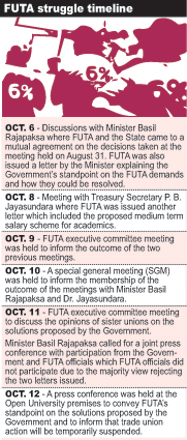
The 100-day long trade union action by university academics fizzled out on Friday amidst protests of section of the academics, but eventually bringing relief to students and parents.�There was disappointment among sections of the academics as they failed to gain clear commitments on the demands of the Federation of the University Teachers Association (FUTA).

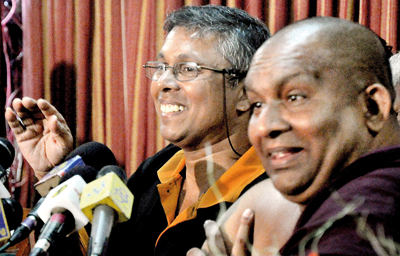
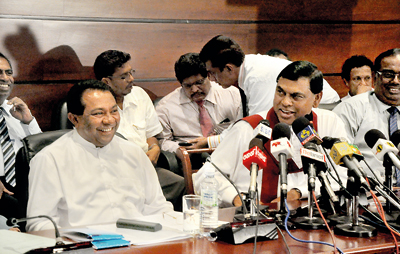
The two news conferences held yesterday: One convened by the Govt. and the other by FUTA. Pix by Mangala Weerasekera
University of Moratuwa FUTA branch President Dr. Rangika Halwathura said that even though an agreement was made to halt the trade union action, the majority of the membership is disappointed in the obdurate stand of the Government on the demands.

“None of the universities frankly wanted to conclude their trade union action but now we have come to the distressing realization that nothing can be gained from this Government and since there is no point on carrying out trade union action on a lost cause, we are concluding it,” he said.

He that the majority at the executive committee meeting rejected the two letters given by Minister Basil Rajapaksa and Treasury Secretary P. B. Jayasundara regarding the solutions to the issues raised.

He said in one way FUTA has achieved victory as it has been able to create a dialogue in the country on the issues of education where 6 per cent of the GDP should be set apart for education became a common slogan among the general public.

He further added that the struggle to save State education will continue even though the trade union action was halted and the strike will be resumed again if the given promises are not kept.

The trade union action which was carried out by FUTA came to a conclusion of Friday as both FUTA and the Government came to a mutual agreement on the former’s demands.

The strike continued for almost 100 days since it began on July 4 crippling the functioning of 14 State universities island-wide.

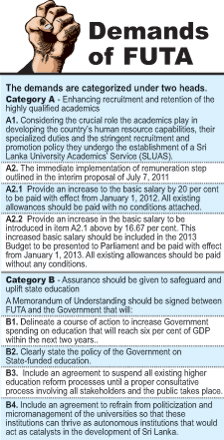
After the consideration of six demands of FUTA which were categorized under enhancing recruitment and retention of highly qualified academics and safeguarding and uplifting State education, FUTA has been issued two letters with regards to salary increments and a promise to increase the budgetary allocation for education.

These letters were issued by Dr. Jayasundara and Minister Basil Rajapaksa respectively, said Dr. FUTA Secretary Terrance Madujith.

He added the academics were presented a proposal by which a medium term salary scheme is to be implemented with effect from the 2013 Budget through a period of five years. �He also said that in Minister Basil Rajapaksa’s letter, it is mentioned that the budgetary allocation on education will be increased but a time frame as to how it will be implemented has not been given by the Government.

However the Sunday Times learns the majority of the sister unions in FUTA believe these two letters are unacceptable but they are compelled to suspend trade union action due to financial difficulties undergone by the membership and inconveniences undergone by the students due to disrupted academic activities.
Meanwhile, FUTA President Dr. Nirmal Ranjith Dewasiri said on the plus side, the negotiations carried out prove that the struggle carried out by FUTA to save State education and the FUTA demands are justified.
He added there are unfinished discussions among the membership within FUTA on whether or not the documents issued by the Government are acceptable or whether to reconsider trade union action.
He also said it is a victory for FUTA that the association has been able to create a dialogue about these issues in society helping to bring the attention of the relevant authorities to these issues.

Adding that university academics will participate in paper marking of the Advanced Level examination scripts commencing from tomorrow, he said university dons will work hard to revive the university system.
Minister Basil Rajapaksa said the responsibility for the disruption caused by this issue to the proper functioning of the university has to be borne by all the stakeholders to the issue. He added the Government has agreed to increase the percentage of GDP allocation for education and pay the salary arrears to the academics.